
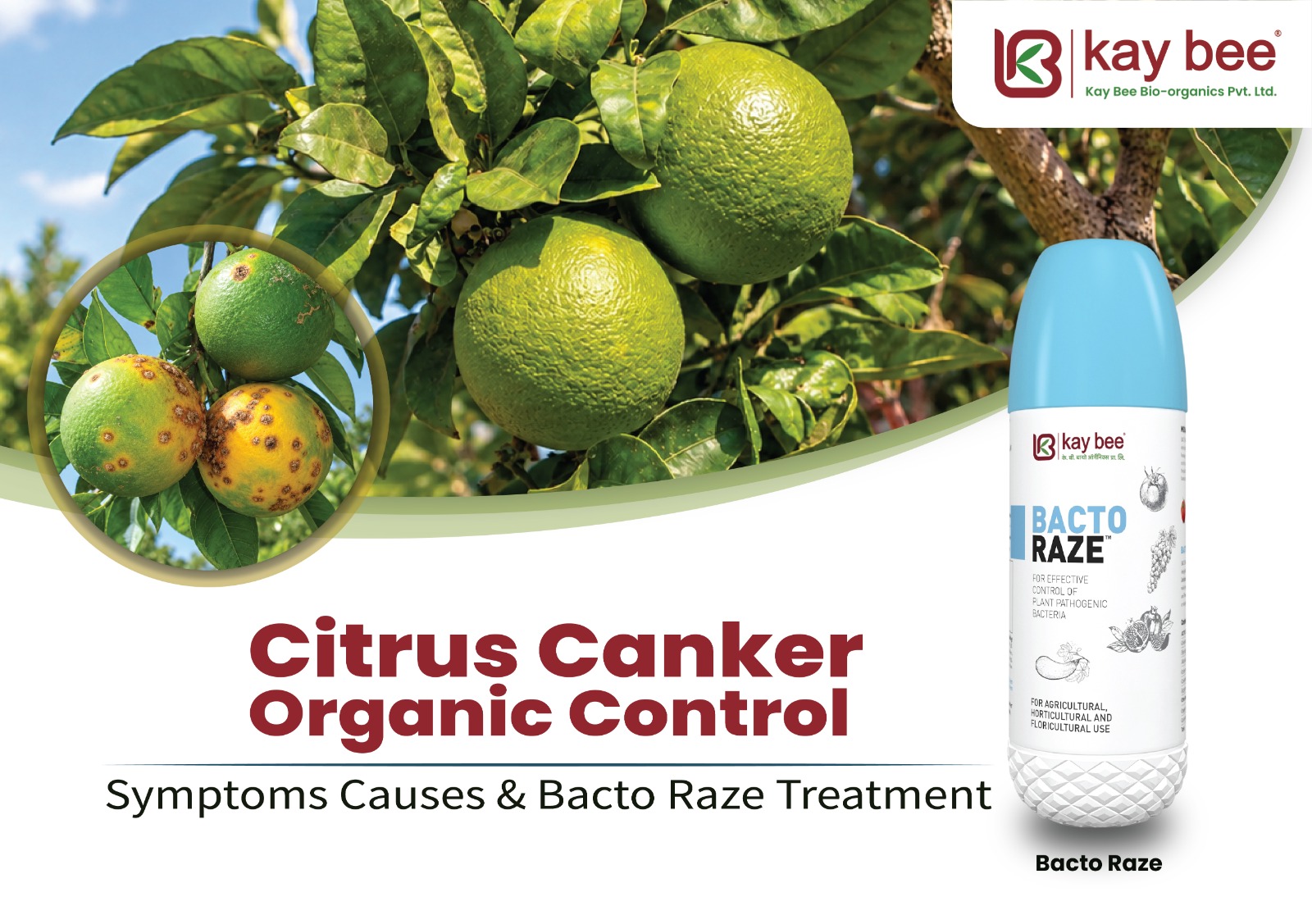
Citrus Canker Organic Control: A Complete Farmer’s Guide
Citrus crops such as lemon, sweet orange, mandarin, acid lime, and sweet lime are among the most important fruit crops grown in India. Healthy trees produce high-quality fruits and better yields, but bacterial diseases can significantly reduce productivity. One of the most damaging diseases is citrus canker, especially during the rainy season when warm temperatures and high humidity favor its spread.
Understanding citrus canker organic control is essential for farmers to protect their orchards. Early detection, good orchard hygiene, and integrated disease management can help reduce disease incidence and maintain healthy trees. For more on why botanical solutions are the right choice for organic disease management, read our guide on why India needs biopesticides in agriculture.
What is Citrus Canker?
Citrus canker is a bacterial disease in citrus caused by the bacterium Xanthomonas citri subsp. citri. The disease attacks leaves, twigs, stems, and fruits, causing raised lesions that reduce fruit quality and overall plant health.
The bacteria spread rapidly through wind-driven rain, irrigation splashes, contaminated tools, infected nursery plants, and human movement within the orchard. Young leaves and developing fruits are the most susceptible to infection. For more on how Xanthomonas bacteria are managed with Bacto Raze across crops, read our guide on damping off and black rot in cabbage and cauliflower — the same bacterial pathogen family is responsible.
Conditions Favoring Citrus Canker
The disease develops rapidly under the following conditions:
- Warm temperatures between 20–30°C
- High humidity and frequent rainfall
- Strong winds that cause wounds on leaves and fruits
- Dense orchards with poor air circulation
- Continuous leaf wetness
- Infected planting material
During the monsoon season, farmers should regularly monitor their orchards because disease pressure increases significantly. For more on how disease pressure builds during high-humidity periods, read our guide on why disease pressure increases in June.
Citrus Canker Symptoms Treatment: How to Identify the Disease
Symptoms on Leaves
- Small, raised brown lesions appear on young leaves.
- Lesions are surrounded by a distinct yellow halo.
- Spots become rough and corky as they mature.
- Severe infection causes premature leaf drop.
Symptoms on Twigs
- Raised corky lesions develop on young shoots.
- Twig growth becomes weak.
- Heavy infection may lead to dieback of young branches.
Symptoms on Fruits
- Small raised brown lesions appear on fruit surfaces.
- Fruits become rough and unattractive.
- Fruit quality and market value decline.
- Severe infection may cause premature fruit drop.
Recognizing these symptoms early allows farmers to begin citrus canker symptoms treatment before the disease spreads throughout the orchard.
Damage Caused by Citrus Canker
If left unmanaged, citrus canker can cause:
- Reduced photosynthesis due to leaf loss
- Poor vegetative growth
- Lower fruit quality
- Premature fruit drop
- Reduced market value
- Lower overall yield
- Weak and stressed trees over time
Although the disease rarely kills mature trees, repeated infections can significantly reduce orchard productivity. Strong root development and tree nutrition help reduce disease susceptibility — read our guide on the significance of white root development in enhancing crop health and yield.
Management
A. Cultural Control
1. Plant Disease-Free Nursery Stock
Always use certified, healthy planting material from reliable nurseries to prevent introducing the bacteria into the orchard.
2. Remove Infected Plant Parts
Prune infected leaves, twigs, and fruits regularly. Destroy infected plant debris away from the orchard to reduce bacterial spread.
3. Maintain Orchard Sanitation
Keep the orchard clean by removing fallen leaves and infected fruits. Good sanitation reduces the bacterial population.
4. Improve Air Circulation
Proper pruning and recommended plant spacing improve airflow, helping leaves dry quickly after rainfall and reducing infection.
5. Balanced Nutrition
Avoid excessive nitrogen fertilizer, as it promotes tender new growth that is highly susceptible to bacterial infection. Balanced nutrition strengthens plant health. For more on how micro-nutrient management supports fruit crop health, read our guide on why micro-nutrients create macro changes at harvest.
6. Proper Irrigation Management
Avoid overhead irrigation whenever possible. Drip irrigation minimizes leaf wetness and helps reduce disease spread.
7. Protect Trees from Mechanical Injury
Injuries caused by strong winds, pruning, insects, or farm operations create entry points for bacteria. Handle plants carefully and manage insect pests that cause wounds. For controlling sucking pests that create entry wounds on citrus, read our guide on red spider mite management in citrus orchards.
B. Botanical Control — Bacto Raze
Bacto Raze is a botanical, organic-based bio-bactericide designed to control and prevent plant-pathogenic bacterial diseases. For a detailed look at how Bacto Raze works across crops, also read our guide on ginger nematode and soft rot control — Root Fit + Bacto Raze which covers the same bactericide in action against soil-borne bacterial diseases.
Dual Action
- Contact: Direct cell-wall lysis and desiccation, causing immediate leakage and death of bacterial cells on the plant surface.
- Systemic: Absorbed by plant tissue to inhibit bacterial cell wall biosynthesis (lipid and protein synthesis), preventing internal disease spread.
Application and Recommendation
| Application Method | Recommended Dosage | Water Volume / Area |
| Foliar Spray | 2.5 ml per Litre of water | ~200 Litres of water / acre |
| Soil Drenching / Drip | 500–1000 ml per acre | Diluted in sufficient water for root area |
For better spray adhesion and leaf coverage, add Balanstick (0.4 ml/l) to the foliar spray mix.
Farmer Tips for Better Citrus Health
- Inspect orchards every week, especially during the rainy season.
- Remove infected plant parts immediately.
- Avoid working in wet orchards to reduce bacterial spread.
- Disinfect pruning tools before moving between trees.
- Maintain proper plant spacing.
- Ensure good drainage to prevent prolonged moisture.
- Apply balanced fertilizers based on soil test recommendations.
- Follow citrus canker organic control practices as part of routine orchard management.
Conclusion
Citrus canker is one of the most important bacterial diseases in citrus, but timely action can greatly reduce its impact. Early diagnosis, orchard sanitation, proper pruning, balanced nutrition, and preventive management are the foundation of effective disease control.
By following recommended citrus canker organic control practices and incorporating biological solutions such as Bacto Raze into an integrated disease management program, farmers can protect fruit quality, improve orchard health, and achieve better yields year after year. For complete citrus orchard protection, also read our guide on control aphids and whitefly in pomegranate to understand how sucking pests create bacterial entry wounds in closely related fruit crops.
Frequently Asked Questions (FAQs)
1. What causes citrus canker?
Citrus canker is caused by the bacterium Xanthomonas citri subsp. citri.
2. What are the first symptoms of citrus canker?
Small raised brown lesions surrounded by yellow halos on young leaves are usually the earliest symptoms.
3. How does citrus canker spread?
The bacteria spread through rain splash, wind, infected nursery plants, contaminated tools, and human movement within orchards.
4. Is citrus canker organic control possible?
Yes. Disease-free planting material, orchard sanitation, pruning, balanced nutrition, proper irrigation, and biological products are key components of citrus canker organic control.
5. Can Bacto Raze help manage bacterial disease in citrus?
Bacto Raze can be used as part of an integrated disease management program along with recommended cultural and preventive practices to help manage bacterial disease in citrus.
Latest Blogs
 Mycorrhiza Technical Manufacturer in India | Kay Bee Bio-Organics Pvt. Ltd.
 Calcium for Cabbage Head Formation: How Calboost (Ca-11%) Ensures Tight & Crack-Free Heads
 Orthosilicic Acid (OSA) for Monsoon Stress: Building Crop Strength & Resilience
 Ginger Nematode and Soft Rot Control: Organic Management with Root Fit & Bacto Raze
 Tomato Nematode Damage: Underground Signs, Crop Loss and Organic Control with Root Fit
COPYRIGHT © 2026 - ALL RIGHTS RESERVED. MADE BY WebAppGigs