
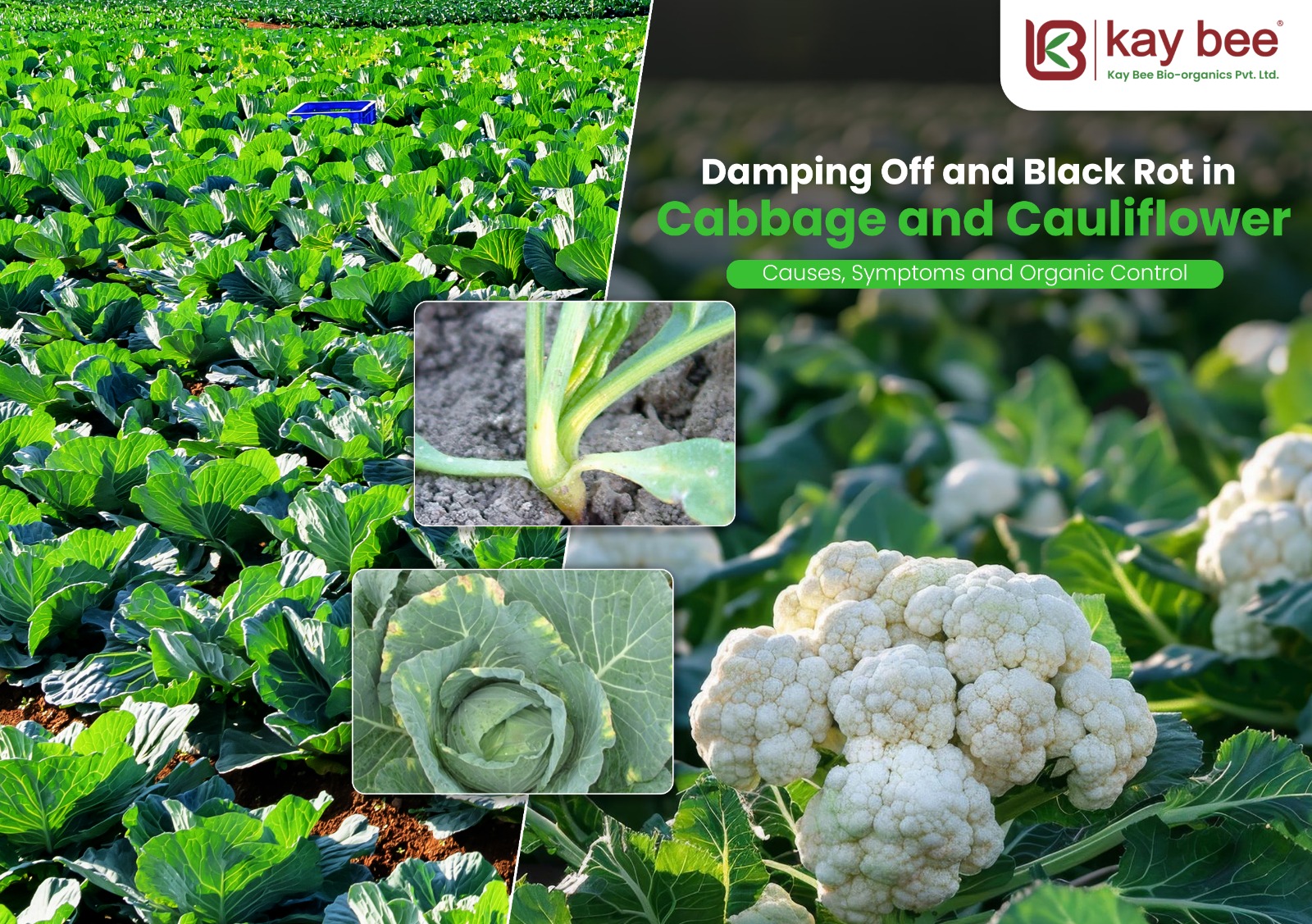
Damping Off and Black Rot in Cabbage and Cauliflower: Causes, Symptoms and Organic Control
Cabbage and cauliflower are two of the most widely grown vegetable crops in India, but they are also highly prone to a handful of diseases that can wreck an entire nursery or field if left unchecked. Among these, black rot in cabbage and damping off are the two biggest headaches that growers face, right from the seedling stage all the way to harvest. If you have ever watched healthy seedlings collapse overnight, or seen yellow V-shaped patches creeping in from the leaf edges of your cabbage, you already know how frustrating these diseases can be.
In this blog, we will walk through what causes these diseases, how to identify them early, and how you can manage them organically using Kay Bee Bio-Organics’ Root Fit and Bacto Raze. To understand why choosing botanical solutions matters for vegetable crops, read our guide on best organic farming products in India.
1. Understanding Damping Off in Cabbage & Cauliflower Seedlings
Damping off in cabbage is a soil-borne disease that mainly attacks young seedlings, either before or shortly after they emerge from the soil. It is caused by a group of fungi including Pythium, Rhizoctonia, Fusarium, and Phytophthora, all of which thrive in wet, poorly drained, and overcrowded nursery conditions. To understand how soil-borne fungal pathogens work broadly, read our guide on managing soil-borne wilt and nematodes.
1.1 Causes of Damping Off
- Excess moisture in the field, nursery bed or seedling tray
- Poor drainage and heavy, compacted soil
- Overcrowded sowing that reduces air circulation
- Contaminated soil or reused trays carrying fungal spores
- Low light and cool, humid weather that favours fungal growth
1.2 Symptoms of Damping Off in Cabbage Seedlings
Damping off cabbage seedlings typically show the following warning signs:
- A thin, water-soaked lesion right at the base of the stem, near the soil line
- Soft, constricted stem tissue that causes the seedling to topple over and die within a day or two
- Seeds rotting before they even germinate
- Poor and patchy germination across the nursery bed
- Large sections of the nursery wiped out quickly once conditions favour the fungus
2. Understanding Black Rot in Cabbage and Cauliflower
While damping off attacks young seedlings, black rot is more destructive to established plants and is one of the most economically damaging diseases of cole crops worldwide. It is caused by the bacterium Xanthomonas campestris pv. campestris, which can survive in seeds, crop debris, and soil for long periods.
2.1 Causes of Black Rot
- Infected or untreated seeds
- Warm, humid weather combined with heavy rainfall or overhead irrigation
- Splashing water that spreads bacteria from plant to plant
- Wounds caused by insects, hail, or handling that allow bacterial entry
- Contaminated tools, hands, or irrigation water in the field
2.2 Black Rot of Cabbage Symptoms
The black rot of cabbage symptoms are fairly distinct once you know what to look for:
- Yellow, V-shaped lesions along the leaf margins, with the point of the V facing towards the leaf vein
- Veins inside the leaf turning black as the infection advances — this is where the disease gets its name
- Infected leaves turning brown, drying up, and dropping off the plant
- In severe cases, bacteria travel down into the vascular system and rot the head from the inside, giving off a foul smell
2.3 Black Rot of Cauliflower
Black rot of cauliflower shows very similar symptoms, though the disease often spreads faster in cauliflower because of its dense curd structure, which traps moisture and creates an ideal environment for bacterial multiplication. Growers dealing with black rot of cauliflower often notice:
- Blackened veins on the wrapper leaves appearing first
- Rapid collapse of the curd if the infection is not controlled early
3. Black Rot of Cabbage Treatment and Management
Effective black rot of cabbage treatment starts with prevention, since the bacteria are extremely difficult to eliminate once they establish themselves inside the plant’s vascular tissue. A good black rot of cabbage management programme includes:
- Using disease-free, certified seeds
- Practising crop rotation with non-cruciferous crops for at least two to three years
- Avoiding overhead irrigation
- Removing and destroying infected plant debris after harvest
- Maintaining field sanitation and wider plant spacing for better airflow
- Avoiding fieldwork when the foliage is wet
However, cultural practices alone are often not enough once disease pressure is high. This is where a targeted organic bactericide becomes essential for both black rot of cabbage treatment and prevention.
4. Organic Control with Kay Bee’s Root Fit and Bacto Raze
Kay Bee Bio-Organics offers two complementary, botanical-based solutions that together address both the seedling and field-stage problems described above.
4.1 Root Fit for Damping Off Control
Root Fit is a botanical-based bio-fungicide and bio-nematicide from Kay Bee designed specifically to tackle soil-borne diseases such as damping off, root rot, collar rot, and wilt. For a detailed breakdown of how Root Fit works, read our pillar guide on Root Fit — a breakthrough in soil-borne fungal disease and nematode control.
- It is a plant-based fungicide and nematicide that combats soil-borne diseases including root rot, damping-off, collar rot, and wilt.
- It works through contact, systemic, and fumigant action.
- It enters the plant’s roots, destroys the pathogens, halts disease progression, and eventually eliminates the disease.
- It also supports stronger, healthier root development — learn more about the significance of white root development for vegetable crop health.
For nurseries struggling with damping off in cabbage seedlings, apply Root Fit as a soil drench right after sowing, and again at the first true leaf stage, to protect young roots and stems from fungal attack. Because it is a botanical formulation, it fits well into organic and residue-free production systems without leaving harmful chemical residues on the crop.
4.1.1 Recommended Dose
- Root Fit @ 0.5 to 1.0 ml/litre of water after transplanting
- Root Fit @ 0.5 to 1.0 ml/litre for drenching up to 25-day crop
- Above 1 month crop: Root Fit @ 750–1000 ml/acre for drenching
4.2 Bacto Raze for Black Rot Control
For managing the bacterial side of the problem, Bacto Raze is Kay Bee’s dedicated organic bactericide. Key points about Bacto Raze:
- It is an organic, botanical-based bactericide that controls bacterial diseases in all types of crops and plants.
- It specifically targets pathogenic bacteria including Xanthomonas, Erwinia, Pseudomonas, Ralstonia, and Clavibacter.
- It has a triple mode of action: contact and systemic, causing desiccation and lysis of the bacterial cell wall and restricting further cell wall biosynthesis.
- It works preventively by stopping pathogen establishment, and curatively by controlling existing bacterial blight infections.
- It is compatible with most pesticides, fungicides, and PGRs, except copper, sulphur, and Bordeaux mixture.
Since black rot of cabbage and cauliflower is caused by a Xanthomonas species, Bacto Raze directly targets the pathogen responsible for this disease. For best results, spray Bacto Raze at the first sign of yellow V-shaped lesions, early in the morning or late evening, and repeat at regular intervals during humid or rainy weather when the disease spreads fastest.
4.2.1 Recommended Dose
- Bacto Raze @ 2.5 ml/litre for spray
4.3 A Combined Organic Approach
Using both products together gives cabbage and cauliflower growers a complete, organic solution that covers the crop from seed to harvest:
- Apply Root Fit at the nursery stage to prevent damping off
- Follow up with Bacto Raze sprays in the field to manage black rot
- Both products are botanical-based, biodegradable, and suited for organic and export-quality production
For better spray coverage when applying Bacto Raze, add Balanstick (0.4 ml/l) to the spray mix.
5. Final Thoughts
Damping off and black rot may attack cabbage and cauliflower at different stages of growth, but both can cause serious yield losses if ignored. Recognising the early symptoms, following good field sanitation practices, and using targeted organic products like Root Fit and Bacto Raze can make a real difference in keeping your crop healthy and productive.
For farmers committed to organic and residue-free farming, this combination offers a practical, sustainable way to manage two of the most troublesome diseases in cole crops. To understand the broader case for biopesticides in Indian agriculture, read our guide on why India needs biopesticides in agriculture, and explore our overview of improving vegetable root development in June for a complete vegetable crop health programme.
Latest Blogs
 Mycorrhiza Technical Manufacturer in India | Kay Bee Bio-Organics Pvt. Ltd.
 Calcium for Cabbage Head Formation: How Calboost (Ca-11%) Ensures Tight & Crack-Free Heads
 Citrus Canker Organic Control: A Complete Farmer’s Guide
 Orthosilicic Acid (OSA) for Monsoon Stress: Building Crop Strength & Resilience
 Ginger Nematode and Soft Rot Control: Organic Management with Root Fit & Bacto Raze
COPYRIGHT © 2026 - ALL RIGHTS RESERVED. MADE BY WebAppGigs