
Zinc Deficiency in Crops: Importance of Zinc in Wheat, Potato and Other Rabi Crops
Ask a farmer what his rabi crop needs and you’ll usually hear the same three words: Urea, DAP, Potash. Zinc rarely comes up. And yet, season after season, we see fields that were fed properly and still fall short. The crop looks fine from the bund, but the yield doesn’t match, and zinc is very often the reason. This is zinc deficiency in crops, and it is far more common than most people think.
Zinc is a micronutrient needed for enzymes, protein synthesis and flowering. Low zinc in alkaline or sandy soils causes pale leaf bands, stunted growth and lower wheat and potato yield.
Plants need only a small amount, but they can’t complete their life cycle without it. In this blog, we’ll cover what zinc does, how to spot zinc deficiency in plants, and how to manage it in wheat, potato, and other rabi crops with the right zinc fertiliser.
-
What Zinc Does Inside the Plant
Zinc is a micronutrient. A hectare of wheat removes only a few hundred grams, but those grams are involved in some of the plant’s most important work. This is the real use of zinc in agriculture, and a good example of the role of micronutrients in plants.
- Runs the enzymes: More than 300 enzymes depend on zinc to function, and these handle the plant’s day-to-day chemistry.
- Builds proteins and growth hormone: Zinc is needed to make proteins and auxin, the hormone behind stem growth and new shoots.
- Keeps leaves working: It helps form chlorophyll, so leaves stay green and keep photosynthesising.
- Makes reproduction possible: Pollen fertility, flowering and the setting of grain or tubers all depend on it.
- Helps the crop handle stress: A plant with enough zinc copes far better with cold nights, dry spells and disease.
-
Why Zinc Deficiency in Crops Is So Common in Indian Soils
Soil surveys across India keep showing the same thing: close to half of our cultivated soils are low in available zinc. That is why zinc deficiency in plants is one of the most common micronutrient problems we have. Several ordinary farming conditions make it worse.
- Soil type: In alkaline, calcareous and sandy soils, zinc gets held in forms that roots can’t take up.
- Low organic matter: Fields that rarely see compost or farmyard manure (FYM) release less zinc.
- Too much phosphorus: Heavy DAP or SSP use can tie up zinc in the root zone.
- Continuous cropping: Rice–wheat or repeated potato cycles keep pulling zinc out of the soil, and little goes back in.
- Cold, wet soil: Early in the rabi season, roots are slow. Even when zinc is present, the crop may not manage to absorb it.
-
Zinc Deficiency in Wheat: What Zinc Does and How to Spot It
What it does for the crop
- Tillering: Zinc helps the plant put out strong, productive tillers.
- Grain filling: It improves grain weight and the number of grains per ear.
- Grain quality: With enough zinc in the soil, the grain itself carries more zinc, which is good for the people who eat it.
How to spot zinc deficiency in wheat
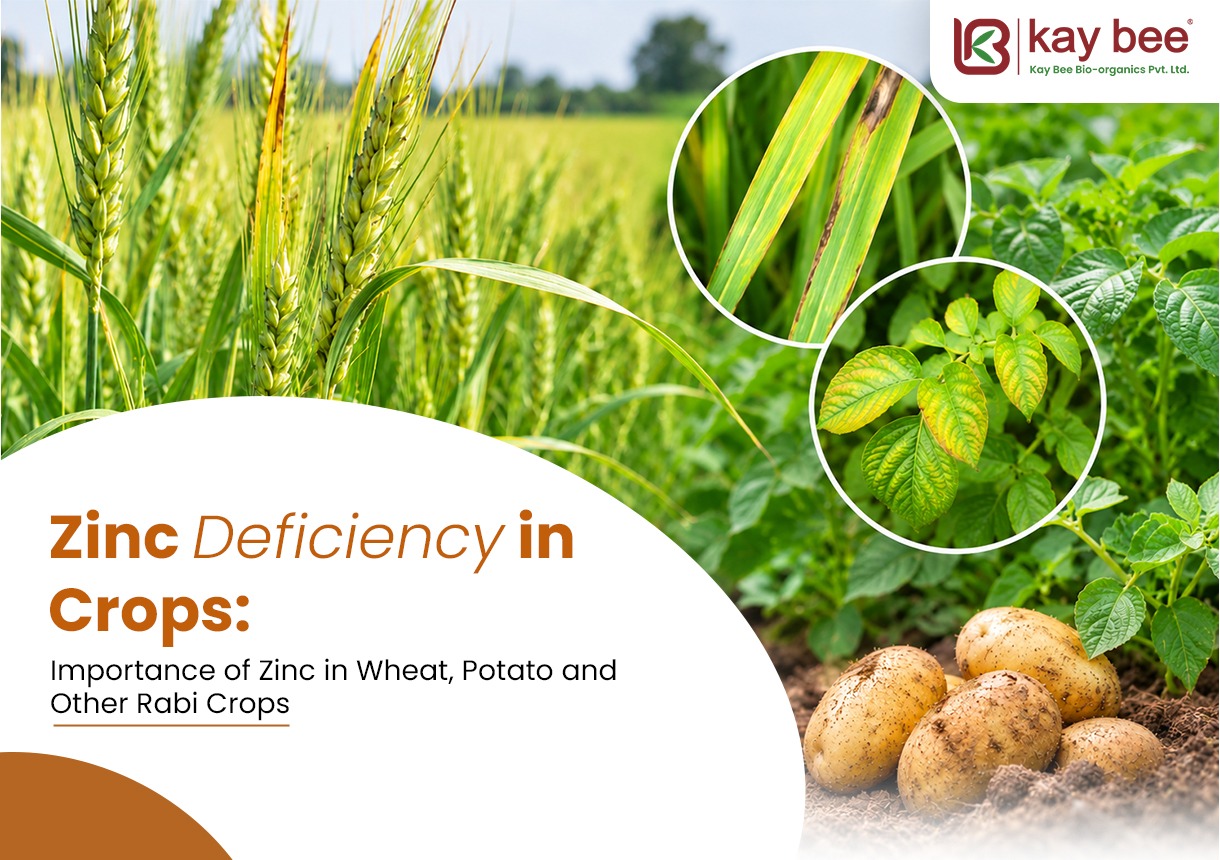
- Pale bands: These are the classic zinc deficiency symptoms in wheat. Light yellow or whitish lines appear on the middle leaves while the tips stay green.
- Patchy growth: Stunted plants show up in uneven patches rather than evenly across the field.
- Late maturity: The crop can take several extra days to ripen.
-
Zinc in Potato
Potatoes take a lot from the soil and respond clearly to zinc, particularly on light or alkaline land.
What it does for the crop
- Tuber initiation: Zinc supports early tuber formation and bulking.
- Moving sugars to the tubers: It helps carbohydrates move from the leaves to the tubers, resulting in better size and more uniform tubers.
How to spot zinc deficiency in potato
- Little leaf: Small, upright, bunched-up leaves at the top of the plant.
- Short internodes: Stems look squeezed together, and bronze or brown spots may show up.
- Poor tubers: At harvest, you get fewer and smaller tubers.
-
Other Rabi Crops
- Chickpea and lentil: Zinc supports flowering and pod set. When it’s short, look for yellowing between the veins and small reddish specks.
- Mustard: It helps branching and seed filling, so a shortage usually means fewer pods.
- Onion and garlic: Both are quite sensitive. Enough zinc gives bigger, firmer bulbs.
- Rabi maise: This is one of the most zinc-starving crops. Zinc deficiency in maise shows up as white buds and pale stripes on the leaves when it runs low.
-
Zilite by Kay Bee Bio-Organics
Zilite is a liquid zinc fertiliser from Kay Bee Bio-Organics. It is a zinc oxide fertiliser in the form of a Zinc Oxide Suspension Concentrate (SC) combined with a plant extract.
Specifications as per the Fertiliser Control Order (India):
- Zinc (as ZnO): minimum 39.5% by weight
- pH (5% solution): 9.0 ± 1
- Specific gravity at 15°C: 1.71–1.75
Technology behind Zilite
- Microfine Particle Dispersion Technology (MPDT): The particles are extremely small, so zinc enters through the leaf and is taken up by roots more easily than with ordinary ZnO. Better availability means deficiencies are corrected faster.
- High Suspension Stability (HSS): Special stabilisers stop the product from settling in the container. Every drop, whether through drip or foliar spray, carries the same concentration.
- Anti Phosphate Binding Shield (APBS): This keeps zinc from reacting with phosphates, reducing fixation. The company reports that zinc use efficiency improves by 25–40%.
-
Zinc Fertiliser for Rabi Crops: Foliar Application Guide
A foliar spray micronutrient fertiliser is the quickest way to correct a shortage, especially when the soil is cold and roots are slow. Here is the dose for each crop.
Crop Foliar spray (Zilite)
| Crop | Foliar spray (Zilite) |
|---|---|
| Wheat | 1–1.5 ml per litre of water, 25–30 days after sowing |
| Potato | 1–1.5 ml per litre of water, 30–40 days after sowing |
| Chickpea / Lentil | 0.5–1 ml per litre of water, at flowering |
| Mustard | 0.5–1 ml per litre of water, at branching |
Zilite can be mixed with most insecticides, pesticides and fungicides. The exceptions are products containing copper or sulphur.
-
How to Tell If Your Field Needs Zinc
Guessing gets expensive, so do a few simple checks before you spend money. A correct diagnosis is always the first step in any micronutrient deficiency solution for plants.
- Soil test: A DTPA-extractable zinc value below about 0.6 ppm is generally treated as low. Your nearest soil testing lab or Krishi Vigyan Kendra can do this for a small fee.
- Field history: If a field has shown pale patches or weak crops in earlier seasons despite good fertiliser use, suspect zinc first.
- Look at the right leaves: Zinc doesn’t move easily within the plant, so symptoms appear on the middle and younger leaves, not the old ones.
- Leave a test strip: Skip zinc on one small strip and compare it with the rest of the field. What you see will tell you more than any book can.
-
Zinc and Human Health
Zinc isn’t only about the crop. Many people, especially children and women, don’t get enough of it in their diet. Wheat grown on well-fertilised soil holds more zinc in the grain, so the benefit goes straight from your field to the family kitchen. This is exactly why agricultural scientists promote zinc as part of grain biofortification.
-
What You Stand to Gain
The benefits of zinc fertiliser are easy to see in the field. On zinc-deficient soils, field trials commonly report yield gains of roughly 10 to 20 per cent, along with better grain and tuber quality. Zilite costs very little compared to the extra harvest, making it one of the better-value inputs you can add. Use it alongside organic manure and your soil will keep paying you back.
Frequently Asked Questions (FAQs)
Q1. What are the symptoms of zinc deficiency in plants?
Pale yellow or whitish bands appear on the middle and younger leaves. Growth turns stunted and patchy, and the crop matures late. In potatoes, you will see small leaves and short internodes.
Q2. What is the use of zinc in agriculture?
Zinc regulates more than 300 enzymes, helps make proteins and auxin, supports chlorophyll formation, and is needed for flowering and grain or tuber set.
Q3. Which rabi crops need zinc?
Wheat, potato, rabi maise, chickpea, lentil, mustard, onion and garlic all benefit from zinc. Rabi maise, onion and garlic are especially sensitive.
Q4. How do I correct zinc deficiency in crops?
Start with a soil test. A DTPA zinc value below about 0.6 ppm is low. Then apply a sensible basal dose along with organic manure, and use a foliar spray if symptoms appear.
Q5. What are the benefits of zinc fertiliser?
It improves tillering and grain filling, produces bigger, more uniform tubers, and on zinc-deficient soils, trials commonly report yield gains of roughly 10 to 20 per cent.
Q6. When should I spray zinc on wheat and potato?
Spray wheat 25–30 days after sowing and potato 30–40 days after sowing, at 1–1.5 ml of Zilite per litre of water.
Final Thoughts
Zinc is a small nutrient, but zinc deficiency in crops can quietly hold your yield down. Get your soil tested, apply a sensible basal dose, watch for early symptoms, and use a foliar spray or zinc fertiliser when the crop needs it. A little care to zinc this rabi season can leave your wheat, potato and other crops healthier, stronger and more profitable.
Latest Blogs
 Red Gram Pod Fly Management: Identify Pod Damage and Protect Tur Crop Yield
 Bunch Rot Of Grapes: Symptoms, Causes, Control And Best Effective Treatment Strategies
 Discovering the Different Types of Soil: Characteristics, Uses and Soil Improvement
 Advancing Agronomic Resilience: A Scientific Analysis of Crop Rotation and Bio-Input Synergies in Indian Agriculture
 Biopesticides in India: Why Indian Agriculture Urgently Needs Sustainable Solutions
COPYRIGHT © 2026 - ALL RIGHTS RESERVED. MADE BY WebAppGigs