
Red Gram Pod Fly Management: Identify Pod Damage and Protect Tur Crop Yield
Red Gram Pod Fly Management
Pigeonpea (Cajanus cajan L.) is an important tropical grain legume, predominantly cultivated in India, which ranks second globally in terms of area and production and contributes approximately 90% of the world’s pigeonpea production. The crop is attacked by more than 300 species of insect pests, among which the pod fly (Melanagromyza obtusa) is one of the most destructive, causing grain damage ranging from 10% to 80%. This guide to red gram pod fly management will help you protect your red gram crop, known as tur in many regions. Red gram is a kharif crop season pulse, and pod fly pressure is highest at pod formation.
Red gram pod fly (Melanagromyza obtusa) lays eggs inside young pods, and the maggots feed on seeds without early outside signs. Monitor from flowering, follow cultural practices, and use botanical sprays as per label to protect your red gram crop.
The pod fly is an internal-feeding pest that lays its eggs inside immature pigeonpea pods. After hatching, the larvae (maggots) enter the developing seeds and feed internally by creating tunnels, eventually pupating within the pods. Pod fly in red gram is hard to spot for this reason.
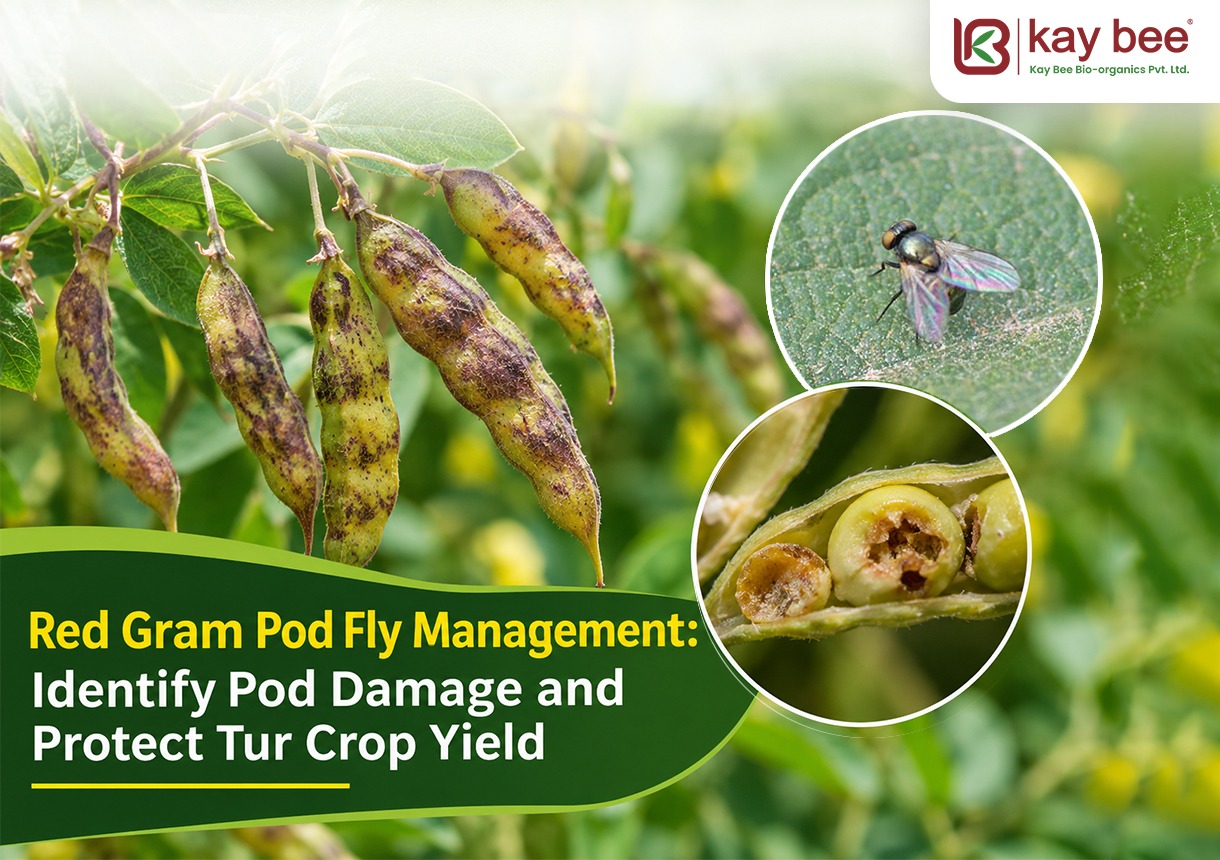
One of the major challenges in managing this pest is that infested pods do not exhibit visible external symptoms during the early stages of infestation. Damage becomes apparent only when the fully developed maggots chew through the pod wall, leaving behind a thin, papery membrane known as a “window,” through which the emerging adult flies eventually exit. Identification, regular field monitoring and timely pest-management practices are essential to protect the red gram plant.
Symptoms and Nature of Damage
These are the main pod fly symptoms in red gram.
- Dark brown encrustation on the pod wall
- Dry pods showing a pin-head-size hole
- Seeds shrivelled, striped and partially eaten
- Maggots cause damage by boring into the soft seeds and feeding on grains.
- The damaged seeds are unfit for consumption as well as for germination.
- The extent of damage may be even up to 60–70% during severe infestation. Life Cycle of Red Gram Pod Fly: Identification of the Pest
- Eggs: Eggs are laid singly or in clusters inside the pod wall by piercing it with the ovipositor. The fly lays about 60–80 eggs. The incubation period is 2–4 days.
- Larva: Larvae are greenish with brown lateral markings and a humped anal segment. The larval period is about 5–18 days.
- Pupa: Pupae are cylindrical, yellowish or brown in colour, but later turn brown or brownish black. The pupal period varies from 7–10 days. A number of overlapping generations are found in a year.
- Adult: Adult flies are yellowish brown in colour. Forewings: yellow with ‘V’-shaped specks. Hindwings: pale brown markings. Why Red Gram Pod Fly Control Is Critical During Pod Formation
- Boring and feeding: Larvae or maggots bore directly into tender green pods and feed on the developing seeds inside.
- Destruction of yield: A single larva can damage multiple pods by chewing circular holes and consuming or spoiling the grain, leading to severe yield reductions of up to 80%.
- Loss of quality: Even if a pod survives, damaged or partially eaten seeds lose their market value, viability and fitness for consumption.
Management of Red Gram Pod Fly Using Larvo Raze + OrgaNeem 3000 ppm + Balanstick
An integrated pest-management programme combines crop monitoring, cultural practices, conservation of beneficial insects and appropriate crop-protection interventions. Kay Bee Bio Organics recommends the following botanical product combination for red gram pod fly management. Together, these products work as a bio plant protector for the red gram crop. For chickpea, read our guide on gram pod borer control in chickpea.
Larvo Raze
Larvo Raze is a botanical crop-protection product intended for managing target larval insect pests. As an insecticide for plants of botanical origin, it fits into plant insect control within an IPM programme. Because Larvo Raze targets multiple points in the pod fly life cycle, it disrupts the pest at more than one stage:
- Contact, systemic, and fumigant modes of action help the product reach larvae on the plant surface before they enter the pods
- Antifeedant activity, desiccation, and cytolysis give a fast knock-down effect on neonates and early instars
- Stomach poisoning and insect growth regulator (IGR) activity disrupt moulting and pupation in later instars
OrgaNeem 3000 ppm
OrgaNeem 3000 ppm is a neem-based botanical formulation that can be incorporated into an integrated pest management programme for pod fly in red gram. Neem-based solutions help manage insect pests by interfering with feeding and other key biological processes. Neem as pesticide is most useful when applied early. See our neem based products. For more information on neem-based crop protection, read our guide on best neem-based pesticides for agricultural crops.
Benefits of OrgaNeem
- Acts as a repellent and antifeedant by decreasing the motility of the gut and the ability to swallow.
- Supports pest management through neem-derived bioactive compounds.
- Interferes with insect growth and development and blocks the development of larvae or nymphs.
- Oviposition deterrent: Deters females from laying eggs and inhibits the development of the eggs. This is why neem for plant pests suits a fly that lays eggs inside pods.
- Can help reduce pest pressure when applied at the appropriate crop stage.
Balanstick
Balanstick is a spreader sticker. See our stickers and spreaders, and read about common fertiliser and pesticide application mistakes.
Recommended Dose
Recommended spray combination:
Larvo Raze @ 2 ml/L + OrgaNeem 3000 ppm @ 1 ml/L. For better spray adhesion and leaf coverage, add Balanstick (0.4 ml/L) to the spray mix.
Cultural Management Practices for Red Gram Pod Fly (Melanagromyza obtusa)
In addition to botanical crop-protection products, farmers can adopt the following measures to reduce pest pressure.
- Deep Summer Ploughing: Plough the field deeply in the summer season to expose pupae residing in the soil to direct sunlight and natural predators.
- Crop Rotation: Avoid continuous cultivation of red gram (pigeonpea) or host-related legumes in the same field to break the pest’s life cycle. The crop rotation advantages include less pest carry-over in the soil.
- Intercropping: Grow red gram with trap or companion crops (sorghum, pearl millet, soybean) to deter the flies and encourage beneficial insects. The intercropping advantages include more beneficial insects, and these intercropping examples suit the red gram crop.
- Adjusting Sowing Time: Plant early-maturing or synchronised varieties to escape peak infestation windows during the pod-development stage.
- Field Sanitation: Remove and destroy fallen, damaged pods, and destroy crop residues after harvest to eliminate overwintering or resting larvae and pupae.
- Conservation of Natural Enemies: Protect parasitoids and natural predators like Euderus lividus, Eurytoma species, and Euderus agromyzae, which naturally parasitise pod fly maggots and pupae.
Frequently Asked Questions (FAQs)
Q1. What is pod fly in red gram?
Pod fly (Melanagromyza obtusa) lays eggs inside immature red gram pods. The maggots feed on the developing seeds and pupate inside the pod.
Q2. What are the symptoms of pod fly in red gram?
Look for a dark brown crust on the pod wall, a pin-head-size hole on dry pods, and shrivelled, striped or partly eaten seeds.
Q3. Why is pod fly damage not visible early in the red gram crop?
The maggots feed inside the pod. The damage shows only when they chew through the pod wall and leave a thin “window”.
Q4. How to manage pod fly in red gram organically?
Combine cultural practices with botanical sprays. Larvo Raze at 2 ml/L, OrgaNeem 3000 ppm at 1 ml/L and Balanstick at 0.4 ml/L can be used as per label.
Q5. Which cultural practices reduce pod fly?
Deep summer ploughing, crop rotation, intercropping, adjusting sowing time, field sanitation and conserving natural enemies.
Q6. When does pod fly cause the most damage in red gram?
During pod formation, when the maggots bore into tender green pods and feed on the developing seeds.
Conclusion
Pod fly (Melanagromyza obtusa) is a major pest of red gram because its larvae feed on developing pods, directly damaging the grains that determine the final yield. For effective red gram pod fly management during flowering and pod formation, integrating botanical crop protection products like Larvo Raze + OrgaNeem 3000 ppm offers an integrated approach to sustainable pest management. Larvo Raze supports the management of pod fly larvae, while OrgaNeem helps deter feeding and interfere with insect development. Together, they can be incorporated into an IPM programme to help protect developing pods, reduce crop damage and support healthier red gram production when used according to approved label directions.
Latest Blogs
 Zinc Deficiency in Crops: Importance of Zinc in Wheat, Potato and Other Rabi Crops
 Bunch Rot Of Grapes: Symptoms, Causes, Control And Best Effective Treatment Strategies
 Discovering the Different Types of Soil: Characteristics, Uses and Soil Improvement
 Advancing Agronomic Resilience: A Scientific Analysis of Crop Rotation and Bio-Input Synergies in Indian Agriculture
 Biopesticides in India: Why Indian Agriculture Urgently Needs Sustainable Solutions
COPYRIGHT © 2026 - ALL RIGHTS RESERVED. MADE BY WebAppGigs