
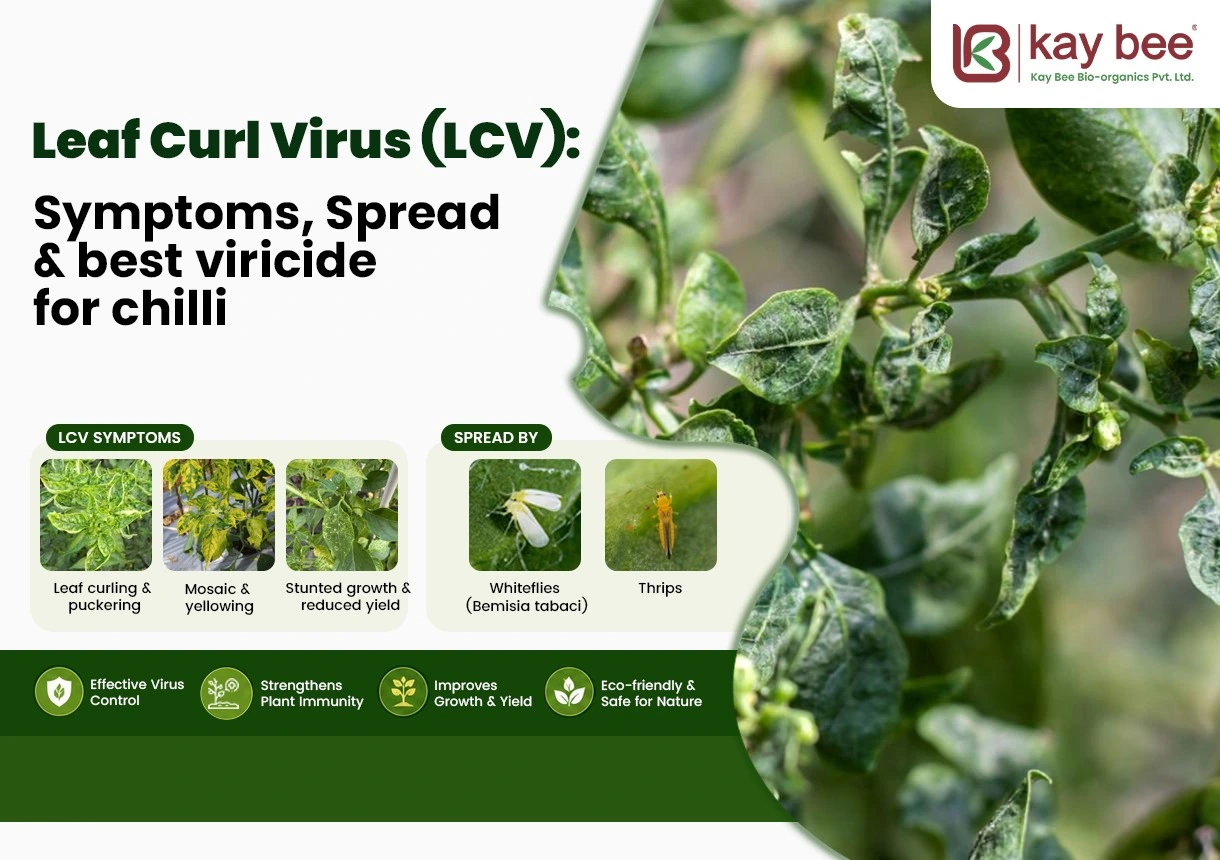
Chilli Leaf Curl Virus (LCV): Symptoms, Spread & the Best Organic Solution
Chilli is a high-value crop, but its yield is often cut down by viral disease — and the most damaging of these is chilli leaf curl virus (LCV). Because a viral infection cannot be cured once it takes hold, early identification, whitefly control, and timely preventive sprays decide whether the crop survives. This guide covers the symptoms, how the virus spreads, an integrated management plan, and the organic solution we recommend.
What is chilli leaf curl virus?
Chilli leaf curl virus is caused by a begomovirus (family Geminiviridae). Once inside the plant, it disrupts normal processes such as photosynthesis and nutrient transport, which leads to weak growth and poor fruit development. Like all plant viruses, it has no direct chemical cure — so prevention and vector control are the heart of any management plan.
Symptoms of chilli leaf curl virus
- Leaf curling — young leaves curl upward or downward, become puckered and distorted, and lose photosynthetic area.
- Leaf thickening and brittleness — affected leaves turn thick, leathery and brittle due to irregular cell growth.
- Vein yellowing / clearing — veins show yellow or transparent discoloration; interveinal areas may pale.
- Mosaic patterns — irregular light-and-dark green patches appear on the foliage.
- Stunted growth — short internodes give the plant a compact, bushy look; maturity is delayed.
- Reduced flowering and flower drop — fewer flowers form and buds drop before opening, lowering fruit set.
- Fruit deformation — fruits are small, twisted, rough and off-colour, with poor market value.
- Severe yield loss — under heavy infection, plants may produce no harvestable fruit.
How chilli leaf curl virus spreads
The virus is carried almost entirely by the whitefly (Bemisia tabaci). When a whitefly feeds on an infected plant it picks up the virus, then injects it into healthy plants at its next feeding. A small whitefly population can start an outbreak; a large one can cause an epidemic within days.
Spread is faster when:
- Weather is warm with moderate humidity — whiteflies multiply and move quickly; dry spells increase their movement.
- Chilli or other hosts are grown continuously — tomato, tobacco, okra and cotton nearby sustain the vector.
- Weeds on bunds and channels act as reservoir hosts during the off-season.
- Infected nursery seedlings are moved into clean fields (human-assisted spread).
- Late-planted crops face higher vector pressure than early-planted ones.
Integrated management of chilli leaf curl virus
No single spray solves a viral disease. Combine these:
1. Resistant varieties. Choose tolerant hybrids — they slow virus multiplication and reduce symptom severity. This is your first line of defence.
2. Cultural practices.
- Roguing: remove and destroy infected plants early.
- Spacing: maintain proper spacing for sunlight and airflow.
- Mulching: reflective silver/black mulch repels whiteflies.
- Crop rotation: avoid continuous chilli or other solanaceous crops.
- Weed control: clear alternate hosts around the field.
3. Whitefly control. Since whiteflies carry the virus, controlling them is critical.
- Monitor with yellow sticky traps.
- Use neem oil / azadirachtin botanical sprays to reduce feeding.
- Encourage natural predators (ladybird beetles, lacewings).
- Keep nursery and field clean.
4. Viricide application. Viruses can’t be eliminated outright, but a botanical viricide suppresses their activity, controls the vector, and strengthens the plant’s defences.
Best recommended solution: Kay Bee Bio’s Viro Raze
Viro Raze is a botanical (plant-based) bio-viricide made from a blend of plant extracts (terpenoids, alkaloids, tannins, polyphenols and peptides). It is residue-free, suitable for organic and export production, and works in both open fields and polyhouses. It works four ways:
- Vector control — its bio-insecticidal action reduces whiteflies and thrips, cutting further spread.
- Inhibits virus multiplication — phytochemicals interfere with viral replication at the ribosomal level.
- Supports recovery — promotes fresh, healthy, virus-free new leaves so the plant regains vigour.
- Boosts natural immunity — strengthens the plant’s defences against future infection.
Strengthen plant immunity with Nova Zyme (optional combo)
Because a virus-stressed plant recovers faster when its roots and immunity are strong, many farmers pair the viricide with Nova Zyme, a seaweed-based bio-stimulant. Nova Zyme improves root growth and nutrient uptake, strengthens cell walls, and raises tolerance to stress — helping the plant resist and bounce back from infection. A combined Viro Raze + Nova Zyme pack is available for this purpose.
Correct spray schedule
Recommended dose: 1.5–2.5 ml of Viro Raze per litre of water, depending on crop stage and disease severity. Spray only in the morning or evening; avoid high midday heat. Do not mix with sulphur, copper fungicides, or Bordeaux mixture.
Preventive (best method)
- Start spraying 15–20 days after transplanting
- Use the lower end — about 1.5 ml per litre
- Repeat every 7 days
- Optional: add 1 g chelated zinc per litre to support plant health
[CONFIRM with agronomist]
Curative (if symptoms already visible)
- Use the higher end — about 2.5 ml per litre
- Spray 3 times at 5–7 day intervals
- For recovery support, tank-mix Nova Zyme 2 ml/L and remove heavily infected plants on priority
Stage-wise benefits of Viro Raze
- Vegetative stage: protects against early infection, encourages strong shoot growth and a healthy green canopy.
- Flowering & fruiting stage: maintains vigour for continuous flowering and fruit set; reduces viral stress that causes flower drop.
- Maturity stage: keeps leaves healthy until harvest, supports uniform ripening, and helps deliver residue-free, market-ready produce.
Field performance — [HARVESTED]
In field demonstrations, crops treated with Viro Raze have shown:
- Up to 80% reduction in disease intensity
- 25–30% higher yield versus untreated fields
- Better fruit uniformity and longer shelf life
Farmers in chilli-growing belts such as Nandurbar, Sillod and Guntur have used it to keep crops virus-free while maintaining premium, residue-free quality.
Important precautions
- Spray in the morning or evening only.
- Do not mix with copper fungicides or sulphur.
- Use a fine mist for full leaf coverage, especially the underside.
- Keep up whitefly control if vector pressure is high.
Simple advice if you already see LCV
- Start Viro Raze immediately at the curative dose.
- Maintain strict whitefly control.
- Remove severely infected plants.
- Continue the spray schedule consistently — don’t stop after one spray.
Conclusion
Chilli leaf curl virus, caused by a begomovirus and spread by whiteflies, can wipe out a chilli crop if it is not managed early. There is no cure once a plant is infected, so the winning strategy is prevention: resistant varieties, clean fields, strict whitefly control, and timely sprays of an organic viricide like Viro Raze — supported by Nova Zyme for stronger recovery. Used together as part of an integrated plan, they protect both yield and quality.
FAQ
What is the best solution for chilli leaf curl virus?
There is no cure once a plant is infected, so the best solution is preventive: grow resistant varieties, control whiteflies, and spray an organic viricide like Viro Raze early. Viro Raze suppresses the virus, controls the whitefly vector, and helps the plant push out healthy new growth.
Can chilli leaf curl virus be cured?
No. A viral infection cannot be reversed inside an already-infected plant. You can stop further spread, protect healthy plants, and help mildly affected plants recover by controlling the vector and strengthening immunity.
Which insect spreads chilli leaf curl virus?
The whitefly (Bemisia tabaci). Controlling whiteflies with sticky traps, neem/azadirachtin sprays, and field sanitation is essential to slow the disease.
What is the Viro Raze dose for chilli virus?
Spray 1.5–2.5 ml of Viro Raze per litre of water — about 1.5 ml/L for preventive sprays and up to 2.5 ml/L when symptoms are visible. Spray in the morning or evening, covering the underside of leaves.
Is Viro Raze safe for organic and export crops?
Yes — it is a botanical, residue-free bio-viricide, suitable for organic production and crops meant for export, and it does not harm beneficial insects when used as directed.
Latest Blogs
 How to Choose the Best Biostimulant for Flowering Plants
 Calcium Deficiency in Plants: Symptoms, Causes & Treatment
 Ecto vs Endo Mycorrhiza: Why Your Soil Needs Both for Maximum Root Development
 The Underground Traffic Jam that Farmers Can’t See : How Botanical Nematicides Keep Roots Moving
 Why Farmers Prefer Neem Insecticides for Global Export Markets
COPYRIGHT © 2026 - ALL RIGHTS RESERVED. MADE BY WebAppGigs