
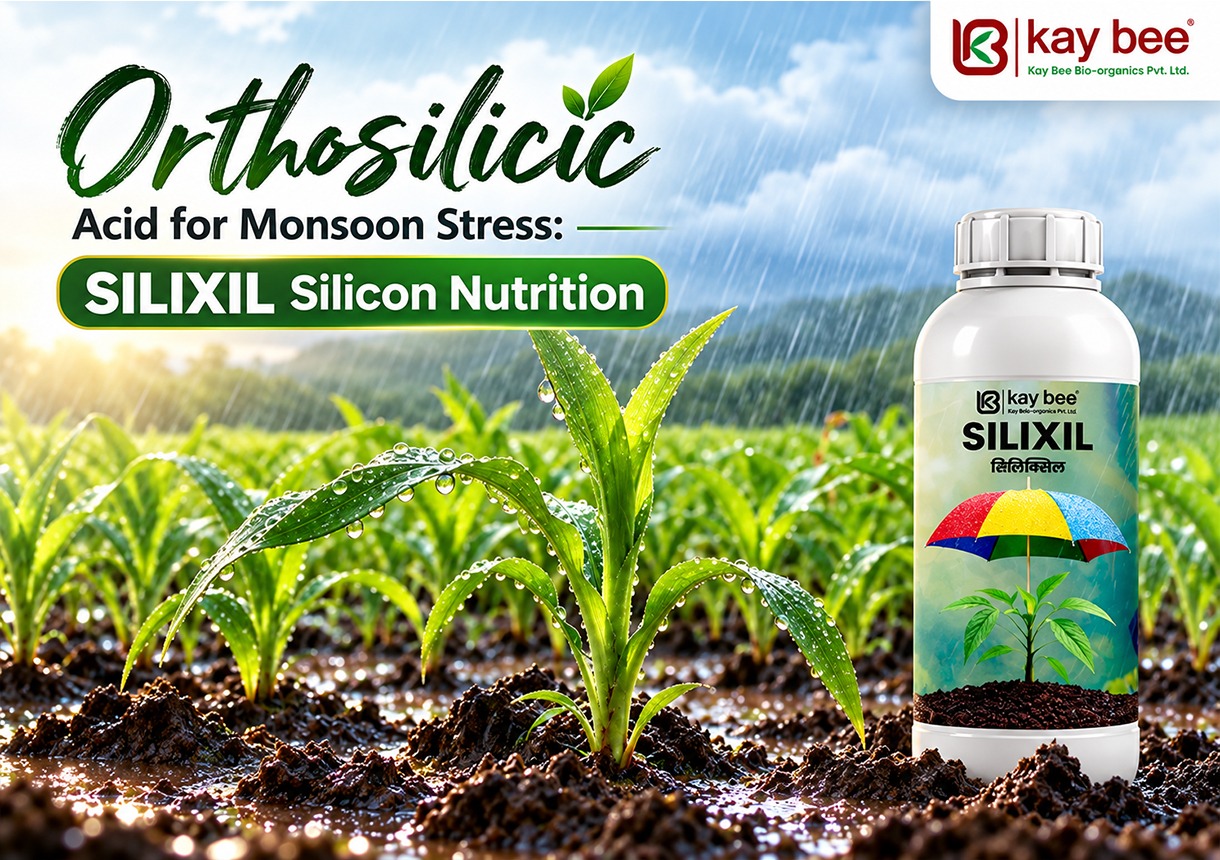
Orthosilicic Acid (OSA) for Monsoon Stress: Building Crop Strength & Resilience
When rain becomes excessive, crop strength matters. Understand what Orthosilicic Acid is, how plants use it, and why plant-available silicon can support crops during challenging monsoon conditions.
Monsoon brings essential water for crop growth, but excessive rainfall can create a stressful growing environment. Continuous wetness, high humidity, strong winds and changing soil conditions can affect plant growth, nutrient availability and overall crop health.
During such conditions, farmers need more than regular nutrition. They also need to support the crop’s natural strength and ability to cope with environmental stress. This is where orthosilicic acid for monsoon stress in crops becomes an important concept in modern crop nutrition. For more on how micronutrients support crops during challenging seasonal conditions, read our guide on role of micronutrients in kharif crops.
Silicon: Plenty in Soil, But Is It Available?
Silicon is naturally abundant in soil, but not all of it is available for direct plant uptake. Much of the soil silicon exists in mineral forms that plants cannot readily absorb.
The plant-available form is monosilicic acid, also known as Orthosilicic Acid (OSA), Si(OH)₄.
Therefore, when considering silicon nutrition, the question is not simply how much silicon is present in the soil, but how much is available in a form the plant can use. For more on hidden nutrient deficiencies that affect crops even when soil levels appear adequate, read our guide on hidden hunger in crops.
What Is Orthosilicic Acid?
Orthosilicic Acid (OSA) is a soluble form of silicon that plants can absorb through their roots and, depending on the formulation, through foliar application.
Once absorbed, silicon becomes associated with plant tissues and can contribute to their structural strength. Research has associated silicon nutrition with improved tolerance to several environmental and biological stresses, although the response can differ according to crop and growing conditions.
Its role can be understood through four key areas:
1. Structural Support
Structural Support
Silicon can contribute to stronger plant tissues and cell-wall structures. This can be particularly useful when crops experience mechanical pressure from heavy rain and strong winds.
2. Stress Response
Silicon nutrition is associated with plant responses to environmental stresses such as drought, salinity and certain disease pressures.
3. Nutrient Utilization
Silicon can influence nutrient balance and utilization, supporting the plant’s physiological performance under challenging conditions. For more on how plants utilize nutrients efficiently, read our guide on why micro-nutrients create macro changes at harvest.
4. Crop Quality
By supporting plant structure and stress tolerance, silicon nutrition can contribute to healthier crop growth and quality when conditions are suitable.
Why Does OSA Matter During Monsoon?
Monsoon stress rarely comes from one factor. It is usually a combination of heavy rainfall, high humidity, strong winds, wet soil and changing nutrient availability.
Heavy Rain & Strong Winds
Heavy rainfall accompanied by wind can put mechanical stress on stems, branches and leaves. Stronger plant tissues can help crops better cope with this physical pressure.
Wet Soil & Nutrient Movement
Repeated rainfall can change conditions around the root zone and influence nutrient availability. Supporting efficient nutrient uptake becomes important during prolonged wet conditions.
High Humidity & Leaf Wetness
Monsoon humidity and prolonged leaf wetness can create favourable conditions for several fungal and bacterial diseases. Silicon can support physical and biochemical defence mechanisms in plants, including strengthening tissues that form part of the plant’s natural barriers. For more on how fungal diseases spread during high-humidity periods, read our guide on why disease pressure increases in June.
However, silicon should be considered supportive crop nutrition, not a replacement for proper disease, pest, drainage or water-management practices.
OSA and Plant Immunity: What Does It Really Mean?
The term “plant immunity” is often used while discussing silicon, but it does not mean that OSA works like a pesticide. Instead, silicon nutrition can support stronger physical barriers and influence the plant’s response to certain stresses.
In simple terms:
Better silicon availability → Stronger plant tissues + improved stress response → Better ability to cope with challenging conditions
Therefore, orthosilicic acid plant immunity monsoon is best understood as part of an integrated crop-resilience strategy rather than a standalone protection method. For an overview of how botanical biostimulants support crop immunity alongside silicon nutrition, read our guide on the best biostimulant for flowering plants.
Why the Form of Silicon Matters
Not every silicon source provides the same immediate availability. OSA is a soluble, plant-available form of silicon, while much of the silicon naturally present in soil remains in less-available mineral forms.
| Conventional Soil Silicon | Orthosilicic Acid |
| Often limited availability | Plant-available form |
| Generally lower solubility | Soluble |
| Uptake depends on release/conversion | Readily available for plant uptake |
| Acts largely as a silicon reservoir | Provides available silicon |
This distinction matters when farmers are looking for silicon for crop stress management rather than simply adding another silicon source.
SILIXIL — Stabilized Orthosilicic Acid
Understanding OSA is only the first step. The next question is how farmers can provide plant-available silicon to their crops.
SILIXIL is a stabilized Orthosilicic Acid formulation containing 2% OSA. It is designed to provide plant-available silicon while supporting plant strength, stress tolerance and nutrient utilization.
Its key focus areas include:
- Stronger plant structure
- Better stress tolerance
- Improved nutrient utilization
- Support against environmental pressure
- Healthy crop growth and quality
SILIXIL Monsoon Spray
Recommended dose: 2 ml per litre of water
SILIXIL can be incorporated into suitable crop nutrition programs during stages such as vegetative growth, pre-flowering and early fruit/grain development, depending on the crop and recommended application schedule. For better spray adhesion and leaf coverage, add Balanstick (0.4 ml/l) to the spray mix.
The Takeaway
Managing crops during the monsoon is not only about handling excess water. It is also about supporting plant strength, nutrient efficiency and resilience under changing environmental conditions.
Understanding the difference between total soil silicon and plant-available silicon is an important part of effective silicon nutrition. Orthosilicic Acid provides plants with a soluble form of silicon that can support structural strength, stress response and overall crop performance.
When monsoon conditions become challenging, the goal is simple:
Don’t just help the crop grow. Help it stay resilient.
For more on managing crop health during the monsoon season, also read our guides on sugarcane growth management during monsoon and why disease pressure increases in June, and explore how Nova Zyme biostimulant supports healthy crop growth alongside SILIXIL as part of a complete monsoon nutrition programme.
Latest Blogs
 Mycorrhiza Technical Manufacturer in India | Kay Bee Bio-Organics Pvt. Ltd.
 Calcium for Cabbage Head Formation: How Calboost (Ca-11%) Ensures Tight & Crack-Free Heads
 Citrus Canker Organic Control: A Complete Farmer’s Guide
 Ginger Nematode and Soft Rot Control: Organic Management with Root Fit & Bacto Raze
 Tomato Nematode Damage: Underground Signs, Crop Loss and Organic Control with Root Fit
COPYRIGHT © 2026 - ALL RIGHTS RESERVED. MADE BY WebAppGigs