
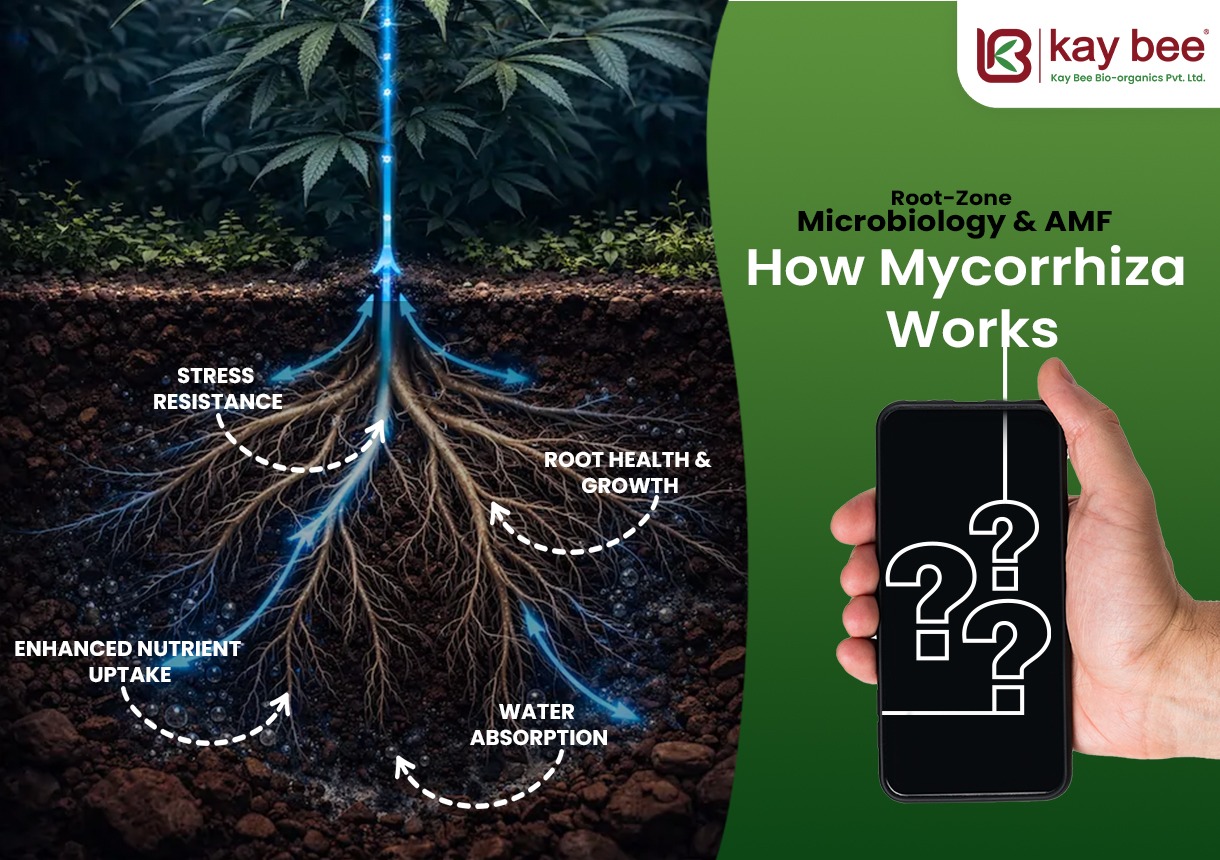
Root-Zone Microbiology & AMF – How Mycorrhiza Works
Healthy crops do not grow from fertilizer alone. They grow from living soil. Under every plant root, there is a hidden world full of tiny life. This zone is called the root zone or rhizosphere. It is one of the busiest places in nature.
Millions of microbes live there. Some help plants. Some compete with them. Among all these microbes, one group stands out for its power: mycorrhizal fungi.
Understanding how this fungus works helps farmers use it correctly. This guide explains the science in simple words. You will learn how root-zone biology works, how AMF supports crops, and why mycorrhizal fungus benefits long-term soil health.
👉 For farmer-friendly usage instructions, read the full Mycorrhiza Biofertilizer Guide.
What is Root-Zone Microbiology?
The root zone is not just soil. It is a living system.
When roots grow, they release sugars and natural chemicals. These substances attract microbes. Bacteria, fungi, and other organisms gather around roots to feed on these exudates. In return, many of them help the plant.
This partnership is called root-zone microbiology.
In a healthy soil:
- Roots and microbes exchange nutrients
- Beneficial microbes protect plants
- Organic matter is broken down into usable food
- Soil structure becomes stronger
If soil biology is damaged by heavy chemicals or erosion, this system weakens. Plants then depend more on artificial inputs.
Mycorrhiza is one of the strongest helpers in this underground network.
What is Arbuscular Mycorrhizal Fungi (AMF)?
Arbuscular Mycorrhizal Fungi, or AMF, are beneficial soil fungi that form a partnership with plant roots.
Older agricultural texts may call it VAM (Vesicular Arbuscular Mycorrhiza). Both names describe the same group.
AMF is not new. It is ancient. Scientists believe this partnership helped the first plants survive on land millions of years ago.
Important fact:
👉 Around 80–90% of all plant species naturally depend on mycorrhiza.
That means most crops evolved expecting fungal partners.
When soil loses this fungus, plants struggle even if fertilizer is added.
Step-by-Step: How Mycorrhiza Colonizes Roots
The working process is simple when explained step by step.
1. Spore Activation
Mycorrhiza begins as a spore in soil. When roots grow nearby, the spore senses root signals and wakes up.
2. Root Detection
The fungus grows toward young white roots. It looks for entry points.
3. Root Entry
The fungus gently enters the outer root tissue without harming the plant.
4. Arbuscule Formation
Inside the root, the fungus builds tiny tree-like structures called arbuscules. These are nutrient exchange stations.
5. Network Expansion
Outside the root, the fungus spreads thin threads called hyphae deep into the soil. These act like extra roots.
This underground network is much thinner than plant roots. It can reach tiny soil pores that roots cannot enter.
That is where many mycorrhizal fungus benefits come from.
Nutrient Transport Mechanism
Mycorrhiza is like a delivery system. It collects nutrients and brings them directly to plant cells.
Phosphorus Unlocking
Phosphorus often gets locked in soil. Plants cannot absorb it easily.
Mycorrhiza releases natural acids that dissolve trapped phosphorus. It then carries the nutrient to roots.
Nitrogen Transfer
Some forms of nitrogen are also captured and delivered through fungal threads.
Micronutrient Capture
The fungus transports important minerals:
- Zinc
- Phosphorus
- Cupper
- Iron
- Magnesium
- Manganese
- Boron
- Potassium
These nutrients are needed in small amounts, but they are critical for growth.
Water Movement
Hyphae absorb water from distant soil zones. This improves drought tolerance.
Carbon Exchange
The plant feeds the fungus sugars. In return, the fungus feeds the plant nutrients.
It is a fair trade system.
Roots Alone vs Roots with Mycorrhiza
| Roots Alone | Roots + Mycorrhiza |
| Limited soil reach | 100x greater exploration |
| Weak phosphorus uptake | High nutrient efficiency |
| Drought sensitive | Better water absorption |
| Slow early growth | Strong root development |
This table shows why crops perform better when fungal partners are active.
Mycorrhiza and Soil Health
Mycorrhiza does more than feed plants. It improves soil structure.
The fungus produces a sticky compound called glomalin. This natural glue binds soil particles together.
Benefits of glomalin:
- Better soil aggregation
- Improved aeration
- Higher water retention
- Reduced erosion
- Stronger root anchoring
Healthy soil structure allows roots and microbes to work together for many seasons.
Scientific Benefits of Mycorrhizal Fungus
Research across many crops confirms strong advantages.
Key mycorrhizal fungus benefits include:
- Higher nutrient absorption efficiency
- Faster early root growth
- Reduced phosphorus fertilizer need
- Improved drought resistance
- Better soil structure
- Increased plant vigor
- Enhanced microbial balance
- Long-term soil fertility improvement
These benefits grow over time. Mycorrhiza is a biological investment, not a quick chemical boost.
Environmental Impact
Modern farming must protect soil and water.
Mycorrhiza helps by:
- Reducing fertilizer runoff
- Lowering chemical dependency
- Supporting organic systems
- Rebuilding degraded soils
- Improving climate resilience
Fields with strong fungal networks hold nutrients better and waste less input.
Common Mycorrhiza Myths
Myth 1: It works instantly
Mycorrhiza takes time to colonize roots. It is a living organism, not a chemical spray.
Myth 2: It replaces all fertilizers
It improves efficiency but does not remove the need for balanced nutrition.
Myth 3: Only organic farmers use it
Conventional farms also benefit from AMF.
Myth 4: One application lasts forever
Heavy tillage and chemicals can damage fungal networks. Soil care matters.
Practical Takeaway for Farmers
Science becomes useful only when applied correctly.
Remember:
- Mycorrhiza works best during early root growth
- It must touch roots to colonize
- Avoid strong fungicides near application
- Protect soil biology with organic matter
- Think long-term, not one season
👉 For application methods and dosage, read the complete Mycorrhiza farmer guide.
Final Thoughts
Plants never evolved to grow alone. They evolved with microbes.
When farmers restore root-zone biology, crops become stronger, more efficient, and more resilient. Mycorrhiza is one of the most powerful partners in this underground ecosystem.
Understanding how it works helps you use it wisely.
👉 Ready to turn science into results?
Shop Mycorrhiza products and strengthen your soil today.
Frequently Asked Questions
How does AMF help plants?
AMF expands the root system through fungal threads. It delivers nutrients and water directly to roots.
Is mycorrhiza fungus safe?
Yes. It is a natural soil organism found in healthy ecosystems.
How long does colonization take?
Initial colonization usually begins within 2–4 weeks.
Can AMF survive drought?
Yes. It improves plant drought tolerance by increasing water absorption.
Does deep ploughing damage mycorrhiza?
Yes. Heavy tillage can break fungal networks and reduce effectiveness.
Latest Blogs
 Brown Plant Hopper Paddy Organic Control with Pesto Raze & Mealy Raze
 Mycorrhiza Technical Manufacturer in India | Kay Bee Bio-Organics Pvt. Ltd.
 Cotton Whitefly Management During Square Formation Stage: Effective Control with Pesto Raze & OrgaNeem
 Calcium for Cabbage Head Formation: How Calboost (Ca-11%) Ensures Tight & Crack-Free Heads
 Citrus Canker Organic Control: A Complete Farmer’s Guide
COPYRIGHT © 2026 - ALL RIGHTS RESERVED. MADE BY WebAppGigs