

Stop Fall Armyworm Before It Destroys Your Maize Farms
Fall Armyworm (Spodoptera frugiperda) is the most significant threat to maize cultivation in India today. Capable of destroying up to 73% of your crop, this pest requires immediate attention. Whether you are a smallholder or managing a large farm, effective maize pest management is no longer optional, it is a necessity for your livelihood.
What is Fall Armyworm (FAW) and Why Is It Dangerous?
The Fall Armyworm is not a local pest; it is a highly invasive species that arrived from the Americas. It is distinct from common caterpillars for several reasons:
- Voracious Appetite: It feeds day and night, attacking leaves, the whorl, stems, and eventually the cob.
- Rapid Migration: An adult moth can fly up to 100 km in a single night, spreading infestations rapidly across neighboring fields.
- Hidden Danger: Larvae hide deep within the plant whorl, making them difficult to target with standard surface sprays.
- Rapid Reproduction: In warm, humid Kharif conditions (25–30°C), FAW completes multiple generations quickly, escalating damage every week.
Our Organic and Natural Biopesticides for Farming Products
How to Identify FAW in Your Field
Before spending money on pesticides, you must confirm the presence of FAW. Misidentification leads to wasted resources and poor results.
The “Y-Mark” Identification
The most reliable sign of FAW is a clear, inverted white ‘Y’ shape on the dark brown/black head of the larva. Other caterpillars do not have this mark.
Key Signs of Attack
- Window Pane Damage: Young leaves show thin, transparent patches that look like frosted glass.
- Brown Frass (Waste): You will see sawdust-like brown powder at the opening of the whorl.
- Ragged Holes: As larvae grow (3rd–4th instar), they cause ragged holes in leaves.
- Dead Heart: The central shoot dries and dies, ruining the plant’s growth.
FAW Life Cycle at a Glance
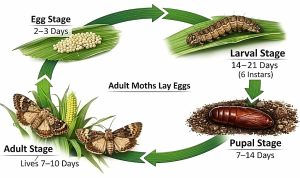
| Stage | Duration | Primary Characteristics |
| Egg | 2–3 Days | Laid in groups (100-200) on leaf undersides. |
| Larva | 14–21 Days | The main damaging stage. Moves through 6 instars. |
| Pupa | 7–14 Days | Occurs 2-8 cm deep in the soil; hard to reach. |
| Adult Moth | 7–10 Days | Nocturnal flier; starts the cycle again. |
When Should You Spray? (Action Thresholds)
Don’t spray blindly. Monitor your crop every 3 days.
- Young Plants: Spray when 20% of plants show fresh damage and live larvae.
- Whorl Stage: Spray when 10% of plants have larvae in the whorl or you see 2–3 larvae per plant.
- Reproductive Stage: Act immediately if 10% of plants show damage. Cob damage is irreversible.
Introducing Larvo Raze: The Next-Gen Bio-Larvicide
Standard chemical insecticides often fail because FAW quickly develops resistance to them. Furthermore, chemicals leave harmful residues, kill beneficial insects like bees and spiders, and degrade soil health.
Larvo Raze is a bio-larvicide powered by Multi-Marker Compound Technology. It utilizes multiple plant-based active ingredients to attack FAW from every angle.
Why Larvo Raze is Buffed?
- Contact Action: Kills larvae immediately upon touch.
- Systemic Action: Absorbed by the plant, killing larvae feeding from within.
- Fumigant Action: Repels adult moths, preventing egg-laying.
- Anti-Feedant: Stops larvae from eating the crop within minutes of contact.
- IGR Activity: Disrupts the larva’s growth, ensuring it cannot molt or reproduce.
- Ovicidal Activity: Kills eggs before they hatch.
Pro-Tip: The Power Pair Strategy
For heavy infestations, mix Larvo Raze (2.5 ml) with Organeem 3000 PPM (1 ml) per liter of water. This combo kills existing larvae and repels moths, breaking the life cycle entirely without toxic chemical residues.
Best Practices for Successful FAW Control
- Spray Technique: Always focus your spray nozzle directly into the whorl of the maize plant.
- Timing: The best time for application is early morning or late evening.
- Community Action: Since moths fly between fields, coordinate with neighbors for a simultaneous “village-wide” spray day.
- Natural Enemies: Protect birds, spiders, and ladybird beetles. Avoid harsh chemicals that wipe out these natural FAW predators.
- Crop Rotation: To break the soil-dwelling pupa cycle, rotate maize with non-host crops like soybean, turmeric, or onion every 2–3 years.
Conclusion
Fall Armyworm is a serious challenge, but it is manageable. By scouting early, identifying the pest correctly, and utilizing residue-free, effective solutions like Larvo Raze, you can protect your yield and your income.
Remember: Farming is an investment. Investing in smart, bio-based larval pest management today ensures a healthier, more profitable harvest tomorrow.
Latest Blogs
 Brown Plant Hopper Paddy Organic Control with Pesto Raze & Mealy Raze
 Mycorrhiza Technical Manufacturer in India | Kay Bee Bio-Organics Pvt. Ltd.
 Cotton Whitefly Management During Square Formation Stage: Effective Control with Pesto Raze & OrgaNeem
 Calcium for Cabbage Head Formation: How Calboost (Ca-11%) Ensures Tight & Crack-Free Heads
 Citrus Canker Organic Control: A Complete Farmer’s Guide
COPYRIGHT © 2026 - ALL RIGHTS RESERVED. MADE BY WebAppGigs