
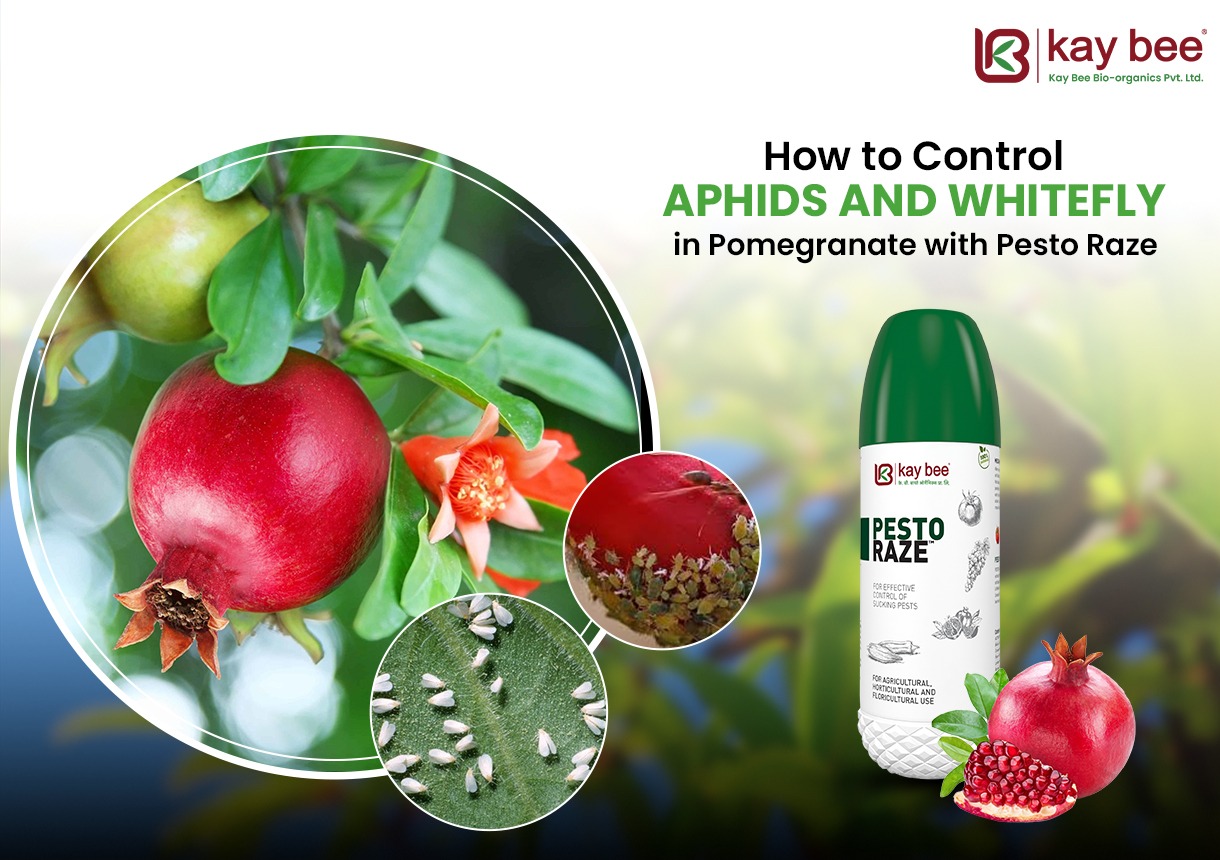
How to Control Aphids and Whitefly in Pomegranate with Pesto Raze
Pomegranate farming is highly profitable, but the crop is frequently threatened by sap-sucking pests such as aphids and whiteflies. If not managed properly, these insects can significantly affect plant vigor, fruit quality, and overall profitability.
Both aphids and whiteflies feed by extracting sap from tender plant parts, weakening the crop and reducing its productive potential. Their infestation often results in curled leaves, sticky honeydew deposits, black sooty mold development, and poor fruit formation ultimately lowering the market value of the produce.
Overdependence on conventional chemical insecticides has created challenges, including pesticide residue concerns, pest resistance, and reduced acceptance in residue-sensitive export markets.
Fortunately, effective management is possible through organic pest control strategies. By adopting the right product, spray schedule, and application method, farmers can control these pests safely while maintaining orchard health and sustainability.
In this blog, we explain:
- How aphids and whiteflies damage pomegranate
- Why organic control is the best option
- A proven organic solution using Pesto Raze
- Step-by-step spray method for best results
How Aphids and Whiteflies Damage the Crop
Aphids and whiteflies are among the most damaging sucking pests in pomegranate orchards.
- Both pests suck sap from tender leaves, shoots, flowers, and fruits
- Continuous feeding weakens the plant and reduces photosynthesis
- They excrete sticky honeydew on plant surfaces
- Honeydew promotes black sooty mold fungus growth
- Heavy infestation reduces fruit quality and marketability
Common Symptoms
Aphid Damage Symptoms
- Curling and yellowing of young leaves
- Wilting of tender shoots
- Sticky honeydew on leaves and fruits
- Black sooty mold development
- Premature flower and fruit drop
Whitefly Damage Symptoms
- Yellowing of leaves
- Whitefly flying when canopy is disturbed
- Honeydew deposition on foliage
- Sooty mold on leaves and fruits
- Leaf drop in severe infestation
View Product Details – Pesto Raze
Why Chemical Control Is No Longer the Best Option
Many farmers still rely heavily on chemical insecticides, but this approach is becoming less effective and more risky.
Problems with Chemical Insecticides
- Chemical residues reduce export quality
- Market rejection due to residue limits
- Pest resistance after repeated sprays
- Harm to beneficial insects
- Higher spray cost over time
- Negative impact on soil and orchard ecology
Why Organic Pest Control Is the Right Choice for Farmers
Organic pest control helps suppress pest populations while supporting sustainable orchard health.
Key Benefits of Organic Pest Control:
- Safe for fruits, farmers, and consumers
- No harmful chemical residue
- Suitable for organic farming
- Ideal for export-oriented production
- Supports Integrated Pest Management (IPM)
- Reduces long-term pest pressure
One of the most effective organic solutions for sucking pest management is Pesto Raze.
Why Farmers Should Use Pesto Raze
Pesto Raze is an advanced organic insect control formulation specially designed for effective management of sucking pests in horticultural crops.
- Controls aphids, whiteflies effectively
- Provides fast, and lethal action on pests
- Visible results within 48 hours
- Residue-free and safe for export crops
- Suitable for organic farming
- Improves crop quality and yield
How Pesto Raze Works (Mode of Action)
To control sucking pests effectively, Pesto Raze works through multiple mechanisms:
Contact Action
When spray droplets contact aphids and whiteflies, active ingredients quickly affect their feeding and survival.
Fumigant Action
Vapour-phase activity helps control hidden and exposed populations of whiteflies and aphids by acting through insect respiration in the crop canopy.
Systemic Action
The product is absorbed and translocated within the plant, providing internal protection against sap-sucking pests like whiteflies and aphids.
Anti-Feeding Effect
Disrupts pest feeding behavior immediately after exposure.
Population Suppression
Reduces pest multiplication and colony establishment.
Improved Coverage
Formulation spreads effectively on leaf surfaces including lower leaf area where pests hide.
How to Use Pesto Raze (Step-by-Step Guide)
Spray Dosage
For a liter of water, mix:
- Pesto Raze – 2 ml/lit
Best Time for Spraying
- Early morning or late evening
- Do not spray before rainfall
Spray Schedule for Best Results
- First spray: At initial pest appearance
- Repeat spray: Every 5–6 days depending on infestation pressure
- Regular monitoring is essential
Benefits of Using Pesto Raze in Pomegranate
- Reduces sap-sucking damage and protects tender plant parts
- Minimizes honeydew secretion and sooty mold development
- Enhances plant vigor and photosynthetic activity
- Improves fruit shine, size, and overall appearance
- Increases marketable produce and productivity
- Eco-friendly solution suitable for sustainable farming
Farmers often report visible reduction in sucking pest infestation within 48 hours of application.
Common Mistakes Farmers Should Avoid
- Delaying spray until infestation becomes severe
- Spraying only upper leaf surface
- Ignoring lower leaf coverage
- Ignoring orchard sanitation and monitoring
Correct timing and proper coverage are more important than frequent spraying.
Conclusion
Aphids and whiteflies are serious sucking pests in pomegranate that can significantly reduce crop productivity and fruit quality. Chemical pesticide dependency is no longer sustainable due to residue and resistance issues. By adopting organic pest control, farmers can manage sucking pests effectively while producing safer, higher-quality fruit.
Frequently Asked Questions (FAQs)
Q1. Is Pesto Raze safe during the fruiting stage?
Yes, when used at recommended dosage, it is safe during the fruiting stage.
Q2. Can Pesto Raze be used in organic farming?
Yes, it is suitable for organic and residue-free cultivation.
Q3. How soon can I see results after spraying?
Visible reduction in pest population is generally observed within 48 hours.
Q4. How many sprays are required?
Typically, 2 sprays, depending on pest pressure and orchard conditions.
Q5. Can Pesto Raze be mixed with micronutrients?
Pesto Raze can be mixed with micronutrients and is compatible with most agricultural inputs; however, it should not be mixed with copper- or sulfur-based products.
Q6. Is Pesto Raze safe for beneficial insects?
Yes, when used at recommended doses, it is generally safer for beneficial insects compared to conventional chemicals.
Q7. What precautions should farmers take while spraying?
- Ensure complete canopy coverage
- Clean spray equipment after use
Latest Blogs
 Brown Plant Hopper Paddy Organic Control with Pesto Raze & Mealy Raze
 Mycorrhiza Technical Manufacturer in India | Kay Bee Bio-Organics Pvt. Ltd.
 Cotton Whitefly Management During Square Formation Stage: Effective Control with Pesto Raze & OrgaNeem
 Calcium for Cabbage Head Formation: How Calboost (Ca-11%) Ensures Tight & Crack-Free Heads
 Citrus Canker Organic Control: A Complete Farmer’s Guide
COPYRIGHT © 2026 - ALL RIGHTS RESERVED. MADE BY WebAppGigs