
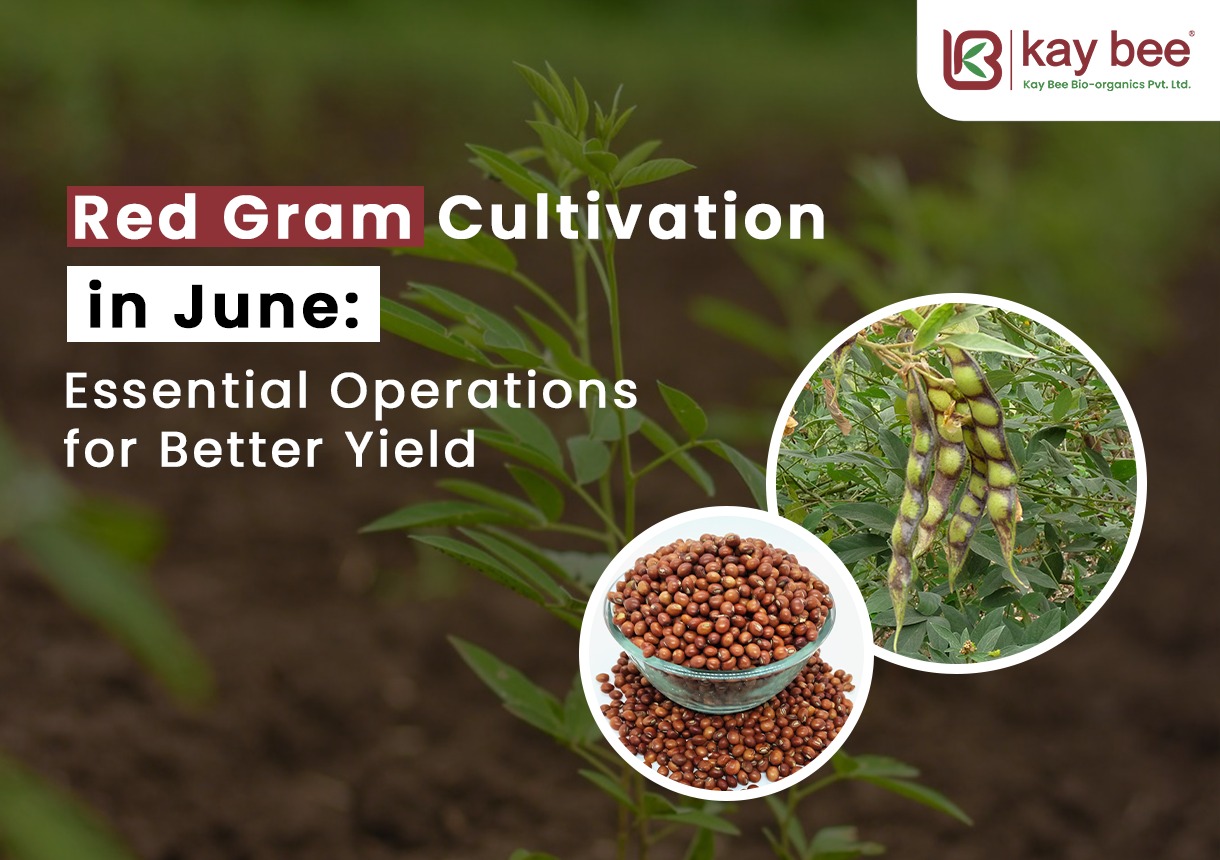
Red Gram Cultivation in June: Essential Operations for Better Yield
Introduction
June marks the beginning of the monsoon season across most parts of India and is considered the ideal period for establishing a successful red gram crop. Also known as pigeon pea or arhar, red gram (Cajanus cajan L.) is one of the most important pulse crops cultivated under rainfed conditions. It serves as a major source of dietary protein and contributes significantly to soil fertility through biological nitrogen fixation.
Proper planning and timely field operations during red gram cultivation in June play a crucial role in determining final yield. Delayed sowing, poor land preparation, improper nutrient management, and inadequate pest monitoring can adversely affect crop performance. Therefore, adopting scientifically recommended agronomic practices is essential for profitable production.
This article highlights the key operations involved in tur dal farming in June, from field preparation to early crop management, to help farmers achieve better productivity.
Importance of June Sowing in Red Gram
June coincides with the onset of southwest monsoon, providing optimum soil moisture for seed germination and seedling establishment. Timely arhar dal sowing ensures that the crop utilizes available rainfall efficiently during its vegetative growth phase.
Advantages of June sowing include:
- Better germination and crop establishment.
- Enhanced root development
- Efficient utilization of monsoon rainfall.
- Reduced moisture stress during early growth.
- Improved flowering and pod formation.
- Higher yield potential compared to delayed planting.
In most regions of India, sowing during the second fortnight of June to early July is considered ideal.
Climate Requirements
Understanding climate requirements is fundamental to successful red gram agronomy in India.
Red gram grows well under:
- Temperature: 25–35°C.
- Annual rainfall: 600–1,000 mm.
- Warm and moderately humid conditions.
- Well-distributed rainfall during vegetative growth.
Although drought tolerant due to its deep root system, prolonged waterlogging can severely affect plant growth.
Land Preparation
Proper field preparation creates favorable conditions for germination and root development.
Recommended operations include:
- One deep ploughing during summer to expose soil-borne pests and weed seeds.
- Two to three harrowings before sowing.
- Removal of previous crop residues.
- Formation of a fine and level seedbed.
- Provision of drainage channels in heavy soils.
Good soil tilth ensures better seed-to-soil contact and uniform emergence.
Soil Requirements
For effective red gram cultivation in June, suitable soil selection is essential.
Ideal soils include:
- Well-drained black cotton soils.
- Medium to deep loamy soils.
- Sandy loam soils with adequate organic matter.
Preferred soil characteristics:
- Soil pH: 6.5–7.5.
- Good water-holding capacity.
- Absence of prolonged water stagnation.
Poorly drained fields increase the risk of root diseases and reduced plant stand.
Variety Selection
Selection of suitable varieties based on local agro-climatic conditions significantly influences productivity.
Farmers should choose varieties possessing:
- High yield potential.
- Resistance or tolerance to wilt and sterility mosaic diseases.
- Adaptability to regional conditions.
- Suitable maturity duration.
Using certified seed improves crop uniformity and vigor.
Seed Rate and Sowing
Timely arhar dal sowing with an appropriate seed rate ensures optimum plant population.
Recommended Seed Rate
- Early and medium-duration varieties: 12–15 kg seed/ha.
- Long-duration varieties: 15–18 kg seed/ha.
Spacing
- Medium-duration varieties: 60 × 20 cm.
- Long-duration varieties: 90 × 20–30 cm.
Sowing Depth
- Maintain a seed depth of 4–6 cm.
- Avoid excessively deep sowing, which delays emergence.
Uniform spacing minimizes competition for nutrients, moisture, and sunlight.
Seed Treatment
Seed treatment is an important component of red gram agronomy in India.
Recommended practices include:
Fungicidal Treatment
Treat seeds to protect against seed- and soil-borne pathogens responsible for seedling mortality.
Biofertilizer Inoculation
Application of beneficial microorganisms such as:
- Rhizobium culture.
- Phosphate-solubilizing bacteria (PSB).
Benefits include:
- Enhanced nitrogen fixation.
- Improved phosphorus availability.
- Better root development.
- Increased nutrient-use efficiency.
Allow treated seeds to dry in shade before sowing.
Nutrient Management
Balanced nutrition is essential for higher productivity during tur dal farming June.
General recommendations include:
Organic Sources
- Farmyard manure (FYM).
- Compost.
- Vermicompost.
Benefits:
- Improved soil structure.
- Enhanced microbial activity.
- Better moisture retention.
Fertilizer Application
Apply nutrients based on soil test recommendations.
Particular attention should be given to:
- Phosphorus for root growth and nodulation.
- Sulphur for protein synthesis.
- Micronutrients in deficient soils.
Integrated nutrient management improves long-term soil health and crop productivity.
Weed Management
Weeds compete aggressively with red gram during the early growth period.
The critical weed competition period generally occurs during the first 45–60 days after sowing.
Effective measures include:
- Timely intercultivation.
- Manual weeding.
- Mechanical weeders.
- Mulching where feasible.
Maintaining a weed-free field during early stages significantly enhances yield potential.
Water Management
Although red gram is relatively drought tolerant, proper moisture management remains important.
Recommendations include:
- Ensure adequate soil moisture during germination.
- Avoid water stagnation after heavy rainfall.
- Maintain effective drainage systems.
- Provide protective irrigation during prolonged dry spells, if facilities exist.
Proper drainage is particularly important during monsoon months.
Pest and Disease Monitoring
Regular field scouting is essential during red gram cultivation June.
Major insect pests include:
- Pod borer
- Pod fly
- Plume moth
Important diseases include:
- Fusarium wilt.
- Sterility mosaic disease.
Management strategies involve:
- Use of resistant varieties.
- Field sanitation.
- Crop rotation.
- Monitoring pest incidence.
- Adoption of Integrated Pest Management (IPM) practices.
Early detection reduces economic losses.
Intercropping
Intercropping is widely practiced in red gram agronomy in India to enhance resource-use efficiency.
Suitable combinations include:
- Red gram + soybean.
- Red gram + black gram.
- Red gram + green gram.
- Red gram + sesame.
Advantages include:
- Risk reduction.
- Better utilization of space and nutrients.
- Additional income sources.
- Improved system productivity.
Harvesting and Yield Expectations
The crop is harvested when approximately 75–80% of pods attain maturity and change color.
Harvesting recommendations:
- Avoid harvesting immature pods.
- Dry harvested plants adequately.
- Thresh carefully to minimize grain damage.
- Store grains at safe moisture levels.
Yield varies depending on variety, rainfall distribution, and management practices. Timely operations and adherence to recommended practices during turdal farming in June can substantially improve productivity.
Enhancing Red Gram Productivity with Kay Bee Bio Organics
Farmers can further improve red gram performance by integrating Kay Bee Bio Organics solutions with recommended agronomic practices. Root Fit, Mycoris, and Neutralite Granules support healthy root growth and soil health, while Novazyme enhances plant vigor and nutrient uptake. For crop protection, Organeem, Thrips Raze, Larvo Raze, and Fungo Raze help manage key pests and diseases under an IPM approach. Zilite & Nutrix support nutritional requirements, and Balanstick improves spray coverage and effectiveness. Together, these solutions contribute to healthier crops, better resilience, and improved yield potential in red gram cultivation.
Conclusion
Successful red gram cultivation June depends on timely sowing, proper land preparation, balanced nutrient management, effective weed control, and continuous pest monitoring. Scientific arhar dal sowing practices not only improve crop establishment but also maximize the efficient use of monsoon rainfall.
By adopting the principles of red gram agronomy India, farmers can achieve healthier crops, better resilience against environmental stresses, and higher yields. With appropriate management during the early stages of crop growth, tur dal farming June can become a profitable and sustainable enterprise, contributing to both farm income and national pulse production.
With Kay Bee Bio Organics’ innovative crop nutrition and protection solutions, farmers can achieve healthier plants, better stress tolerance, and improved productivity in red gram.
Latest Blogs
 Brown Plant Hopper Paddy Organic Control with Pesto Raze & Mealy Raze
 Mycorrhiza Technical Manufacturer in India | Kay Bee Bio-Organics Pvt. Ltd.
 Cotton Whitefly Management During Square Formation Stage: Effective Control with Pesto Raze & OrgaNeem
 Calcium for Cabbage Head Formation: How Calboost (Ca-11%) Ensures Tight & Crack-Free Heads
 Citrus Canker Organic Control: A Complete Farmer’s Guide
COPYRIGHT © 2026 - ALL RIGHTS RESERVED. MADE BY WebAppGigs