
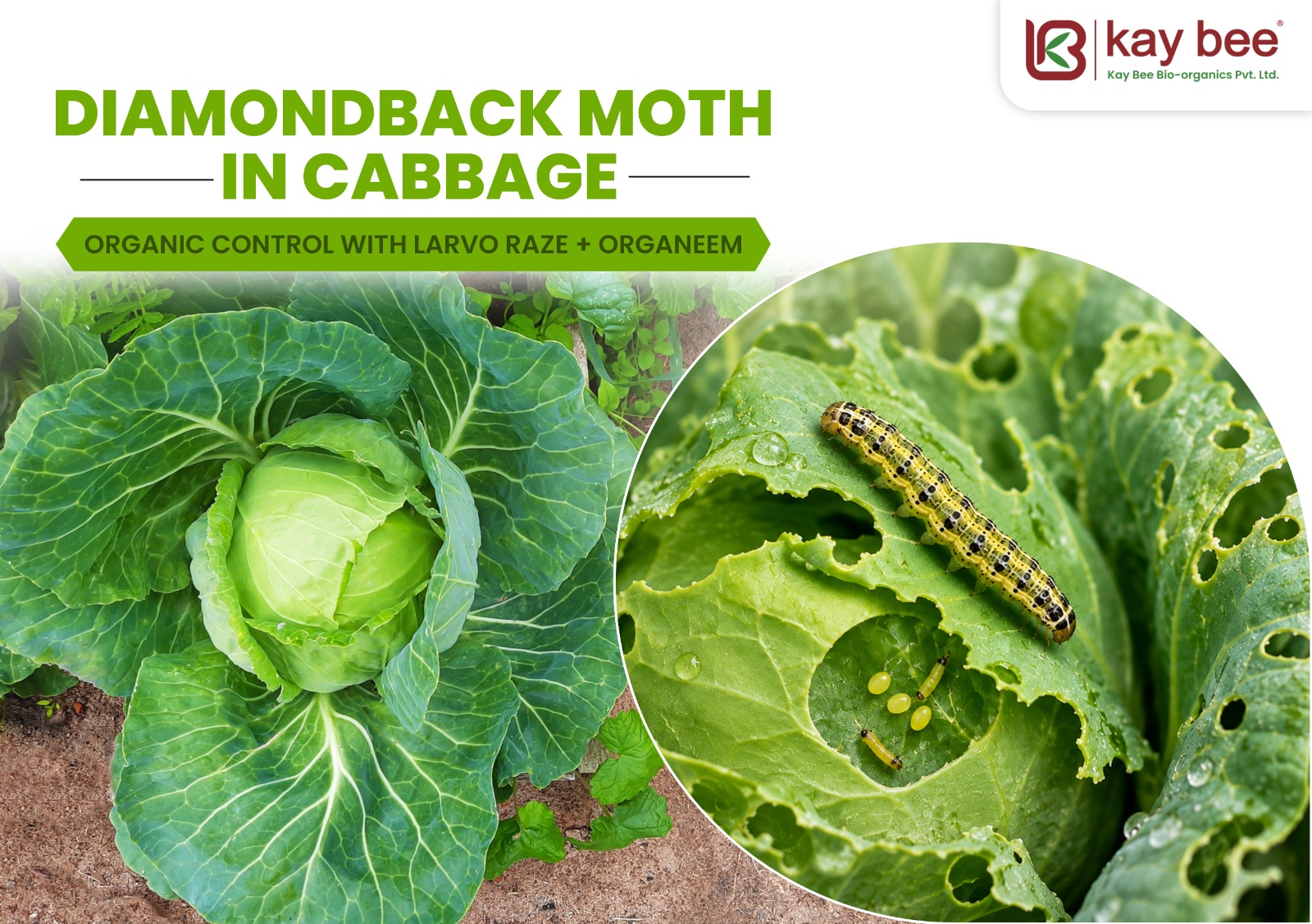
Management of Cabbage Diamondback Moth with Larvo Raze + OrgaNeem Organic Products
Introduction
For effective diamond back moth cabbage control, note that Cabbage is one of the most important vegetable crops cultivated throughout India. However, its productivity is severely affected by the diamondback moth (DBM), scientifically known as Plutella xylostella. This insect is regarded as one of the most destructive pests of cruciferous vegetables worldwide. The diamondback moth has developed resistance to several conventional insecticides due to repeated chemical applications. As a result, farmers often experience poor pest control, increased production costs, pesticide residues, and environmental concerns.
Therefore, adopting diamond back moth cabbage control through botanical and organic solutions has become an effective and sustainable alternative. To understand why biopesticides are the right choice for vegetable crops, read our guide on why India needs biopesticides in agriculture. Kay Bee Bio Organic offers an integrated organic solution using Larvo Raze and OrgaNeem 3000 ppm, which provides fast action against caterpillars while supporting residue-free and environmentally friendly cabbage production.
Life Cycle of Diamondback Moth (DBM)
DBM life cycle helps farmers apply control measures at the most vulnerable stage.
1. Egg Stage
Female moths lay tiny yellowish-white eggs singly or in small groups on the underside of cabbage leaves. A single female can lay approximately 150–250 eggs during her lifetime.
- Egg period: 3–5 days
2. Larval Stage
The newly hatched larvae feed on leaf tissues. Young larvae scrape the lower leaf surface, whereas older larvae consume larger portions of leaves. The larval stage consists of four instars and lasts about 10–14 days. This is the most destructive stage.
3. Pupal Stage
Fully grown larvae spin loose silken cocoons on leaves and transform into pupae.
- Pupal period: 4–7 days
4. Adult Stage
Adults are small greyish-brown moths with characteristic diamond-shaped white markings on folded wings, giving the insect its common name diamondback moth. The complete life cycle is completed within 18–25 days, allowing multiple generations during the cropping season. For more on how short lifecycle pests complete multiple generations in kharif seasons across vegetable crops, read our guide on damping off and black rot in cabbage and cauliflower for a broader picture of cabbage crop protection.
Nature of Damage
Diamondback moth larvae feed continuously on cabbage foliage and can attack the crop from seedling to harvest.
Typical symptoms include:
- Small window-like patches on young leaves.
- Numerous irregular holes that later produce a “shot-hole” appearance.
- Skeletonization of leaves under heavy infestation.
- Feeding on developing cabbage heads reduces market quality.
- Severe infestations may completely defoliate young plants.
- Yield losses may exceed 50–80% if unmanaged.
Continuous feeding also reduces photosynthesis, weakens plants, and lowers overall crop quality.
Integrated Control Measures
Effective diamond back moth cabbage control requires an integrated approach combining monitoring, cultural practices, biological conservation, and botanical insecticides.
1. Field Monitoring
- Inspect fields twice weekly.
- Monitor the underside of leaves for eggs and young larvae.
- Install pheromone traps for adult moth monitoring.
- Begin management during early infestation before larvae become abundant.
2. Cultural Practices
- Remove crop residues immediately after harvest.
- Destroy heavily infested plants.
- Maintain field sanitation.
- Avoid continuous cultivation of cruciferous crops.
- Practice crop rotation with non-host crops.
- Ensure balanced fertilizer application; excessive nitrogen encourages pest multiplication.
3. Encourage Natural Enemies
Several beneficial insects naturally suppress DBM populations, including:
- Cotesia plutellae
- Ladybird beetles
- Green lacewings
- Spiders
Avoid indiscriminate insecticide applications that harm these beneficial organisms.
DBM Organic Management in Cabbage with Larvo Raze + OrgaNeem 3000 ppm
Botanical crop protection provides an effective and sustainable solution for cabbage growers seeking residue-free production. For a broader look at how botanical pest management works across crops, read our guide on best organic farming products in India.
Larvo Raze
Larvo Raze is a novel bio-larvicide formulated using marker compounds from various plant extracts.
Mode of Action
Contact, Systemic, and Fumigant:
Antifeedant, Desiccation, Cytolysis activity and Knockout effect can be seen in neonates and early instars. Stomach poisoning, anti-moulting hormonal changes, neurotoxicity, IGR activity for late instar, and multilevel target action lead to a bewildering detoxification system of the insect body which fails to survive and never develops resistance to this product.
Benefits of Larvo Raze
- Rapid action with visible results within 48 hours
- Effective against early larval stages of diamondback moth
- Botanical formulation with multiple bioactive plant compounds
- Helps reduce resistance development compared to repeated use of single-site chemical insecticides
- Safe for Integrated Pest Management (IPM) programmes
- Suitable for residue-conscious vegetable production
- Supports healthy crop growth while protecting foliage
OrgaNeem 3000 ppm
OrgaNeem 3000 ppm is a CIB & RC (Central Insecticides Board & Registration Committee) approved neem-based product containing Azadirachtin 3000 ppm as an active ingredient. It contains bioactive compounds like nimbin, nimbidin, nimbolide, limonoids, and other bitter compounds derived from neem seed kernels. Kay Bee Bio-Organics is a leading manufacturer of technical Azadirachtin. For more on KBBO’s neem extraction process and CIB registered neem molecules, read our guides on the neem miracle — how we extract azadirachtin from neem and leading azadirachtin manufacturer in India.
Role of Neem for Cabbage Pest Control
Using neem for cabbage pest control offers several advantages:
- Acts as an oviposition deterrent
- Reduces egg laying by adult moths
- Suppresses larval feeding
- Interferes with moulting and development
- Repels adult insects
- Reduces overall pest population over time
- Safe for beneficial insects when used appropriately
Recommended Dose
Larvo Raze 2.5 ml + OrgaNeem 3000 ppm 1 ml per litre of water. For better spray coverage and adhesion, add Balanstick (0.4 ml/l) to the spray mix.
Additional Tips for Successful Management
- Start monitoring immediately after transplanting.
- Spray during early larval stages before severe leaf damage occurs.
- Ensure complete coverage of both upper and lower leaf surfaces.
- Rotate botanical products within an integrated pest management programme.
- Avoid unnecessary chemical insecticides that may destroy natural enemies.
- Continue regular field scouting throughout the crop season.
Conclusion
The diamondback moth remains one of the most economically important pests of cabbage, causing serious yield and quality losses if left unmanaged. Because of widespread resistance to conventional insecticides, growers increasingly need sustainable alternatives that provide reliable control without compromising environmental or food safety.
An integrated approach combining field monitoring, cultural practices, conservation of beneficial insects, and botanical crop protection offers the most effective solution. The combination of Larvo Raze and OrgaNeem 3000 ppm supports effective diamond back moth cabbage control by targeting feeding larvae while reducing future pest populations through neem-based activity. This strategy promotes DBM organic management cabbage, helps produce residue-free vegetables, and contributes to long-term sustainable cabbage cultivation.
For complete cabbage crop protection across diseases and pests, also read our guide on damping off and black rot in cabbage and cauliflower and explore best neem-based pesticides for agricultural crops for a complete crop protection programme.
Latest Blogs
 Mycorrhiza Technical Manufacturer in India | Kay Bee Bio-Organics Pvt. Ltd.
 Cotton Whitefly Management During Square Formation Stage: Effective Control with Pesto Raze & OrgaNeem
 Calcium for Cabbage Head Formation: How Calboost (Ca-11%) Ensures Tight & Crack-Free Heads
 Citrus Canker Organic Control: A Complete Farmer’s Guide
 Orthosilicic Acid (OSA) for Monsoon Stress: Building Crop Strength & Resilience
COPYRIGHT © 2026 - ALL RIGHTS RESERVED. MADE BY WebAppGigs