
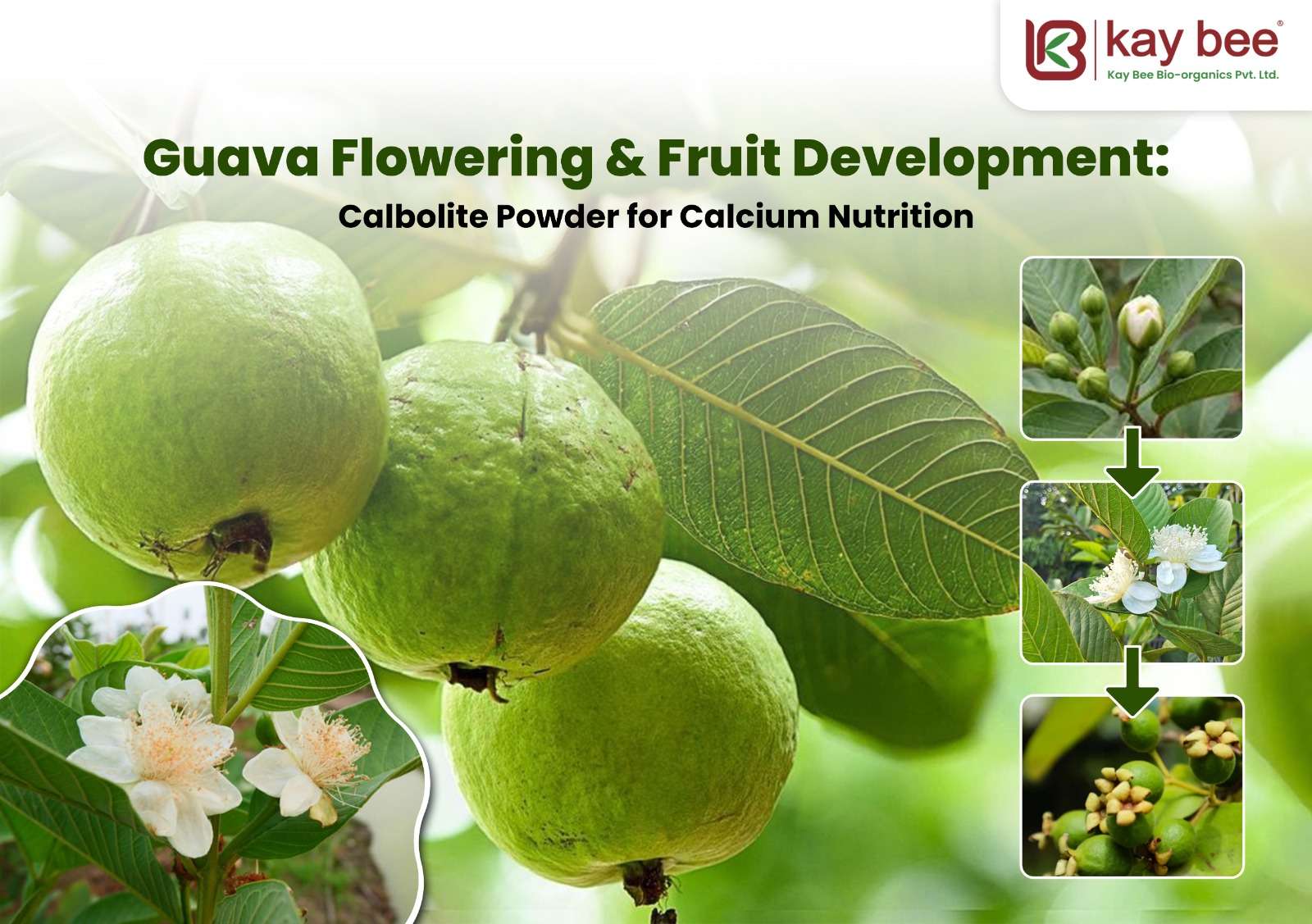
Guava Flowering & Fruit Development: Calbolite Powder for Calcium Nutrition
Apple of the Tropics: Where Every Flower Counts
During guava flowering and fruit development, Walk through a healthy guava orchard during the flowering season, and you’ll see hundreds of white blossoms covering the trees. It looks promising. But every experienced grower knows one thing — not every flower becomes a fruit.
Some flowers fall before pollination. Some tiny fruits drop within a few weeks. Others develop unevenly and never reach premium market quality. By the time harvesting begins, the crop has already decided much of its final yield.
This is why guava flowering, fruit development and calcium nutrition are considered important factors in determining the crop’s final yield and quality. For the broader picture of how calcium supports fruit crops, read our guide on the hidden power of calcium in crops.
Known as the “Apple of the Tropics,” guava (Psidium guajava) is one of India’s most valuable fruit crops. Rich in Vitamin C, antioxidants, and dietary fibre, it enjoys strong demand in fresh fruit markets as well as processing industries.
India contributes nearly 40–45% of the world’s guava production, making it the global leader. Yet today’s guava market is changing. Buyers aren’t just looking for more fruits — they’re looking for better fruits: better size, better firmness, better shelf life, and increasingly, residue-conscious produce.
A Healthy Flower Is the Beginning of a Healthy Harvest
Many growers notice heavy flowers or young fruits drop and immediately blame the weather. While weather certainly plays a role, it’s rarely the only reason.
During flowering, the guava tree shifts its energy from producing leaves to producing fruits. This stage demands a careful balance of moisture, nutrition, sunlight, and successful pollination. If any one of these factors is missing, the plant naturally sheds flowers and young fruits to reduce stress.
Some of the most common reasons behind poor fruit retention include:
- Calcium deficiency
- Zinc and boron deficiency
- Water stress
- Excess nitrogen during flowering
- Poor pollination
- Pest and disease pressure
A small amount of fruit drop is completely natural. However, excessive flower and fruit drop means fewer marketable fruits and lower returns at harvest. For more on how calcium deficiency symptoms appear across crops, read our guide on calcium deficiency in plants — symptoms and treatment.
Today, Fruit Quality Pays Better Than Yield Alone
Whether you’re supplying local retailers, supermarkets, or export buyers, fruit quality often decides the final price. India already produces nearly half of the world’s guava, but only a small share reaches premium international markets. Countries such as the UAE, Saudi Arabia, the United Kingdom, the United States, and the Netherlands are looking for fruits that meet strict quality and residue standards.
These buyers prefer guava with uniform fruit size, better firmness, attractive appearance, longer shelf life, higher sweetness, low pesticide residue, and consistent quality.
This growing demand is encouraging many farmers to adopt residue-conscious and export-oriented farming practices, where balanced crop nutrition plays a key role. For more on why export farmers choose botanical crop protection, read our guide on why export farmers choose neem insecticides.
Typical Market Value of Guava
| Market Type | Typical Price Range* | Buyer Preference |
| Conventional Local Market | ₹15–35/kg | Mixed quality fruits |
| Premium Domestic Organic Market | ₹30–60/kg | Better appearance & residue-conscious produce |
| Export Quality Organic Guava | ₹100+/kg | Firm fruits with good shelf life |
| Organic Guava Powder (Processed) | ₹400–500/kg | Premium organic raw material |
*Prices are indicative and may vary depending on season, variety, location, demand, and fruit quality.
The takeaway is simple — quality creates opportunity. Improving fruit quality can help growers move beyond local markets and access higher-value buyers.
So, What Does the Crop Need During Flowering?
Flowering isn’t the stage to experiment. It’s the stage to support the crop.
Along with timely irrigation, pruning, and good orchard management, balanced nutrition becomes essential. A few simple practices can make a noticeable difference:
- Maintain adequate soil moisture before and during flowering.
- Avoid excessive nitrogen, which promotes leaves instead of flowers.
- Encourage pollinators like bees by avoiding unnecessary insecticide sprays during bloom.
- Prune overcrowded branches for better sunlight and air circulation.
- Supply essential micronutrients at the right crop stage.
Among these, calcium, zinc, and boron deserve special attention because they directly influence flowering, fruit setting, and fruit development. Therefore, effective guava fruit drop management should combine proper irrigation, balanced nutrition, good pollination, and timely orchard management rather than relying on a single input.
Why Calcium, Zinc & Boron Matter
Think of these nutrients as the crop’s support system during reproduction.
Calcium strengthens cell walls, helping fruits become firmer and improving their shelf life. Adequate calcium for guava fruit setting also supports healthy fruit development and helps the developing fruit maintain better structural strength. For more on how calcium nutrition works in fruit crops, read our detailed guide on calcium for banana — the principles apply equally to guava.
Zinc supports healthy shoot growth and flower formation while contributing to pollen development. For more on zinc’s role in crop nutrition, read our guide on zinc deficiency, toxicity and application methods.
Boron plays an important role in pollination, fertilization, and sugar movement inside the plant, helping more flowers develop into healthy fruits.
Together, they help the crop:
- Retain more flowers
- Improve fruit setting
- Reduce flower and fruit drop
- Produce firmer fruits
- Improve shelf life
- Enhance overall fruit quality
Supporting Flowering & Fruit Development with Calbolite Powder
Once flowering begins, the crop’s demand for calcium, zinc, and boron increases significantly. Supplying these nutrients at the right time helps the plant complete one of its most important growth stages more efficiently.
Calbolite Powder is developed to provide this balanced combination of essential micronutrients. With its advanced nutrient delivery technology, it allows faster absorption and better nutrient movement inside the plant, making nutrients available when the crop needs them most.
When included as part of a balanced nutrition programme, Calbolite Powder helps:
- Improve flowering
- Support better fruit setting
- Reduce flower and fruit drop
- Improve fruit firmness
- Enhance shelf life
- Improve overall fruit quality
Rather than replacing the regular fertilizer schedule, it complements it by supplying critical micronutrients during flowering and early fruit development. For more on how Calbolite works as part of a broader calcium nutrition programme in fruiting crops, read our guide on calcium deficiency in tomato and chilli — Calbolite and Calboost guide.
Recommended Application Schedule
Applying micronutrients at the correct crop stage is just as important as selecting the right product.
| Crop Stage | Application | Recommended Dose |
| Vegetative Growth (March/April) | Foliar Spray | 1.5–2 gm/L |
| Fruit Development (Sept/Oct) | Foliar Spray | 1.5–2 gm/L |
For better spray adhesion and coverage, add Balanstick (0.4 ml/l) to the spray mix.
Grower’s Takeaway
Every guava flower carries the possibility of becoming a healthy, marketable fruit. The goal isn’t simply to increase the number of flowers — it’s to help more of them stay on the tree and develop into fruits that buyers are willing to pay a premium for.
By combining good irrigation, balanced orchard management, and timely nutrition with essential micronutrients like calcium, zinc, and boron using Calbolite Powder, growers can improve fruit retention, firmness, shelf life, and overall quality. As markets continue to shift towards premium and residue-conscious produce, these small decisions during flowering can make a meaningful difference by harvest time.
For more on micronutrient nutrition and biostimulant benefits in fruit crops, also read our guides on why micro-nutrients create macro changes at harvest and the best biostimulant for flowering plants.
Latest Blogs
 Brown Plant Hopper Paddy Organic Control with Pesto Raze & Mealy Raze
 Mycorrhiza Technical Manufacturer in India | Kay Bee Bio-Organics Pvt. Ltd.
 Cotton Whitefly Management During Square Formation Stage: Effective Control with Pesto Raze & OrgaNeem
 Calcium for Cabbage Head Formation: How Calboost (Ca-11%) Ensures Tight & Crack-Free Heads
 Citrus Canker Organic Control: A Complete Farmer’s Guide
COPYRIGHT © 2026 - ALL RIGHTS RESERVED. MADE BY WebAppGigs