
Gram Pod Borer Control in Chickpea: How to Control Gram Pod Borer in Chickpea: Symptoms, Life Cycle, and Organic Management
Introduction : Gram Pod Borer Control in Chickpea
Chickpea, also known as gram or chana, is one of the most important pulse crops cultivated across India and plays a vital role in food security, farmers’ income, and soil fertility. However, achieving higher chickpea productivity depends largely on effective pest management, especially during the flowering and pod formation stages, when the crop develops flowers and seeds. During these stages, one of the most destructive insect pests is the gram pod borer (Helicoverpa armigera), which can cause significant damage to flowers, developing pods, and grains, resulting in reduced yield and poor grain quality if left unmanaged. This guide covers gram pod borer control in chickpea, from symptoms and life cycle to organic management of Helicoverpa armigera in chickpea.
Gram pod borer (Helicoverpa armigera) is a major chickpea pest whose larvae feed on leaves, flowers and developing pods. Monitor with pheromone traps, protect the crop at flowering and pod formation, and combine cultural practices with botanical sprays as per label.
For effective gram pod borer control in chickpea, farmers need an integrated approach that combines regular field monitoring, preventive crop-management practices, and suitable botanical crop-protection solutions. The combination of Larvo Raze + OrgaNeem 3000 ppm offers a botanical approach to gram pod borer management while supporting sustainable chickpea production. For a broader understanding of pest management in chickpea, read our guide on gram pod borer control in chickpea: symptoms, prevention and organic management.
Gram Pod Borer in Chickpea
Chickpea, also known as gram or chana, is an important pulse crop cultivated across India. However, gram pod borer (Helicoverpa armigera) is one of the major insect pests affecting chickpea production. The larvae feed on leaves, flower buds, flowers, and developing pods, causing considerable damage to the crop and reducing grain yield and quality. The pest is particularly damaging during flowering and pod formation, when the crop develops its reproductive structures. Early identification, regular field monitoring, and timely pest-management practices are essential to protect the crop. It is also called American bollworm in chickpea, and chickpea pod borer management should begin before flowering starts.
Nature of Damage Caused by Gram Pod Borer
Gram pod borer causes damage mainly through its larval feeding activity. Young larvae feed on leaves and tender plant parts, while older larvae attack flowers and developing pods.
The major types of damage include:
- Leaf feeding: Young larvae feed on leaf tissue and may cause skeletonization, leaving veins behind.
- Flower damage: Larvae feed on flower buds and flowers, potentially reducing pod formation.
- Pod boring: Caterpillars create circular holes in green pods and feed on the developing seeds.
- Seed damage: Infested pods may contain partially eaten or completely damaged grains.
- Yield reduction: Severe infestation can reduce the number of healthy pods and lower marketable grain yield.
Symptoms of Gram Pod Borer Infestation
These are the common pod borer symptoms in chickpea to look for during field walks.
- Skeletonization of leaves: Young larvae feed on leaf tissue, sometimes leaving only the veins.
- Defoliation: Heavy feeding can reduce the crop’s effective leaf area.
- Damaged flowers: Flower buds and flowers may be eaten by feeding larvae.
- Circular boreholes in green pods: Visible holes indicate that larvae have entered or fed on pods.
- Damaged or empty pods: Seeds inside affected pods may be partially eaten or missing.
- Visible caterpillars: Green, brown, or yellowish larvae may be found on foliage, flowers, and pods.
- Reduced grain quality: Seed damage can lower the marketable yield.
Life Cycle of Gram Pod Borer
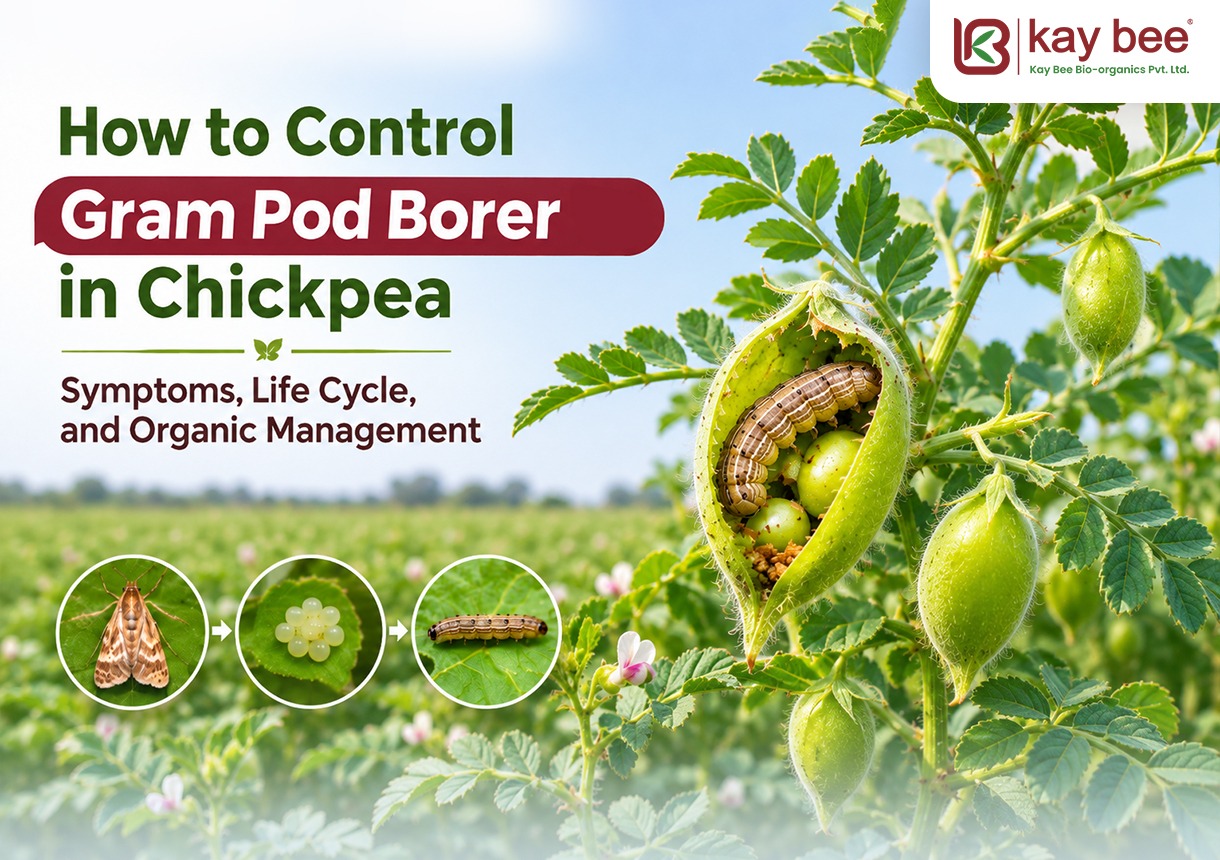
The life cycle of gram pod borer has four stages, and the larval stage is the one that damages the crop.
-
Egg Stage
Adult female moths lay eggs singly on suitable plant parts, including leaves, flower buds, and flowers. The eggs are generally spherical and creamy white in colour.
-
Larval Stage
Young larvae feed on leaves and tender plant parts, while older larvae attack flowers and developing pods. Larvae vary in colour, commonly appearing green, brown, or yellowish, and may have longitudinal stripes.
-
Pupal Stage
Mature larvae usually enter the soil and form brown pupae. The insect develops inside the pupal case before emerging as an adult moth.
-
Adult Stage
The adult is a stout moth, generally pale brownish-yellow to brown. The forewings are greyish to pale brown with characteristic markings, while the hindwings are pale or smoky white with a broad dark outer margin.
Why Gram Pod Borer Control Is Critical During Flowering and Pod Formation
- Larvae feed on flowers and developing pods and reduce grain yield.
- Pod boring allows larvae to consume developing seeds.
- Delayed intervention may permit extensive damage before the infestation is noticed.
- Different larval stages may be present in the field at the same time.
This is why gram pod borer control in chickpea has to be timed to flowering and pod formation.
Management of Gram Pod Borer Using Larvo Raze + OrgaNeem 3000 ppm + Balanstick
An integrated pest-management programme combines crop monitoring, cultural practices, conservation of beneficial insects and appropriate crop-protection interventions. Kay Bee Bio Organics recommends the following botanical product combination for gram pod borer management. The same combination is used for sawfly in mustard, as explained in our guide on mustard crop management.
Larvo Raze
Larvo Raze is a botanical crop-protection product intended for managing target larval insect pests. As a larva insecticide, it fits into insect control for plants within an IPM programme. Because Larvo Raze targets multiple points in the pod borer life cycle, it disrupts the pest at more than one stage:
- Contact, systemic, and fumigant modes of action help the product reach larvae on the plant surface before they enter the stem
- Antifeedant activity, desiccation, and cytolysis give a fast knock-down effect on neonates and early instars
- Stomach poisoning and insect growth regulator (IGR) activity disrupt moulting and pupation in later instars
OrgaNeem 3000 ppm
OrgaNeem 3000 ppm is a neem-based botanical formulation that can be incorporated into an integrated pest management programme for gram pod borer in chickpea. Neem-based solutions help manage insect pests by interfering with feeding and other key biological processes. As a neem pesticide for plants and a natural insecticide for plants, it works best when sprayed at the right crop stage. See our neem based products. For more information on neem-based crop protection, read our guide on best neem-based pesticides for agricultural crops.
Benefits of OrgaNeem
- Helps deter feeding by insect larvae.
- Supports pest management through neem-derived bioactive compounds.
- Interfere with insect growth and development.
- Can help reduce pest pressure when applied at the appropriate crop stage.
Recommended spray combination:
Larvo Raze @ 2 ml/L + OrgaNeem 3000 ppm @ 1 ml/L. For better spray adhesion and leaf coverage, add Balanstick (0.4 ml/l) to the spray mix. This is an organic insecticide for plants option, so follow the product label for dose and interval. Balanstick is a spreader sticker, see our stickers and spreaders and read about common fertiliser and pesticide application mistakes.
Additional Cultural Practices for Gram Pod Borer Management
In addition to botanical crop-protection products, farmers can adopt the following measures to reduce pest pressure.
-
Use Pheromone Traps
Install pheromone traps for Helicoverpa armigera to monitor adult moth activity. A pheromone trap for Helicoverpa shows when moths are active, which helps you time your first spray.
-
Install Bird Perches
Bird perches can encourage insectivorous birds to visit the field and feed on exposed caterpillars.
-
Hand-Pick Larger Larvae
Where practical, collect larger larvae and destroy them safely. This method can supplement other interventions, particularly in smaller fields or localized infestation areas.
-
Biological Pest Control
HaNPV (Helicoverpa armigera nucleopolyhedrovirus) is a biological control option used against gram pod borer larvae. HaNPV for pod borer is a biological insecticide that can be rotated with botanical sprays. Check compatibility before mixing the two in one tank.
Frequently Asked Questions (FAQs)
Q1. What is gram pod borer and why is it harmful to chickpea?
Gram pod borer (Helicoverpa armigera) is a major chickpea pest. Its larvae feed on leaves, flowers and developing pods, which reduces grain yield and quality.
Q2. What are the symptoms of gram pod borer in chickpea?
Look for skeletonised leaves, eaten flowers, circular holes in green pods, damaged or empty pods, and green, brown or yellowish caterpillars on the plant.
Q3. When is gram pod borer control most important?
During flowering and pod formation, when larvae feed on flowers and developing seeds and can cause extensive damage if noticed late.
Q4. How to control gram pod borer organically?
Monitor with pheromone traps, install bird perches, hand-pick larger larvae and use HaNPV. A botanical option is Larvo Raze at 2 ml/L with OrgaNeem 3000 ppm at 1 ml/L, with Balanstick at 0.4 ml/L, as per label.
Q5. Is neem effective against gram pod borer?
Neem-based products help deter feeding and interfere with insect growth. OrgaNeem can be used in an IPM programme at the appropriate crop stage.
Q6. What is the life cycle of gram pod borer?
Eggs are laid singly on leaves, buds and flowers. Larvae feed on leaves, flowers and pods, then pupate in the soil and emerge as adult moths.
Conclusion
Gram pod borer (Helicoverpa armigera) is a major pest of chickpea because its larvae feed on leaves, flowers, and developing pods, directly damaging the grains that determine final yield. For effective gram pod borer control in chickpea during flowering and pod formation, integrating botanical crop protection products like Larvo Raze + OrgaNeem 3000 ppm offers an integrated approach to sustainable pest management. Larvo Raze supports the management of pod borer larvae, while OrgaNeem helps deter feeding and interfere with insect development. Together, they can be incorporated into an IPM programme to help protect flowers and developing pods, reduce crop damage and support healthier chickpea production when used according to approved label directions. Timely chickpea pod borer management at flowering protects both yield and grain quality.
Latest Blogs
 Efficient Nutrient Management: How to Reduce Crop Production Costs
 Irrigation Management for Rabi Crops: How to Save Water and Boost Yield
 Zinc Deficiency in Crops: Importance of Zinc in Wheat, Potato and Other Rabi Crops
 Red Gram Pod Fly Management: Identify Pod Damage and Protect Tur Crop Yield
 Bunch Rot Of Grapes: Symptoms, Causes, Control And Best Effective Treatment Strategies
COPYRIGHT © 2026 - ALL RIGHTS RESERVED. MADE BY WebAppGigs