
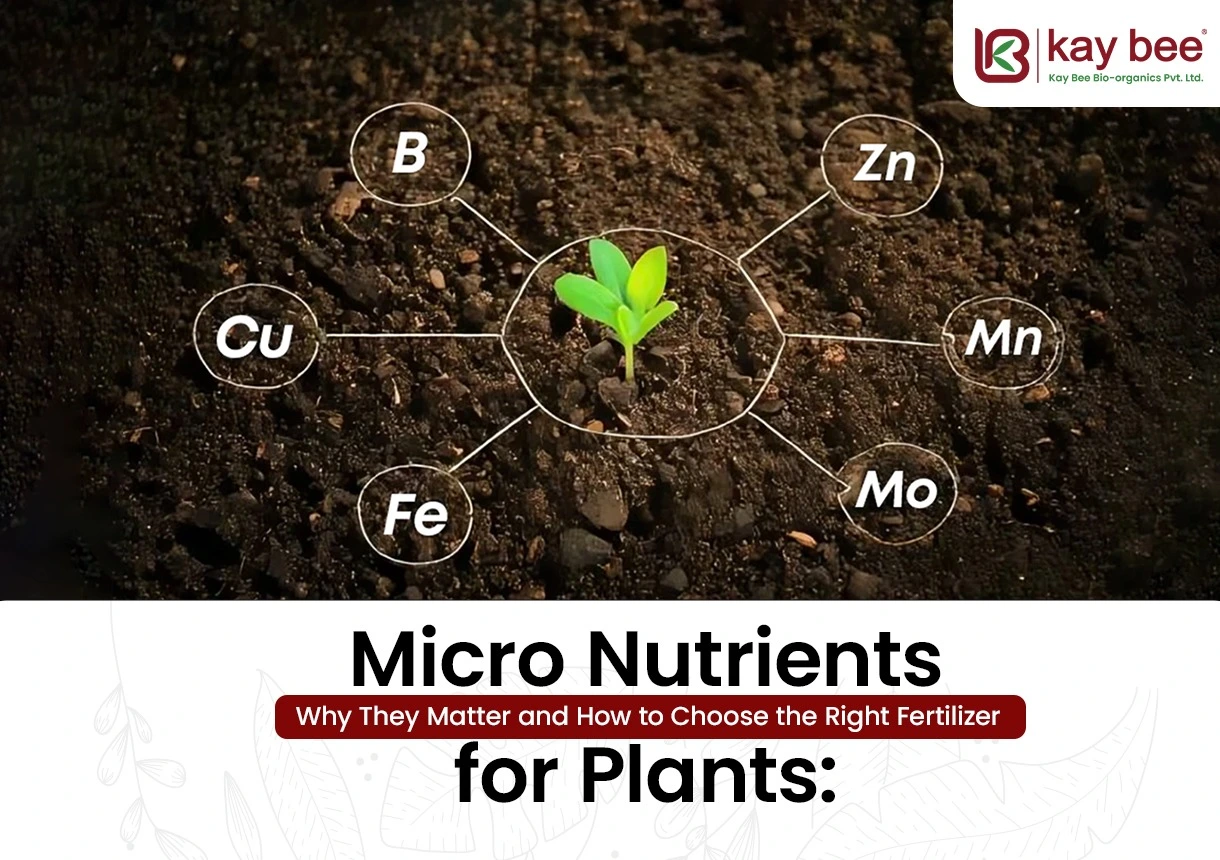
Micronutrients for Plants: Deficiency Signs & Correction
Plants need micronutrients in tiny quantities, but their absence causes damage easily confused with pest attack, viral disease or drought: yellow leaves, short shoots, misshapen fruit, dead growing tips and poor flowering. Most deficiencies follow predictable patterns, respond quickly to targeted correction and can be confirmed with a micronutrient soil test before you spend a rupee on treatment.
At Kay Bee Bio-Organics, we work with farmers growing pomegranates, tomatoes, brinjal and cabbage, and supply NPOP- and NOP-compliant crop nutrition and pest management solutions for sustainable, productive farming.
What Micronutrients Do Inside the Crop
Iron, zinc and manganese: the photosynthesis trio – Iron drives photosynthetic electron transfer and chlorophyll synthesis; without it, leaves lose colour. Zinc activates enzymes for protein synthesis, auxin production and nitrogen metabolism, controlling growth and shoot architecture. Manganese powers Photosystem II; without it, energy production and growth stall.
Boron, copper and molybdenum: the flowering and fruiting team – Boron cross-links pectin in cell walls and is essential for pollen and seed formation. Copper drives respiration, lignin formation and antioxidant defence, keeping stems strong. Molybdenum enables nitrate reductase to convert nitrate into usable ammonium. Shortages hit flowering, fruit set and pod fill first.
Chlorine and nickel: the overlooked two – Chlorine supports Photosystem II and regulates stomata, aiding water-use efficiency in hot summers. Nickel activates urease, converting urea into ammonium. Calcareous or leached soils in high-input vegetable regions can run short of both.
Reading Deficiency Signals Before They Cost Yield
Pomegranate and tomato – Pomegranate iron deficiency shows sharp interveinal yellowing on young leaves while old leaves stay green; zinc deficiency causes small, narrow leaves, short internodes and rosetting, reducing fruit set. Tomato boron shortage causes cupped young leaves, cracked stems and poor fruit set, often mistaken for a virus. Manganese deficiency shows soft, mottled yellowing on recently expanded leaves.
Brinjal and cabbage – Boron-deficient brinjal shows pale growing tips, thick brittle leaves and flower drop; test before correcting. Molybdenum deficiency in cabbage and cauliflower causes “whiptail,” leaving only the midrib. Copper deficiency in brassicas causes wilting, twisted young leaves despite adequate moisture.
Quick field separation guide – Symptoms overlap with drought, root damage and viruses, so test before correcting to avoid lost time and cost.
- Green veins on yellow new leaves: iron
- Mottled interveinal yellowing: manganese
- Small leaves, short internodes: zinc
- Dead growing point, brittle young tissue: boron
- Nitrogen-like yellowing with brassica whiptail: molybdenum
Why Nutrients in Soil May Be Unavailable
The pH lock – Soil pH is the biggest controller of micronutrient availability. Above pH 7.5, common in black cotton and calcareous Indo-Gangetic soils, iron, zinc, manganese and copper become unabsorbable. Calcium carbonate converts iron to insoluble ferric oxides and zinc to sparingly soluble hydroxide and carbonate, so a soil test may show adequate total content but low available supply. Molybdenum becomes more available as pH rises.
Organic matter – Organic matter forms soluble complexes that keep these nutrients available, especially in alkaline soils. Low-organic-matter vegetable soils are doubly at risk. Composted FYM or seaweed-based granules improve both supply and mobility.
Fix the bottleneck first – Apply elemental sulphur as per soil test to gradually lower high pH (slower in heavy or calcareous soils). In acidic soils with manganese or iron toxicity risk, apply lime carefully and retest. Chelated micronutrients on pH-locked soil give only partial, temporary relief.
Foliar vs. Soil Application: Route and Dosage
Foliar for faster results – Foliar micronutrients bypass soil chemistry, ideal during active growth, flowering or fruit fill. Spray in cool mornings with clean water and jar-test compatibility before mixing with pesticides or calcium products.
Dosage ranges – Chelated multi-micronutrient (Zn, Fe, Mn, Cu, B): 1–3 g per litre foliar, 2–3 sprays 10–15 days apart; soil or fertigation 1–2 kg per acre, split between establishment and pre-flowering. Chelated zinc alone: 0.5–1.5 g/L. Excess boron and copper injure crops, so start low and check recovery before repeating, especially on seedlings and tender vegetables.
Organic programme compatibility – Chelated sprays generally mix with botanical biopesticides and neem products after a jar test. Avoid phosphate-rich or alkaline materials. Without compatibility data, spray 24–48 hours apart.
Confirm With Soil and Tissue Tests
Sampling – Collect soil samples in a zigzag pattern at 0–20 cm from the affected zone and a healthy area of the same crop and variety. Take tissue from the youngest fully developed leaf, avoiding sprayed, dusty or diseased tissue that falsely raises iron and boron readings. Send matched “problem” and “healthy” samples together.
Reading results – Compare with crop- and stage-specific critical ranges. Confirmed deficiency needs low soil supply, low tissue levels and matching symptoms. If soil is adequate but tissue low, check pH, waterlogging, salinity or root damage before adding fertiliser. A treated test strip beside an untreated one gives strong confirmation. Retest perennial crops and problem fields each season.
Compliant Products and Tracking Progress
Kay Bee Bio-Organics range – Synthetic chelates aren’t automatically NPOP/NOP compliant. Our Nutrix and Silixil are NPOP/NOP-compliant formulations for common trace-element gaps, while Calboost supports calcium mobility, fruit quality and cell-wall strength in tomato and pomegranate.
Pairing with biostimulants – Strong roots speed correction. Our slow-release seaweed-based granules provide sustained nutrient delivery, and MYCORIS and MYCORIS PREMIUM mycorrhizal inoculants extend root absorption, possibly helping phosphorus and zinc uptake in high-pH soils (confirm with local trials). Together they form a complementary programme, not isolated fixes.
Monitoring protocol – Mark two to three plants per section and photograph new growth every 10–14 days. Normal leaf colour and internode length signal recovery. If symptoms persist after two foliar sprays, tissue-test before a third; it usually indicates pH or root uptake problems. Contact our free agri advisory team for a crop-specific programme or trial availability.
Getting Micronutrient Diagnosis Right Saves Seasons
Micronutrient deficiencies are among the most under-diagnosed causes of yield loss in Indian crops, returning every season because growers treat symptoms, not causes. Extra NPK does little without micronutrients to process it, so costs rise while yield stays flat. Zinc-poor soil also produces zinc-poor crops, while balanced micronutrition improves fruit colour, texture and shelf life.
Diagnose properly, check pH, then choose foliar or soil application by crop stage and urgency. Nutrix, Silixil and Calboost help certified organic farmers close gaps without compromising certification. With correct treatment and monitoring, most recurring deficiencies become manageable within a few seasons.
Frequently Asked Questions
Q1. What are plant micronutrients and why are they important?
Ans: Iron, zinc, manganese, boron, copper, molybdenum, chlorine and nickel, needed in small amounts but directly affecting yield and quality.
Q2. How can I tell a deficiency from a pest or disease?
Ans: Green veins on yellow leaves suggest iron, short internodes zinc, dead growing points boron. Confirm with soil and tissue tests.
Q3. Why does deficiency appear when soil has enough nutrients?
Ans: Above pH 7.5, Fe, Zn, Mn and Cu become unavailable; low organic matter worsens this.
Q4. Foliar or soil application?
Ans: Foliar works faster during growth, flowering or fruit fill; soil suits long-term correction. Fix locked pH first.
Q5. What is the recommended dosage?
Ans: Chelated mix: 1–3 g/L foliar or 1–2 kg/acre soil; chelated zinc: 0.5–1.5 g/L. Start low with boron, copper and tender crops.
Q6. How do I sample correctly?
Ans: Zigzag soil sampling at 0–20 cm, youngest fully developed leaf tissue and a healthy-area comparison.
Q7. Can sprays be mixed with biopesticides?
Ans: Usually with neem and botanical products after a jar test; otherwise spray 24–48 hours apart.
Q8. Which products suit NPOP and NOP farming?
Ans: Nutrix and Silixil, with Calboost for calcium and cell-wall strength.
Q9. How long does recovery take?
Ans: Check new growth every 10–14 days; persistent symptoms after two sprays need a tissue test.
Q10. Can biostimulants help uptake?
Ans: Yes. Seaweed-based granules and MYCORIS inoculants support roots and nutrient delivery.
Latest Blogs
 Zinc Deficiency in Crops: Importance of Zinc in Wheat, Potato and Other Rabi Crops
 Red Gram Pod Fly Management: Identify Pod Damage and Protect Tur Crop Yield
 Bunch Rot Of Grapes: Symptoms, Causes, Control And Best Effective Treatment Strategies
 Discovering the Different Types of Soil: Characteristics, Uses and Soil Improvement
 Advancing Agronomic Resilience: A Scientific Analysis of Crop Rotation and Bio-Input Synergies in Indian Agriculture
COPYRIGHT © 2026 - ALL RIGHTS RESERVED. MADE BY WebAppGigs