
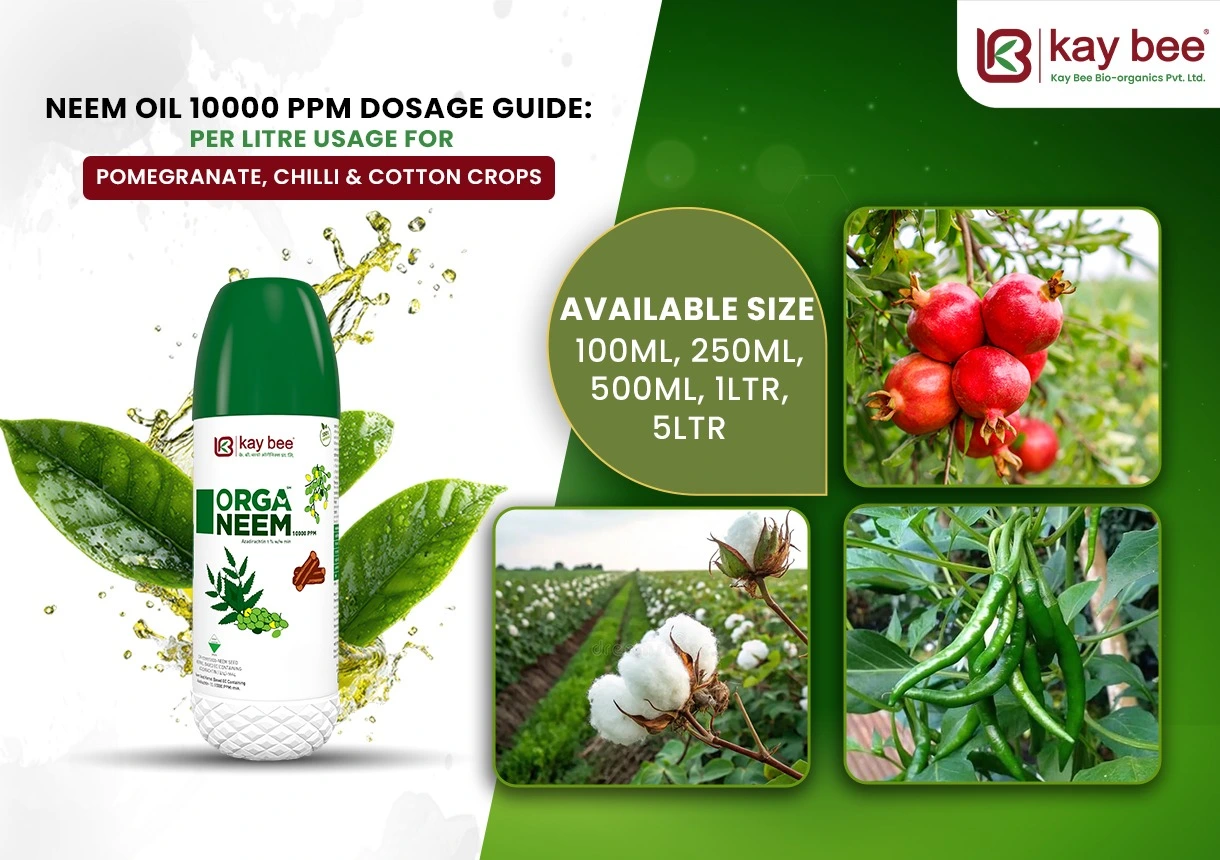
Neem Oil 10000 PPM Dosage Guide: Per Litre Usage for Pomegranate, Chilli & Cotton Crops
Introduction
Pomegranate, chilli, and cotton are high-value crops that provide significant income to farmers and meet strong market demand. However, these crops are highly susceptible to insect pests and diseases that can severely reduce both yield and quality.
Pomegranate is commonly damaged by oily spot, wilt, thrips, and aphids. Chilli crops frequently suffer from thrips, mites, fruit borers, and fungal infections, while cotton crops are often attacked by the bollworm complex and leaf diseases.
Neem Oil 10000 PPM plays an important role in protecting these crops through natural means. It helps control insect feeding, egg laying, and pest development, thereby reducing crop damage. It also supports better plant health by limiting the spread of certain fungal diseases. Since neem oil is biodegradable and leaves minimal residue, it is considered a safer option for crops, beneficial insects, and the overall environment.
Today, farmers increasingly seek organic products with low input costs and effective protection against pests and diseases. Neem oil is a practical and preferred solution for these needs. It is extracted from the neem tree, Azadirachta indica Juss., which belongs to the Meliaceae family and is widely known as the “Life-Giving Tree” or “Village Pharmacy”.
Neem Oil 10000 PPM, a high-concentration formulation, is widely used by farmers growing pomegranate, chilli, and cotton. Applying the correct dosage is critical to achieving the best results , a concentration lower than recommended may not control pests adequately, while a concentration higher than recommended may cause leaf burn or result in wastage of resources.
Many farmers choose neem oil because it is eco-friendly, safe for beneficial insects and soil microbes, and compatible with organic farming practices. The Government of India supports organic farming through several schemes:
- Paramparagat Krishi Vikas Yojana (PKVY)
- National Mission for Sustainable Agriculture (NMSA)
- Soil Health Card Scheme (SHC)
- Rashtriya Krishi Vikas Yojana (RKVY)
These programs encourage farmers to adopt bio-insecticides and bio-fungicides, reduce input costs, and promote organic farming through the use of neem-based products.
What Does 10000 PPM Mean?
PPM (Parts Per Million) is a unit of concentration commonly used to express the strength of active ingredients in a formulation. A higher PPM value indicates a stronger concentration of the active ingredient, which means effective pest control can be achieved at a lower application dose.
How Organeem 10000 PPM Works
Organeem 10000 PPM contains more than 100 organic compounds. The most important ones include azadirachtin, limonoids, nimbidin, nimbin, nimbolides, nimbinin, salannin, and fatty acids (oleic, stearic, and palmitic). These compounds are primarily responsible for controlling insects, fungi, bacteria, and viruses.
Key Active Mechanisms
Anti-Moulting Hormone (Anti-MH) Activity:
Neem Oil 10000 PPM prevents insects from shedding their skin (moulting) and stops them from progressing to the next developmental stage.
Anti-Juvenile Hormone (Anti-JH) Activity:
It suppresses the release of Juvenile Hormone (JH), which prevents female insects from laying eggs, thereby reducing pest populations.
Anti-Fungal Activity:
The 10000 PPM concentration creates a coating around fungal cells, cutting off their access to oxygen and nutrients. It also prevents spore germination and blocks the production of harmful toxins such as polyketides and aflatoxins.
Anti-Bacterial Activity:
At high concentrations, the fatty acids and limonoids in neem oil penetrate bacterial cell membranes, disrupting their function and inhibiting growth.
Anti-Viral Activity:
Many viruses are transmitted by sucking pests. The high concentration of neem oil acts as a strong antifeedant, discouraging pest feeding and thereby reducing virus transmission.
View Product Details – ORGANEEM 10000 PPM
Major Pests and Diseases by Crop
| Sr. No. | Disease | Insect Pest |
| Pomegranate | ||
| 1 | Bacterial Leaf Blight | Aphid |
| 2 | Fruit Spot | Thrips |
| 3 | Fusarium Wilt | Whiteflies |
| Chilli | ||
| 1 | Powdery Mildew | Aphids |
| 2 | Damping Off | Fruit Borer |
| 3 | Fruit Rot & Die-Back | Mites |
| Cotton | ||
| 1 | Bacterial Leaf Spot | Pink Bollworm |
| 2 | Anthracnose | American Bollworm |
| 3 | Leaf Spot | Spotted Bollworm |
| 4 | Leaf Curl Virus | Mealybug |
Recommended Dosage
| Crop | Dose | Spray Interval |
| Pomegranate | 2–3 ml per litre | 10–12 days |
| Chilli | 2 ml per litre | 7–10 days |
| Cotton | 2.5–3 ml per litre | 10–12 days |
Combination Use: When mixing with any pesticide, add 0.5 ml of Organeem per litre of water.
Why Should Farmers Use Organeem 10000 PPM?
- Controls a wide range of pests including aphids, whiteflies, thrips, jassids, mealybugs, mites, bollworms, caterpillars, and fruit borers.
- Acts as a powerful antifeedant, insects stop feeding on crops soon after application, reducing crop damage quickly.
- Effective across all stages of the insect life cycle: egg, larva, pupa, and adult, providing comprehensive pest control.
- Reduces pest reproduction by disrupting egg laying, egg hatching, and insect growth.
- Does not cause resistance in pest populations due to its multi-compound mode of action, unlike synthetic chemical pesticides.
- Suitable for organic farming and Integrated Pest Management (IPM) programs as it is plant-based and eco-friendly.
- Safe for beneficial insects such as honeybees, predatory insects, and parasites when used at the recommended dose.
- Leaves no harmful residues on crops, making produce safer and more acceptable for domestic and export markets.
- Improves crop health and yield by protecting plants from repeated pest attacks.
- Applicable to a wide variety of crops including cotton, chilli, onion, tomato, brinjal, pomegranate, fruits, vegetables, pulses, and oilseeds.
- Can be used alongside chemical insecticides and fungicides to enhance overall pest management while reducing reliance on heavy chemical inputs.
Key Benefits of Organeem 10000 PPM
- Acts as a natural insect repellent and feeding inhibitor.
- Does not lead to resistance development in insects or diseases, unlike chemical pesticides.
- Leaves no harmful residues on crops, ensuring produce safety.
- Prevents fungal spore germination and stops secondary infections from spreading.
- Provides broad-spectrum pest control and delivers a phyto-tonic (plant-strengthening) effect.
Conclusion
Organeem 10000 PPM is an organic and eco-friendly solution for managing pests and diseases in important crops such as pomegranate, chilli, and cotton. Its high concentration of active compounds enables effective control of insects at multiple life stages, reduces feeding and egg laying, and provides protection against fungal, bacterial, and viral threats.
When applied at the recommended dose, it can improve crop health, reduce crop losses, and enhance yield quality. Since it is biodegradable, residue-free, and safe for beneficial insects and the environment, it is an ideal choice for organic farming and integrated pest management.
Farmers can also combine it with chemical pesticides and fungicides to improve overall effectiveness while minimising excessive chemical use, making Organeem 10000 PPM a smart, sustainable investment for modern agriculture.
Latest Blogs
 Leaf Curl Virus (LCV): Symptoms, Spread & best viricide for chilli
 Healthy Roots, Wealthy Farmers: A Guide to Managing Soil-Borne Wilt and Nematodes
 Why MICRO Nutrients Create MACRO Changes in Your Harvest : The invisible elements your crop cannot grow without
 Enhancing Fruit Size in Watermelon and Muskmelon with Gibberellic Acid
 Downy Mildew in Cucumber: Disease Cycle, Economic Impact & Effective Control
COPYRIGHT © 2026 - ALL RIGHTS RESERVED. MADE BY WebAppGigs