

Downy Mildew in Cucumber: Disease Cycle, Economic Impact & Effective Control
Introduction
Nowadays a major concern of farmers is to control a downy mildew disease. It is the most challenging and destructive disease that infects the cucurbit family. Sometimes well-known cucurbit fungicides also could not control a disease. In that cucumber is an important vegetable because it gives more profit in less time. It grows intercropped with the main crop and starts to give yield within 40-60 days after sowing. Cucumbers have several health benefits and industrial value; that’s why there’s high demand for export. The cucumber crop is affected by several diseases, but cucumber downy mildew is the most challenging disease to control, even with cucurbit fungicides. It spread rapidly, and reduced quality of cucumber leads to yield losses and becomes unprofitable to farmers. Delayed identification of the disease leads to complete damage to the crop and accelerates its spread. Hence, it is essential to increase farmer awareness, ensure early detection, and implement integrated cucumber crop protection approaches to control cucumber downy mildew effectively and maintain sustainable cucumber production.
Causes of Downy Mildew of Cucumber
The main cause of cucumber downy mildew disease is Pseudopernospora cubensis caused by an obligate parasitic organism that requires a living host for development. It contains motile zoospores, which are responsible for causing a disease. These organisms are fungus-like but differ from true fungi in their biology and life cycle and another is an environmental factor. In environmental factors, moderate temperature (10-20°C), humidity (85-90%), prolonged leaf wetness, cloudy weather are ideal conditions for the cause and development of disease. Wind flow plays a major role in transferring Pseudopernospora spores and mycelium from an infected farm to a healthy farm.
Economic Impact:
Cucumber downy mildew can cause complete crop failure under favorable environmental conditions; commonly it causes 60% yield losses, but in severe conditions it causes 100% yield losses. The quality of cucumbers is reduced by the attack of downy mildew, so cucumber crop protection practices need to be applied for Pseudoperonospora control, which produces yellow angular spots on leaves. These spots enlarge and merge and produce a scorching appearance, so it leads to reduced photosynthetic ability of the plant, affecting the development of the plant; fruit develops poorly and small in size, so it becomes unacceptable to consumers and declines in market quality. Also, farmers face an increase in cucumber production and protection costs. Repeated monitoring, downy mildew fungicide sprays, and management practices are required to control the cucumber downy mildew disease; by giving these efforts complete control over Pseudoperonospora, it is difficult. In addition, the disease affects export quality, as quality standards in international markets are strict. Infected or low-quality produce may be rejected, leading to further economic losses. Cucumber is more profitable if cucurbit disease management practices are applied well; otherwise, it cause major loss
Symptoms of Downy mildew on Cucumber
- Plant show yellow angular spots on leaves on upper surface of leaves and restricted by veins
- Cottony grey to purple colour fungus growth visible on lower surface of leaves.
- Spots enlarge an d merge with other spot form and form a patch which give scorching appearance.
- In severe condition leaves start to fall.
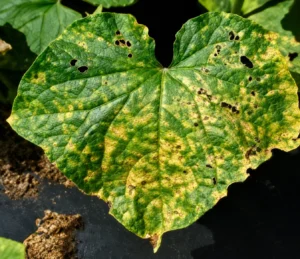 |
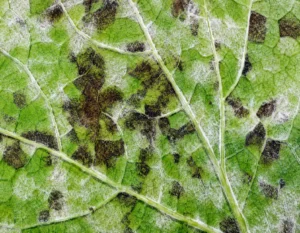 |
Disease Cycle
- Yellow angular spots on leaf
- Sporulation produces fuzzy grey to purple or blackish purple colour growth on back side of leave
- In favourable climatic condition wind flow carry Pseudoperonospora sporangium from infected to healthy plant or remain in plant debris.
- Water present on leaf surface rupture sporangium and release motile zoospore
- With 4-12 days hyphae grow intercellularly and show leaf spot symptoms.
- Spore enlarges and affects the photosynthesis of plant.
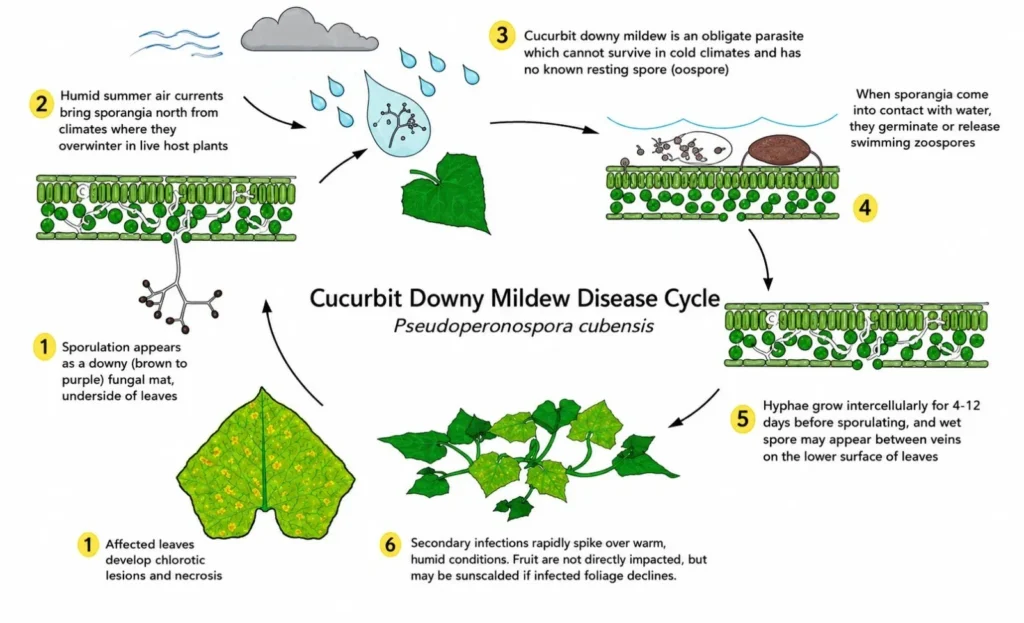
Monitoring of Downy Mildew
- Regular monitoring of cucumber downy mildew is essential for early detection and timely management. It rapidly spread and become difficult to control even by a chemical fungicide.
- Inspect a crop 2-3 times per week during cloudy weather, low temperature and high humidity.
- Inspect a especially yellow angular spots and purple cottony growth on back side of leaf during a morning time because moisture and humidity are higher, making early signs easier to observe
- Focus on older leaves first and check both upper and lower surfaces for any early changes.
- Check surrounding cucumber or other cucurbit crops, as the disease can spread quickly between fields through wind.
- Apply cucurbit disease management practise
View Products: Downy Raze
Effective Control
Crop rotation
Avoid continuous cultivation of cucurbits in the same field. Rotate with non-cucurbit crops like legumes or cereals for 1–2 seasons to reduce disease carryover which help to protect a cucumber crop in next season.
Field sanitation
regularly remove and destroy infected plant parts, including fallen leaves, affected fruits, and other debris. Also, clean tools and equipment to minimize the spread.
Proper spacing and field layout
Ensure proper air movement in the field by maintaining spacing between plants and trimming excess foliage. This improves sunlight penetration and helps leaves dry faster.
Timely sowing
Adjust planting time to avoid peak periods of cool and humid conditions that favour disease development.
Use of resistant varieties
Grow tolerant or resistant variety whenever available, as this is one of the most effective and economical control methods.
Irrigation Management
Avoid using overhead irrigation methods, as they keep the leaves wet and favor disease development. Instead, apply water directly to the soil using drip systems to keep the foliage dry.
Fungicidal Management
When the situation becomes more severe and cumber crop protection practices are not enough to Pseudoperonospora control which responsible for causing cucumber downy mildew. Here additional support is needed. At this stage Downy Raze used as effective downy mildew fungicide to control a disease. Downy Raze is a botanical-based solution but act as supportive partners in maintaining cucumber crop protection. There is several downy mildew special fungicide present in market but they are not 100% organic like a Downy Raze fungicide and also show residues on cucurbits.
Downy Raze works through both contact and systemic action, providing thorough and reliable disease control. It gives long-lasting protection against downy mildew problems while also helping to reduce spore levels and offering curative effects. In addition, its application promotes a phytotonic effect, supporting stronger plant growth
It prevents Pseudopernospora spores from attaching and germinating, thereby stopping further development. It also inhibits the growth of fungal structures and acts as an antisporulant, reducing spread. By blocking the entry of the fungus into plant tissues, it helps prevent infection and shows strong curative action against downy mildew diseases.
Dose: 2.5 ml per litre of water, On preventive basis spray at 10–15 days interval. However, in case of severe infestation, the spray should be repeated more frequently, at intervals of 5–6 days.
Conclusion
Downy mildew of cucumber is a serious disease that requires careful attention through regular monitoring early identification of yellow angular spots, and timely apply crop protection practises. Continuous field monitoring helps in detecting the disease at an early stage, allowing farmers to take action before it spreads widely and get difficult to Pseudoperonosporacontrol which economically burden to farmer. Major factor responsible for causing disease is zoospore and environmental factor. Effective management includes integrated approaches such as cultural practices, improved field sanitation, and timely application of suitable plant protection measures. Products like Kay bee Bio’s Downy Raze is known as a cucurbit fungicide or downy mildew fungicide can plays an major role in controlling the disease by inhibiting its spore development and germination and maintain a export quality of cucumber.
Latest Blogs
 Brown Plant Hopper Paddy Organic Control with Pesto Raze & Mealy Raze
 Mycorrhiza Technical Manufacturer in India | Kay Bee Bio-Organics Pvt. Ltd.
 Cotton Whitefly Management During Square Formation Stage: Effective Control with Pesto Raze & OrgaNeem
 Calcium for Cabbage Head Formation: How Calboost (Ca-11%) Ensures Tight & Crack-Free Heads
 Citrus Canker Organic Control: A Complete Farmer’s Guide
COPYRIGHT © 2026 - ALL RIGHTS RESERVED. MADE BY WebAppGigs