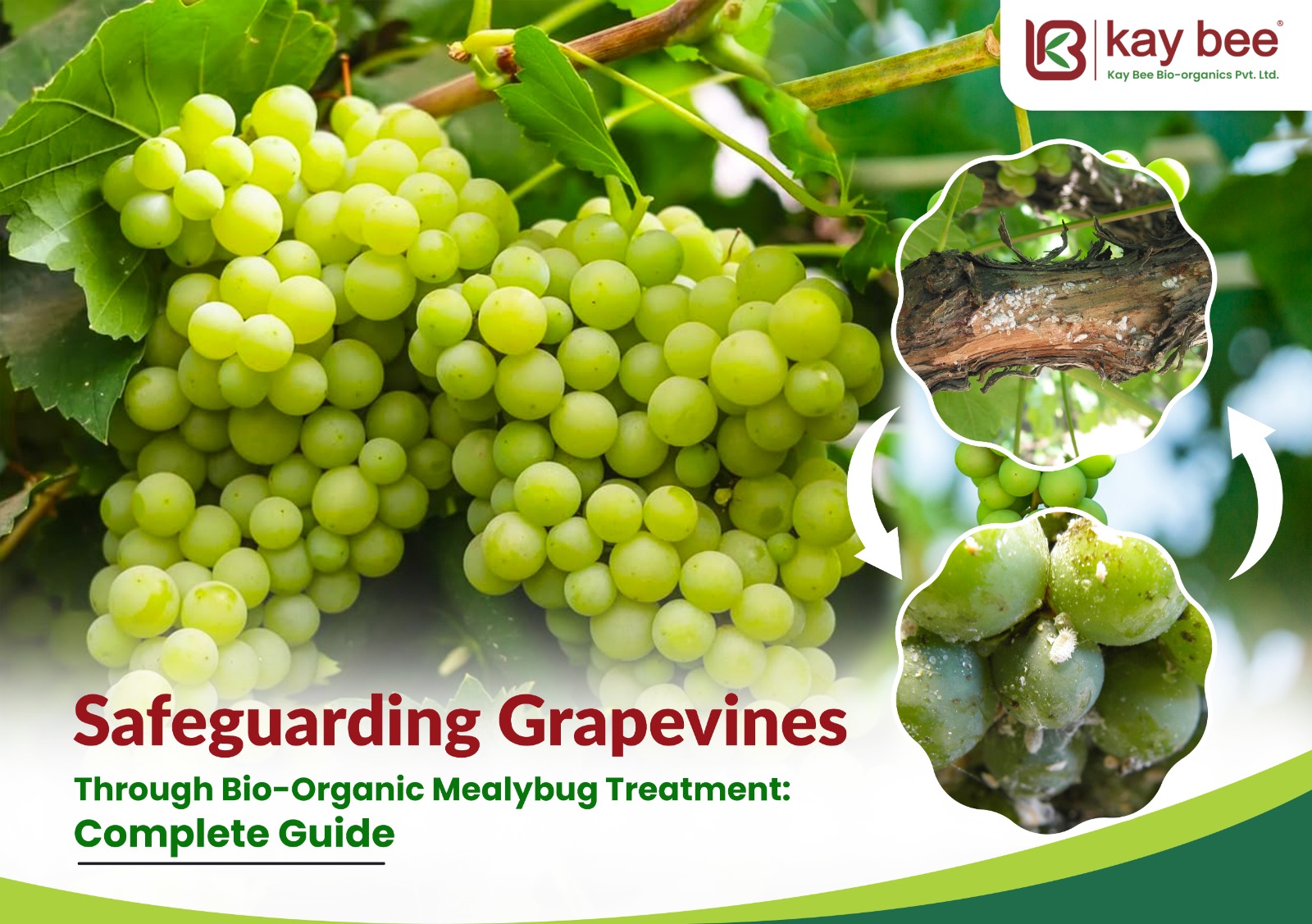
Safeguarding Grapevines Through Bio-Organic Mealybug Treatment, Control And Best Insecticides
Introduction: The Vineyard’s Most Destructive Threat
For grape growers across Maharashtra and South India, the annual production period from October pruning to March harvesting (2026–2027 season) decides financial success. Grapes are one of the India’s high-value and delicate horticultural crop requires very planned management. As successful vineyard growers are known about multiple pest challenges, the grapevine mealybug (Pseudococcus maritimus) remains the most destructive and stubborn pest.
Post-monsoon humidity combined with rising temperatures makes ideal conditions for mealybug populations to increase. Initially they choose their campsite beneath loose vine bark, then gradually migrate to young shoots, leaves, and ultimately hide deep within berry clusters.
If this pest left without any timely intervention using scientifically backed biological technology, a mealybug infestation can reduce fruit quality, cause yield loss up to 50% and 80%. In this article we will explore exact biology of mealybug, how this pest make symbiotic relationship with ants, why synthetic chemicals cause limitations to control pest over time, and how Kay Bee Bio’s Mealy Raze, a botanical extract based formulation specially created to provide a residue-free solution to control mealybug preventively also curatively.
- What Are Mealybugs and How Do They Damage Grapevines?
Mealybugs are tiny, soft insects that suck sap from grapevines. They feed on the trunk, canes, leaves and even the young grapes.
How they damage a vineyard:
- Weak vines: When mealybugs keep drinking the sap, the vine loses its nutrients. Leaves turn yellow, and the vine grows weak and thin.
- Sticky honeydew: They leave behind a sweet, sticky liquid on the leaves and grape bunches.
- Black sooty mould: This honeydew invites a black mould to grow. It covers the bunches, spoils the berries, and the grapes lose their market value completely.
- Export rejections: Countries in the European Union and the Gulf have zero tolerance. Even a visible mealybug or a patch of mould can get the whole shipment rejected.
- The Mealybug Life Cycle and Hideouts
To achieve complete control, we must understand the developmental stages of the mealybug and target their application accordingly:
- Ovisac / Egg Stage
- Nymph / Crawler Stage (Most vulnerable stage; ideal for spraying)
- Adult Waxy Coating (Thick waxy shield; repels synthetic chemicals)
- Egg / Ovisac Stage: Adult females deposit cottony egg sacs containing 300 to 600 eggs beneath loose trunk bark or near the root crown.
- Crawler Stage (First Instar): Newly hatched nymphs are pinkish-orange, highly mobile, and temporarily lack a thick waxy coating. Crawlers migrate rapidly upward towards new shoot flushes and cluster stems. This is the most vulnerable stage for treatment.
- Adult Stage: As nymphs mature, adult females develop a thick, hydrophobic, white waxy coating (epicuticular wax) that shelters them from environmental stress and water-based chemical contact.
- The Symbiotic Relationship Between Ants and Mealybugs
Mealybugs rarely spread on their own. Field ants (Technomyrmex and Anoplolepis species) help them, and both sides gain from it:
- What ants get: They love the sweet honeydew that mealybugs leave behind, and they feed on it eagerly.
- What mealybugs get: The ants guard them from natural enemies like ladybird beetles and lacewing larvae. They also carry the slow-moving baby mealybugs (crawlers) from one vine to the next, which spreads the infestation faster.
- Why Do Synthetic Chemical Insecticides Fail?
Growers often give repeated spray of heavy synthetic chemical insecticides when mealybug infestation increases. However, chemical control frequently fails due to three key factors:
- The Hydrophobic Waxy Shield: The adult mealybug’s dense waxy layer repels water-based synthetic sprays. The chemical liquid slides off without achieving lethal epicuticular contact.
- Rapid Insect Resistance: Repeated sprays using identical chemical classes select for resistant pest populations, rendering future applications ineffective.
- MRL and Chemical Residue Violations: Applying synthetic chemicals close to harvest leaves toxic chemical residues on grape berries, triggering export bans under APEDA and international Maximum Residue Limit (MRL) frameworks.
- Kay Bee Bio’s Botanical Innovation: Mealy Raze
Recognising the severe limitations of chemical insecticides worldwide, Kay Bee Bio Organics engineered Mealy Raze, an advanced botanical-based bio-insecticide formulated using standardized plant extracts using marker compound technology.
Rather than relying on synthetic chemical toxins, Mealy Raze acts directly on the physical structure of the pest.
Detailed Mode of Action of Mealy Raze:
- Melts the wax coat: The plant-based active compounds quickly dissolve the white waxy layer that protects the mealybug.
- Dries out and bursts the pest: Once the wax shield is gone, the mealybug loses its body fluids fast and its cells break open. It is knocked out quickly.
- Kills eggs and crawlers: It dries out the egg sacs and also wipes out the moving baby mealybugs hiding inside the clusters.
- Good for the plant: Since it is fully plant-based, it does not burn the leaves or stain the fruit. It also helps the plant build its own defence and keeps the leaves healthy.
- No chemical residue: Made from pure plant extracts, Mealy Raze is 100% bio-organic. You can spray it up to 15 days before harvest and still stay within MRL limits.
- 2026 – 2027 APEDA Compliance & Integrated Pest Management (IPM)
Under updated APEDA GrapeNet advisories for the 2026 – 2027 season, residue monitoring for international table grape exports has tightened. Vineyard operators should execute Integrated Pest Management (IPM) program:
Step 1: Sanitation & Cultural Control
- Immediately after October pruning, manually scrape loose outer bark from vine trunks to expose hidden mealybug egg sacs.
- Keep vineyard floors weed-free, as weeds serve as secondary host plants for crawlers.
Step 2: Ant Control Strategy
- Apply sticky physical barriers around trunk bases to block ant movement. Eliminating ant transportation reduces mealybug spread across the canopy by up to 80%.
Step 3: Application of Mealy Raze
- Dosage: 2 ml per litre of water
- High-Pressure Spraying: Use high-pressure spray equipment targeting vine bark, canopy undersides, and berry clusters to ensure overall physical coverage.
- Timing: Apply during early morning or late evening hours
- Frequency: For active infestations, apply 2 to 3 consecutive sprays spaced 7 to 8 days interval.
Note: It is not compatible with Sulphur, copper-based fungicides, or Bordeaux mixtures.
-
Synthetic Chemical Pesticides vs. Kay Bee Bio Mealy Raze
| Parameter | Synthetic Chemical Pesticides | Kay Bee Bio Mealy Raze |
|---|---|---|
| Action on Waxy Shield | Repelled by epicuticular wax; poor contact | Rapidly dissolves waxy layer to destroy pest physically |
| Pest Resistance | High risk; mealybugs adapt rapidly | Zero risk; complex natural compounds prevent resistance |
| MRL & Residue Risk | Leaves chemical residues; risks export bans | 0% toxic chemical residues; 100% APEDA & MRL safe |
| Phytotoxicity Risk | High risk of berry staining or leaf scorch | Non-phytotoxic; provides a beneficial phytotonic effect |
| Environmental Safety | Harmful to non-target pollinators & soil life | 100% eco-friendly and safe for beneficial predators |
-
Frequently Asked Questions (FAQ)
Q1. What is the most effective bio-insecticide for mealybug control in grapes?
A: Kay Bee Bio’s Mealy Raze is the premier botanical bio-insecticide for grapevine mealybugs. Its specialized plant-derived marker compounds rapidly dissolve the insect’s protective waxy coating, providing effective physical elimination without chemical residues.
Q2. Is Mealy Raze safe to use in export-grade table grape production?
A: Yes. Mealy Raze is 100% bio-organic and residue-free. It complies with APEDA GrapeNet guidelines and international MRL regulations, making it safe for application during berry development.
Q3. What spraying precautions should be taken when applying Mealy Raze?
A: Use high-pressure spray equipment to ensure penetration into bark crevices and dense berry clusters. Always spray during early morning or late evening hours, and avoid tank-mixing with sulphur or copper-based fungicides.
Q4. How do field ants impact mealybug infestations in vineyards?
A: Ants feed on sweet honeydew excreted by mealybugs. In exchange, ants protect mealybugs from natural insect predators and transport crawlers across the canopy, accelerating the infestation.
Q5. Can Mealy Raze be tank-mixed with sulphur or Bordeaux mixture?
A: No. Mealy Raze is a pure botanical formulation and is incompatible with sulphur, copper-based fungicides, and Bordeaux mixtures. Apply it independently or with compatible bio-inputs.
-
Conclusion
Managing grapevine mealybugs requires a proactive, residue-free approach rather than reactive chemical sprays. By combining vineyard sanitation, ant barriers, and Kay Bee Bio’s Mealy Raze, table grape growers can achieve effective mealybug control while ensuring 100% compliance with international export standards.
(To learn more about sustainable crop protection and soil health, read our detailed article on Why India Needs Biopesticides in Agriculture.)
Academic & Scientific References
- ICAR – National Research Centre for Grapes (NRCG, Pune): NRCG Grape Pest Management Advisory and Guidelines
- APEDA Export Standards & GrapeNet Regulations: APEDA Official Grape Export Standards & MRL Limits
- CIB&RC Registered Bio-Pesticides Directory (Govt. of India): Central Insecticides Board & Registration Committee
- Food and Agriculture Organization (FAO): FAO Viticulture and Pest Management Systems
Latest Blogs
 Discovering the Different Types of Soil: Characteristics, Uses and Soil Improvement
 Advancing Agronomic Resilience: A Scientific Analysis of Crop Rotation and Bio-Input Synergies in Indian Agriculture
 Biopesticides in India: Why Indian Agriculture Urgently Needs Sustainable Solutions
 Intercropping in Indian Farming: Benefits, High-Yield Examples, and Bio-Input Strategies
 Why Bio Pesticides Are the Best Step Forward in Sustainable Agriculture
COPYRIGHT © 2026 - ALL RIGHTS RESERVED. MADE BY WebAppGigs