
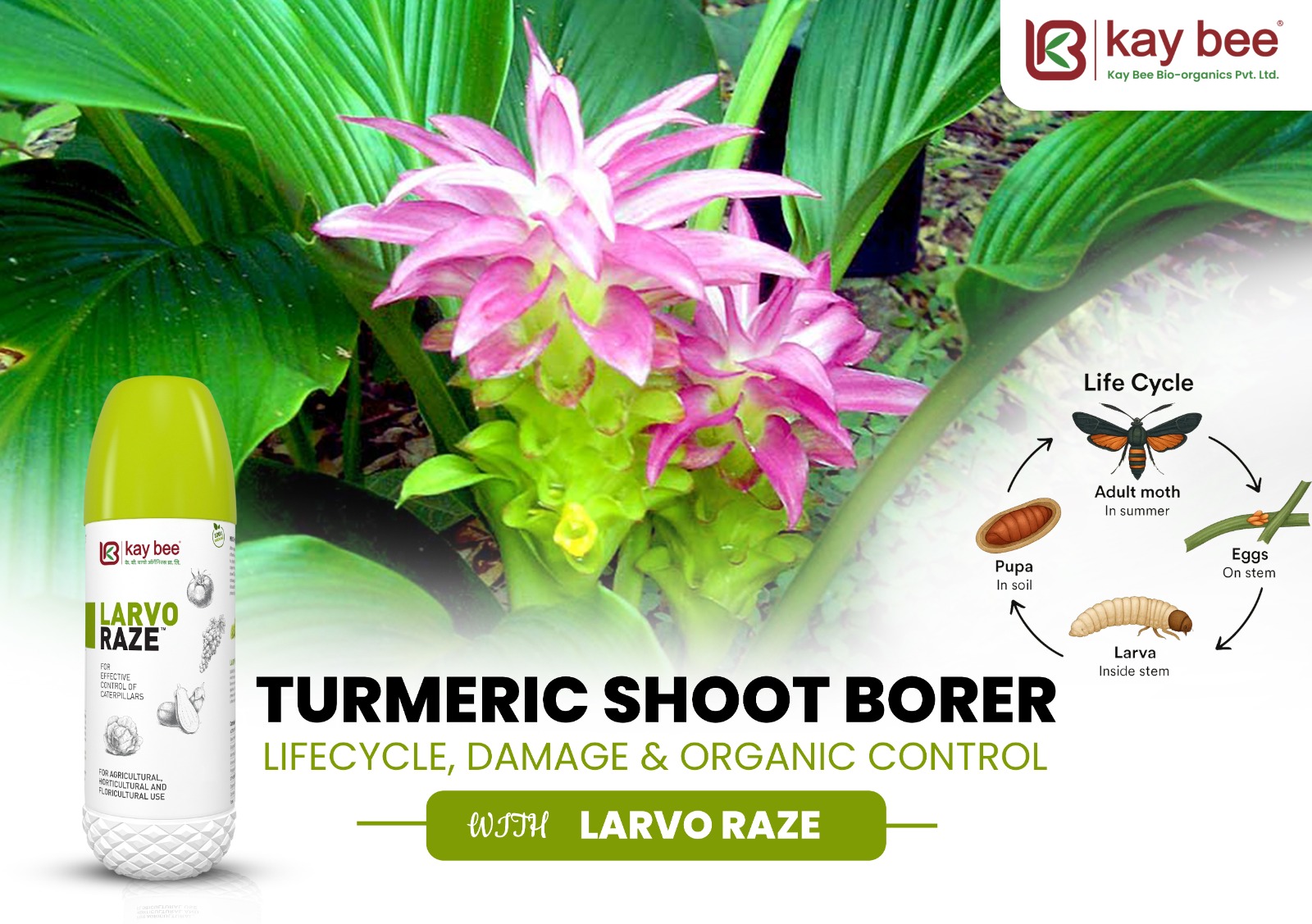
Turmeric Shoot Borer: Lifecycle, Damage & Organic Control with Larvo Raze
Turmeric is a high-value kharif spice crop for many Indian farmers, but it also faces one particularly stubborn enemy hidden inside its own stem: the turmeric shoot borer, scientifically known as Conogethes punctiferalis. Because the larva feeds from inside the pseudostem, this pest is often noticed only after real damage has already been done. The same pest also attacks ginger, so ginger and turmeric shoot borer monitoring often go hand in hand for growers who cultivate both rhizome spice crops in the same season. For managing rhizome rot diseases alongside pest threats in these crops, read our guide on managing rhizome rot in ginger and turmeric.
1. What Is the Turmeric Shoot Borer
The turmeric shoot borer is a lepidopteran pest, meaning it belongs to the moth and butterfly family. It is the larval, or caterpillar, stage of this moth that causes the actual damage to the crop by tunnelling into the turmeric pseudostem.
1.1 Why It Is Hard to Detect Early
Because shoot borer in turmeric operates almost entirely inside the plant, growers often rely on subtle above-ground cues to catch it early. Understanding the turmeric shoot borer life cycle also explains why the damage is so easy to miss at first:
- The larva enters the stem soon after hatching and feeds from the inside
- Damage is not visible on the outer leaves until the shoot begins to wither
- Small entry holes are often hidden near leaf axils or the base of the pseudostem
- By the time symptoms appear above ground, the larva has already caused internal damage
2. Lifecycle of the Turmeric Shoot Borer
Understanding the turmeric shoot borer life cycle helps in timing your organic sprays for maximum effect, since the larval stage inside the stem is the hardest to reach. For context on how kharif pest pressure builds across spice and vegetable crops, also read our guide on top 10 crop diseases in June.
2.1 Stages of Development
Each stage of the turmeric shoot borer life cycle calls for a different monitoring approach:
- Egg: Tiny, flat eggs are laid singly or in small groups on leaves or near the leaf sheath
- Larva: The caterpillar hatches and bores into the pseudostem within a short time, feeding on internal tissue for around 2 to 3 weeks
- Pupa: The larva pupates either inside the damaged stem or in the soil near the base of the plant
- Adult moth: The moth emerges, mates, and lays eggs on a new host plant, restarting the cycle
2.2 Why Kharif Weather Favours the Pest
Warm temperatures combined with high humidity during the monsoon months create ideal conditions for the turmeric shoot borer to complete its lifecycle quickly, often in just three to four weeks. This means multiple, overlapping generations can attack the same field within a single kharif season. Because ginger and turmeric shoot borer share this monsoon-driven biology, fields growing both crops nearby need coordinated monitoring.
3. Damage Caused by Shoot Borer in Kharif Turmeric
Since the larva feeds inside the stem, the damage caused by shoot borer in turmeric goes beyond what is visible from the outside, and can significantly reduce both foliage health and rhizome yield.
3.1 Visible Symptoms
Catching turmeric shoot borer symptoms early can be the difference between losing a single shoot and losing the whole clump.
- Small holes on the pseudostem, often with dried frass (larval excreta) sticking out
- Wilting and drying of the central shoot, commonly called “dead heart” — one of the clearest turmeric shoot borer symptoms to watch for in the field
- Yellowing of leaves on the affected shoot
- Drooping and eventual collapse of the damaged shoot
- Stunted plant growth when infestation occurs at an early stage
3.2 Impact on Yield
Left unmanaged, shoot borer in turmeric fields can quietly erode both plant vigour and rhizome income across the season.
- Reduced photosynthesis due to loss of healthy shoots
- Lower rhizome weight and poorer rhizome quality at harvest
- Secondary rotting of the pseudostem after larval damage, in humid kharif conditions
- Yield losses that can be substantial if the infestation is not controlled early in the season
4. Organic Control of Turmeric Shoot Borer with Kay Bee’s Larvo Raze
Because the larva spends most of its life protected inside the stem, an organic larvicide that works quickly on newly hatched larvae, before they bore in, is essential for effective turmeric shoot borer management. Kay Bee’s Larvo Raze is a botanical bio-larvicide developed specifically for the turmeric shoot borer and similar boring caterpillar pests. Choosing a targeted bio-larvicide like Larvo Raze keeps turmeric pest control organic and residue-free. To understand why botanical solutions are the right choice for spice crop farming, read our guide on why India needs biopesticides in agriculture.
4.1 How Larvo Raze Works
Because Larvo Raze targets multiple points in the turmeric shoot borer life cycle, it disrupts the pest at more than one stage:
- Contact, systemic, and fumigant modes of action help the product reach larvae on the plant surface before they enter the stem
- Antifeedant activity, desiccation, and cytolysis give a fast knock-down effect on neonates and early instars
- Stomach poisoning and insect growth regulator (IGR) activity disrupt moulting and pupation in later instars
- Disrupted metamorphosis means fewer moths emerge, breaking the pest’s life cycle over time
- Safe for honeybees and other beneficial insects in the field
4.2 Recommended Spray Schedule
Getting the timing right is central to turmeric shoot borer management, so follow this schedule closely:
- Remove and destroy affected shoots showing dead heart symptoms to reduce carry-over of larvae
- Install light traps to monitor and catch adult moths during peak flight periods
- Maintain field sanitation by clearing crop debris after harvest
- Avoid planting turmeric continuously in the same field without rotation
- Encourage natural enemies by minimising use of broad-spectrum chemical insecticides
5. Final Thoughts
The turmeric shoot borer is a pest that does most of its damage out of sight, which is exactly why early monitoring and timely organic intervention matter so much during the kharif season. Understanding its lifecycle helps you time your sprays before the larva disappears into the stem, and a reliable botanical product like Kay Bee’s Larvo Raze gives turmeric growers an effective, residue-free way to protect both shoot health and rhizome yield as part of a complete turmeric pest control programme. This guidance applies equally to ginger and turmeric shoot borer populations, since Conogethes punctiferalis moves freely between both hosts.
For complete turmeric crop health — combining pest control with disease management — also read our guide on managing rhizome rot in ginger and turmeric and explore our range of best neem-based pesticides for agricultural crops for additional tools in your kharif spice crop protection programme.
Latest Blogs
 Tomato Nematode Damage: Underground Signs, Crop Loss and Organic Control with Root Fit
 Turmeric Cultivation in India: Vegetative Stage Care with Nova Drip + MYCORIS
 Grapes Downy Mildew, Anthracnose & Powdery Mildew in Monsoon: Downy Raze + Fungo Raze Guide
 Okra Sucking Pests: Jassids, Aphids & Whitefly — Organic Control with Kay Bee’s Pesto Raze
 Onion Thrips in Kharif: Damage, Population Buildup and Organic Control
COPYRIGHT © 2026 - ALL RIGHTS RESERVED. MADE BY WebAppGigs