
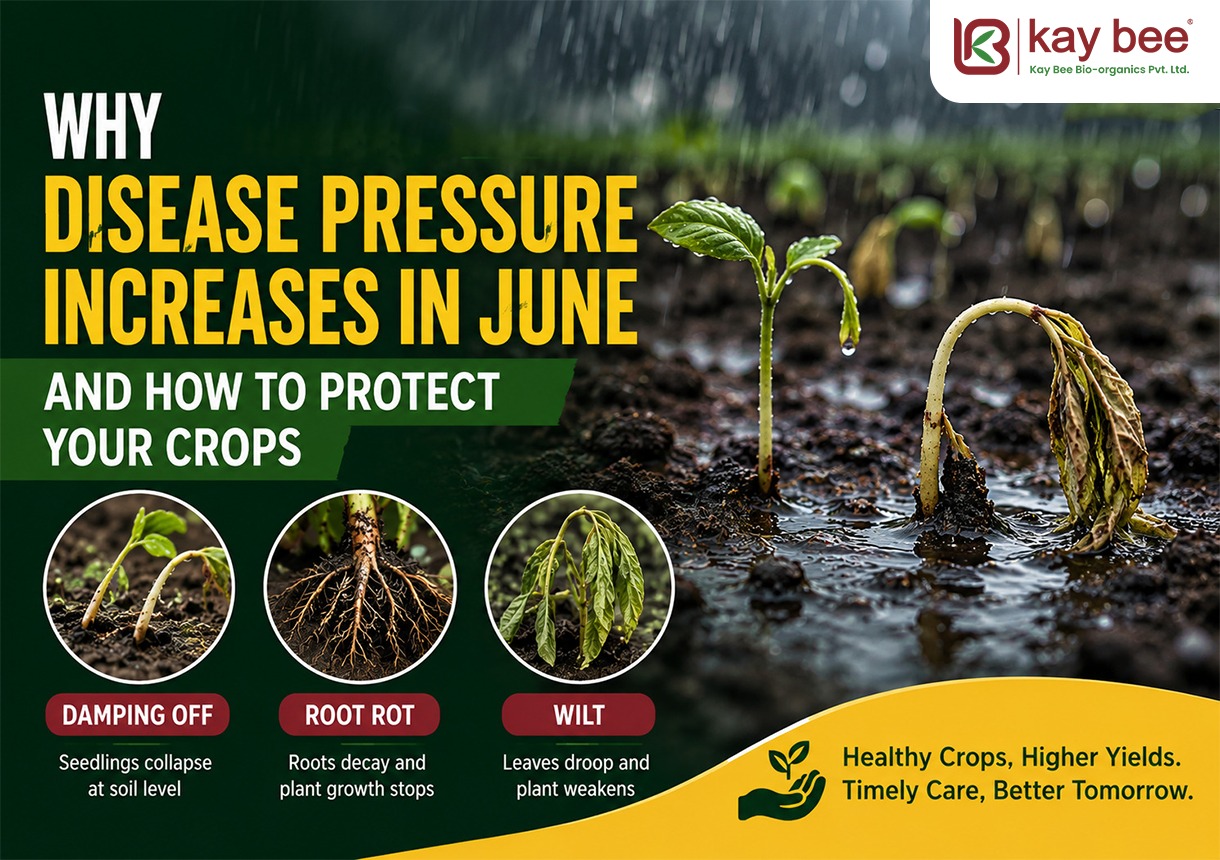
Why Disease Pressure Increases in June and How to Protect Your Crops
Introduction
The month of June brings a wave of happiness and busy schedules for farmers all across the country. After the scorching heat of the summer months, the arrival of the monsoon season feels like a blessing. June marks the official start of the Kharif season. Fields are prepared, seeds are sown, and a new life begins in the soil.
However, along with the beautiful rainy days and refreshing cool winds, June also brings a massive hidden threat to your fields. This threat is a sudden and heavy increase in crop disease pressure in June.
As a farmer, you might notice that just a few days after the first heavy showers, your young seedlings start turning yellow. Some plants suddenly wilt and fall over, while others show dark spots on their leaves. Why does this happen right when the crop is supposed to grow its fastest?
The answer lies in the changing environment. The sudden shift from dry summer to wet monsoon creates a perfect playground for harmful plant pathogens. Especially, monsoon fungal diseases become highly active, attacking crops both from below the ground and through the air.
While most farmers spend their time and money only on applying heavy doses of fertilizers in June, the smart ones know that crop protection must come first. If your plants are fighting diseases at their early growth stage, they can never absorb nutrients properly or give a high yield.
Why Does Crop Disease Pressure Increase in June?
To fight an enemy, you must first understand why and when they attack. Fungi are always present in our environment—in the soil, on old crop residues, and floating invisibly in the air. Most of the time, they remain sleeping (dormant). But as soon as the calendar turns to June, several factors wake them up all at once.
-
The Sudden Explosion of Soil Moisture
When the first heavy monsoon rains hit the dry summer earth, the soil absorbs a massive amount of water. While water is life for your seeds, too much water pushes out the air pockets inside the soil.
- Lack of Oxygen: Wet, compacted soil lacks oxygen. Plant roots need oxygen to breathe. When they cannot breathe, they become weak and stressed.
- Fungal Awakening: Harmful fungi like Pythium, Phytophthora, Rhizoctonia, and Fusarium love oxygen-depleted, wet environments. They wake up and easily attack the weak, suffocating plant roots, leading to a massive spike in Soil Borne Fungal Disease in monsoon.
-
High Humidity and Trapped Air
Fungi do not have roots; they spread through tiny, invisible seeds called spores. For these spores to land on a leaf, hatch, and infect the plant, they need moisture on the leaf surface and high humidity in the air. June provides exactly that. High humidity acts like a protective blanket for fungal spores, allowing them to multiply at double the speed compared to the hot summer months.
-
The Perfect Temperature Trap
Fungi thrive when it is neither too hot nor too cold. In June, daytime temperatures are usually warm, while the night air is packed with moisture. This warm-and-wet combination acts like a greenhouse incubator for diseases. Spores that would normally die in the dry heat can now survive, germinate, and infect a healthy leaf within just a few hours.
-
Vulnerability of Tender, Young Crops
Most crops in June are either in the nursery stage or are young seedlings that have just sprouted.
- Young roots are soft, thin, and do not have a hard protective outer layer.
- Young leaves are tender and easily pierced by fungal tubes.
- The plant’s internal immune system is still developing.
Favorable Environmental Conditions for Disease Development
Fungal diseases cannot spread unless the environment supports them. In June, several weather elements come together to create the “perfect storm” for crop infections.
| Weather/ Field Factor | How It Helps the Fungus | Resulting Disease Type | Relative Humidity & Temperature |
| Continuous Rain & Cloudy Skies | Keeps the crop canopy constantly wet; stops sunlight from drying the leaves. | Foliar Blights, Anthracnose, Leaf Spots | RH-80-90% & Temp- 18-30°C |
| Waterlogging & Poor Drainage | Suffocates the root zone; allows water-loving fungal spores to swim and find roots. | Damping-off, Root Rot, Collar Rot | RH- > 80% & Temp-20-35°C |
| Warm Days & Humid Nights | Speeds up the life cycle of the fungi, causing them to release millions of new spores daily. | Powdery Mildew, Downy Mildew, Rusts | RH- 15-25% & Temp – 85-90°c |
| High Winds during Rainstorms | Physically carries fungal spores from an infected neighbor’s field straight into your healthy field. | Airborne Fungal Infections | RH- >70 % & Temp- 21-30 °c |
Common Mistakes Farmers Make in June
Even the most experienced farmers can fall into traditional habits that accidentally welcome diseases into their fields. Here are the most common mistakes you must identify and fix:
-
Waiting for Visual Damage Before Spraying
Many farmers have a habit of taking action only when they see half their field turning yellow or leaves falling off. By the time a fungal disease is visible to your naked eye, it has already completed multiple life cycles inside the plant tissue. Controlling it at this stage requires heavy, expensive chemical sprays that shock the crop and reduce yield.
-
Over-Irrigating Immediately After Rains
When there is a short break in the monsoon rains, farmers often worry and turn on their tube wells or drip systems. If the soil is already saturated deep down, adding extra irrigation water seals the soil completely, triggering instant root damage and fungal attacks.
-
Relying Solely on Leaf Sprays for Root Problems
When a plant starts wilting or turning yellow from the bottom up, the problem is almost always in the roots. However, many farmers simply buy an expensive chemical fungicide and spray it on the leaves. If the roots are rotting underground, a leaf spray cannot save the plant. Soil problems require soil-specific treatments.
-
Excessive Use of Nitrogen (Urea)
To make the young crop look green and grow fast, farmers often apply heavy doses of Urea in June. Excessive nitrogen creates rapid, watery, soft, and succulent plant growth. These soft tissues have very weak cell walls, making it incredibly easy for fungal pathogens to pierce through them and infect the plant.
-
Ignoring Field Sanitation and Old Stubble
Leaving infected debris, weeds, or old crop roots from the previous season on the field borders provides a ready-made home for fungi. The first rains wash these dormant spores right back into your new rows of crops.
Modern Biological Solutions: The Kay Bee Bio Organics Approach
While good practices help, the high disease pressure of June often requires a powerful, active protector. Traditional chemical fungicides often leave harmful residues, kill beneficial soil microbes, damage soil health over time, and cause fungi to develop resistance.
To solve this problem, Kay Bee Bio Organics has developed advanced, residue-free botanical and biological solutions that protect your crops naturally without harming your soil or consumers.
To give your crop complete protection, you must fight the fungi on both fronts: Underground (Soil-Borne) and Above-Ground (Air-Borne).
1. Protecting the Underground: Root Fit
When it comes to root rot prevention in June, Root Fit is an exceptional choice for farmers. It is a specially formulated, organic biological product designed to manage and eradicate harmful soil-borne fungal pathogens while boosting the plant’s root ecosystem.
How Root Fit Works (Mode of Action)
Root Fit operates through a highly smart, multi-action mechanism directly inside the root zone (rhizosphere):
-
- Anti-Fungal Barrier Creation
- Disruption of Fungal Cell Walls
Root Architecture Enhancement
2. Protecting the Above-Ground: Fungo Raze
Once your roots are secured by Root Fit, you must look upward. The high humidity of June will bring airborne spores to your leaves. To counter this, Kay Bee Bio Organics offers Fungo Raze, a heavy-duty, broad-spectrum botanical fungicide meant for foliar application.
How Fungo Raze Works (Mode of Action)
Fungo Raze provides a dual action of protection and cure against aggressive airborne fungal diseases:
- Spore Germination Inhibition
- Mycelial Growth Arrest
- Systemic Inducer Response
Application Recommendations:
| Features | Root Fit | Fungo Raze |
| Target Diseases | Root Rot, Collar Rot, Stem Rot, Damping-off, and Wilt. | Leaf Blight, Anthracnose, Leaf Spots, Downy Mildew, Powdery Mildew, and Rust. |
| Method of Application | Drenching or Drip irrigation or mixed with fertilizer | Foliar spray |
| Dosage | For below 25 days crop-250ml to 500ml / Acer
For above 1 month crop: 750ml to 1000ml / Acer |
2ml per Liter of water |
| Time of Application | Always ensure the soil has slight moisture when applying | Spray during the early morning or late evening hours |
The Integrated Crop Protection Schedule for June
For the absolute best results, do not treat these products as emergency medicines. Use them as a planned shield. Here is a simple, highly effective schedule you can follow in June:
Farmer’s Quick Checklist for June Crop Protection
- Drainage Cleaned: Are all emergency water exit channels in my field wide open and free of weeds?
- Soil Check: Did I dig 3 inches down to ensure my soil isn’t turning into a sticky, airless mud paste?
- Root Inspection: Did I pull up a random weak seedling to check if the roots are clean white (healthy) or brown/black (rotted)?
- Urea Balance: Did I avoid throwing excessive bags of Urea just for instant green color?
- Biological Shield Ready: Do I have my bottles of Root Fit and Fungo Raze ready in my storage shed before the continuous rains lock me out of the market?
Conclusion
June is a month filled with immense agricultural potential, but it is also a testing phase for every farmer. Rising crop disease pressure in June is an environmental reality, driven by heavy rains, intense humidity, and vulnerable young plants.
By steering clear of traditional mistakes like over-irrigation, excessive chemical nitrogen use, and delayed treatments, you can keep the majority of diseases at bay. Combining good field hygiene and proper spacing with Kay Bee Bio Organics’ powerful duo—Root Fit for deep soil-borne root protection and Fungo Raze for advanced airborne leaf protection—ensures your crops stay stress-free, healthy, and highly productive.
Do not wait for your crops to cry for help. Switch to a smart, residue-free biological protection strategy this June, protect your soil’s natural fertility, and set the stage for a bumper, profitable harvest!
Read More Blogs :
Bio-Fungicide Solution for Powdery Mildew in Fruit Crops & Vegetables
Paddy Nematode Control: How to Protect Rice Roots Before Damage Starts
Latest Blogs
 Brown Plant Hopper Paddy Organic Control with Pesto Raze & Mealy Raze
 Mycorrhiza Technical Manufacturer in India | Kay Bee Bio-Organics Pvt. Ltd.
 Cotton Whitefly Management During Square Formation Stage: Effective Control with Pesto Raze & OrgaNeem
 Calcium for Cabbage Head Formation: How Calboost (Ca-11%) Ensures Tight & Crack-Free Heads
 Citrus Canker Organic Control: A Complete Farmer’s Guide
COPYRIGHT © 2026 - ALL RIGHTS RESERVED. MADE BY WebAppGigs