
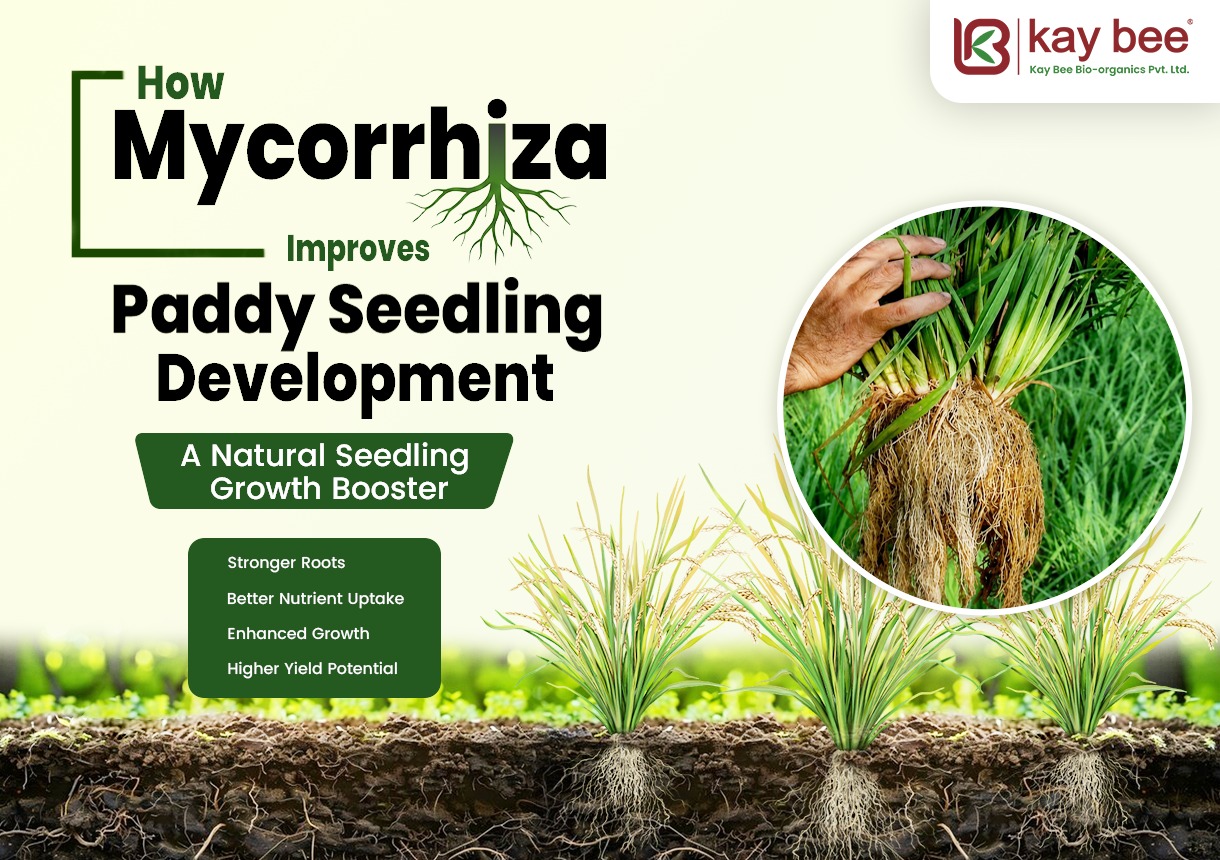
How Mycorrhiza Improves Paddy Seedling Development: A Natural Seedling Growth Booster
Introduction: Why Early Paddy Seedling Development Matters
Paddy is a significant crop for food security in India, there are a number of challenges to early seedling development, such as low transplant survival, limited root growth, nutrient shortages, and disease pressure. Enhancing nutrient uptake, water absorption, plant anchoring, tillering, and overall crop establishment all depend on a robust root system.
By developing a symbiotic relationship with paddy roots, Mycorrhizal Fungi offer a natural biological remedy. By extending the root system through fungal hyphae, mycorrhiza promotes healthier seedlings, increases stress tolerance, improves phosphorus and micronutrient uptake, and enhances root development.
Mycorrhiza for paddy seedlings is a sustainable microbial solution that increases crop establishment and output while lowering reliance on chemical inputs and improving nutrient efficiency.
A paddy crop’s future productivity can be determined by enhanced root system during the nursery stage. Paddy plants naturally develop this foundation with the help of mycorrhizal fungus.
What is Mycorrhiza?
Mycorrhiza is a beneficial association between plant roots and fungi, especially Arbuscular Mycorrhizal Fungi (AMF).
The fungus colonizes the root system and develops microscopic fungal networks called hyphae, which extend into the surrounding soil.
These fungal networks:
- Increase root exploration capacity
- Improve nutrient absorption
- Enhance water uptake
- Support healthier plant growth
How Mycorrhiza Improves Paddy Seedling Development
Enhances Root Growth and Root System Development
Healthy paddy seedlings develop on a solid root structure. By creating a favorable relationship between plant roots and Arbuscular Mycorrhizal Fungi (AMF), mycorrhiza for paddy seedlings enhances early root development.
Mycorrhiza helps in:
- Fungal hyphae expand the root absorption zone, increasing root length.
- Enhance the development of lateral roots and root branching
- Boost the biomass and general strength of the roots
- Improve root architecture to facilitate effective soil exploration
The enhanced root system increases survival during early crop growth and allows seedlings to establish more quickly following transplantation.
Improves Nutrient Uptake in Paddy Seedlings
A major advantage of mycorrhizal biofertilizer for paddy is enhanced nutrient availability and absorption. AMF develops a network of fungal hyphae that works as an extension of plant roots, allowing seedlings to access nutrients beyond the normal root zone.
Mycorrhiza improves uptake of:
- Phosphorus (P): Supports energy transfer, root growth, and early plant development
- Zinc (Zn): Helps enzyme activity and healthy growth
- Iron (Fe): Essential for chlorophyll production and photosynthesis
- Other micronutrients: Supports various metabolic processes
This improved nutrient efficiency is especially beneficial in soils where phosphorus availability is limited.
Acts as a Natural Seedling Growth Booster
Mycorrhiza works as a natural seedling growth booster by improving plant nutrition and physiological activity.
Benefits include:
- Increased seedling height
- Better leaf development
- Higher chlorophyll content
- Improved fresh and dry biomass
Better nutrient uptake supports stronger photosynthesis, which promotes healthier root and shoot growth, resulting in vigorous seedlings.
Enhances Stress Tolerance in Paddy Seedlings
Early-stage paddy plants often face challenges such as water stress, nutrient deficiency, and environmental fluctuations. Mycorrhiza helps seedlings tolerate these conditions by improving root efficiency and plant resilience.
How mycorrhiza helps:
- Water stress: Fungal hyphae improve water absorption by exploring a larger soil area
- Nutrient stress: Better nutrient acquisition maintains plant growth under limited availability
- Environmental stress: Improves plant physiological responses and adaptability
The fungal network acts as a biological support system that helps seedlings maintain growth under unfavorable conditions.
Improves Resistance Against Soil-Borne Diseases
Mycorrhiza enhances natural plant defense mechanisms and supports healthier root environments.
It helps by:
- Strengthening root tissues
- Improving beneficial microbial activity around roots
- Reducing pathogen establishment
AMF can help reduce the impact of common soil-borne pathogens such as:
- Rhizoctonia spp.
- Fusarium spp.
- Pythium spp.
By improving plant defense and microbial balance, mycorrhiza supports healthier seedlings with reduced disease pressure.
How to Apply Mycorrhiza in Paddy?
Apply with organic manure near the root zone during or after transplantation:
-
- Mix AMF inoculum with decomposed organic matter
- Place 2-3 cm beside the root zone at 5-7 cm depth
- Ensure moisture is present for fungal activation
Kay Bee Mycoris is a specialized mycorrhizal biofertilizer product produced using root organ culture technology designed for optimal performance in paddy cultivation. This product contains high-quality Endo-Mycorrhiza and Ecto-Mycorrhiza inoculum, specifically formulated to enhance paddy seedling development and crop establishment.
Key features of Kay Bee Mycoris:
- Premium fungal inoculum: Contains viable, high-concentration AMF spores and colonized root fragments
- Paddy-specific formulation: Optimized for paddy cultivation conditions and nursery applications
- Organic-compatible: Works synergistically with compost, farmyard manure, and other organic inputs
- Easy application: Suitable for all three application methods (soil mixing, root dipping, and field application)
- Quality assured: Manufactured under controlled conditions to ensure fungal viability and colonization success
Buy Now : MYCORIS – Mycorrhizal Bio-Fertilizer for Strong Roots & Higher Yield
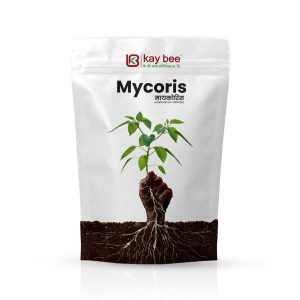
Recommended usage for Kay Bee Mycoris in paddy:
| Application Stage | Dosage | Method |
| Field application at the time of transplanting | 2-4 kg per acre | Mix with 50 kg organic manure or granular fertilizer, apply near root zone |
Why choose Kay Bee Mycoris?
- Proven to improve root length by 25-40% in paddy seedlings
- Enhances phosphorus uptake efficiency by 30-50%
- Increases transplant survival rate by 15-25%
- Reduces transplant shock duration by 3-5 days
- Supports sustainable paddy production with reduced chemical fertilizer dependence
- Easy to apply-100% water soluble formulation
Kay Bee Mycoris integrates seamlessly into existing paddy seedling management practices while delivering measurable improvements in seedling quality and field performance.
Conclusion
Paddy seedling development is capable of being enhanced naturally and sustainably with the help of mycorrhiza. Mycorrhizal biofertilizer for paddy helps farmers produce healthier seedlings with improved field establishment by enhancing root growth, nutrient absorption, and stress tolerance.
Kay Bee Mycoris is a premium quality AMF solution that improves field production and paddy seedling performance in measurable ways. It produces stronger seedlings that establish more quickly and yield more when treated using the right paddy seedling soil mixing, root dipping, and field treatment techniques.
Mycorrhiza-based paddy seedling treatment, which uses products like Kay Bee Mycoris, is becoming an important biological technology for increasing paddy output while lowering input costs and environmental effect as sustainable agriculture expands.
This approach aligns perfectly with modern farming goals of achieving higher yields through science-based, eco-friendly solutions.
Latest Blogs
 Brown Plant Hopper Paddy Organic Control with Pesto Raze & Mealy Raze
 Mycorrhiza Technical Manufacturer in India | Kay Bee Bio-Organics Pvt. Ltd.
 Cotton Whitefly Management During Square Formation Stage: Effective Control with Pesto Raze & OrgaNeem
 Calcium for Cabbage Head Formation: How Calboost (Ca-11%) Ensures Tight & Crack-Free Heads
 Citrus Canker Organic Control: A Complete Farmer’s Guide
COPYRIGHT © 2026 - ALL RIGHTS RESERVED. MADE BY WebAppGigs