
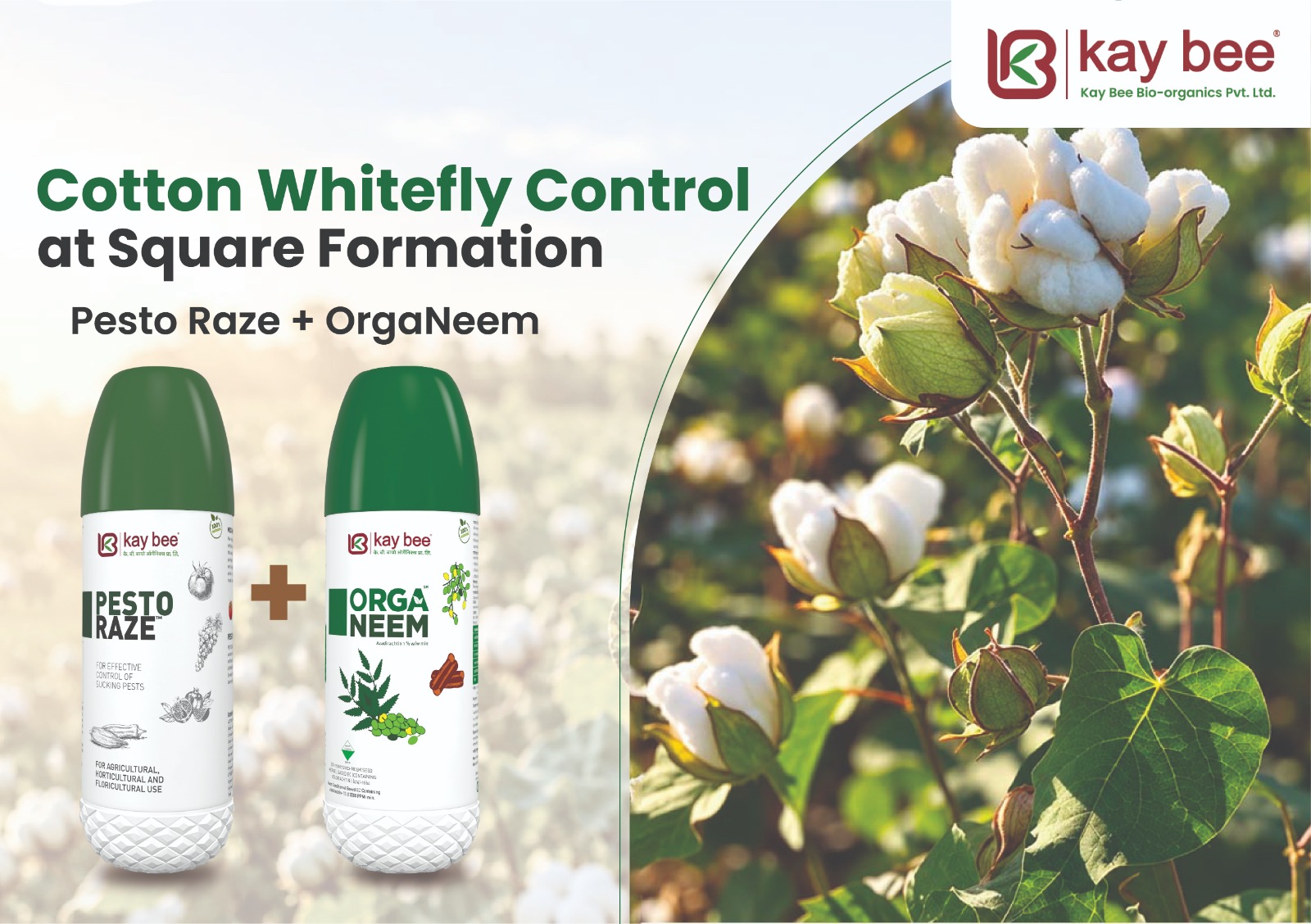
Cotton Whitefly Management During Square Formation Stage: Effective Control with Pesto Raze & OrgaNeem
Cotton is one of the most important commercial fiber crops grown across India and plays a significant role in the country’s agricultural economy. It provides raw material for the textile industry, supports millions of farming families, and contributes significantly to export earnings. However, achieving higher cotton productivity depends largely on effective pest management, especially during the square formation stage, when the crop begins developing flower buds. During this stage, one of the most destructive sucking pests is the whitefly, which can severely reduce crop vigor, yield, and fiber quality if left unmanaged.
For effective whitefly control in cotton square formation stage, farmers need an integrated approach that combines botanical and eco-friendly crop protection solutions. The combination of Pesto Raze + OrgaNeem 3000 ppm offers an excellent solution by providing quick suppression of whiteflies while supporting sustainable crop production. For a broader understanding of how sucking pests affect cotton, read our guide on cotton sucking pests in kharif — whitefly, aphids, jassids and thrips.
Whitefly in Cotton
Whitefly (Bemisia tabaci) is a major sucking pest affecting cotton throughout the growing season. It attacks tender leaves by sucking plant sap and multiplies rapidly under warm and humid weather conditions. The pest becomes particularly damaging during the square formation stage because plants require maximum nutrients for flower bud development. Continuous feeding weakens the crop, reduces photosynthesis, and creates favourable conditions for fungal growth through honeydew secretion. Without timely management, whitefly populations increase rapidly and may result in severe yield losses.
Whiteflies are also the primary carriers of Cotton Leaf Curl Virus (CLCuV). For more on how this virus spreads and is managed, read our guide on whitefly control in cotton and chilli with bio-pesticides.
Nature of Damage Caused by Whitefly
Whiteflies damage cotton in several ways:
- Both adults and nymphs suck sap from tender leaves.
- Heavy infestation causes loss of plant vigor.
- Honeydew secreted by whiteflies promotes the growth of black sooty mould.
- Sooty mould blocks sunlight, reducing photosynthesis.
- Flower buds and squares may shed prematurely.
- Plants become stunted with reduced boll formation.
- Whiteflies also transmit viral diseases such as Cotton Leaf Curl Virus (CLCuV), leading to severe crop losses. For more on virus spread via whitefly vectors, read our guide on leaf curl virus symptoms and spread.
Symptoms of Whitefly Infestation
Farmers should regularly monitor cotton fields for the following symptoms:
- Tiny white insects flying when plants are disturbed.
- Whitefly eggs and nymphs present on the underside of leaves.
- Yellowing of leaves due to continuous sap sucking.
- Curling and downward folding of leaves.
- Sticky honeydew deposits on leaves.
- Black sooty mould developing on leaf surfaces.
- Reduced plant growth and weak flowering.
- Premature dropping of flower buds and squares.
- Reduced boll setting under heavy infestation.
Life Cycle of Cotton Whitefly
The whitefly has a rapid reproductive cycle, allowing multiple generations within a single crop season.
1. Egg Stage
Female whiteflies lay tiny yellow eggs on the underside of tender leaves. Eggs hatch within 3–5 days depending on temperature.
2. Nymph Stage
The emerging nymphs attach themselves to leaves and continuously suck plant sap. This is the most damaging stage because they remain stationary and feed continuously.
3. Pseudo Pupa
The last immature stage resembles a pupa. During this period, transformation into adults takes place.
4. Adult Stage
Adult whiteflies are tiny insects with white powdery wings. Adults emerge within 2–4 weeks and begin laying eggs shortly after emergence, resulting in rapid population buildup.
Why Whitefly Control Is Critical during Square Formation Stage
The square formation stage marks the beginning of reproductive growth in cotton. At this stage:
- Plants require maximum nutrients.
- Flower buds begin developing.
- Any stress reduces boll initiation.
- Sap-sucking pests weaken plant metabolism.
- Viral disease transmission increases significantly.
Therefore, whitefly control in cotton square formation stage is essential to protect flower buds, maintain healthy foliage, and maximize boll development. For a complete picture of cotton crop care during kharif, also read our guide on cotton crop care in June — nutrition and pest management.
Management of Whitefly Using Pesto Raze + OrgaNeem
Pesto Raze
Cotton whitefly management begins with Pesto Raze, an effective botanical crop protection solution developed using Marker Compound Technology. It helps suppress sucking pests such as whiteflies, aphids, and jassids, while promoting sustainable and eco-friendly farming practices.
Mode of Action — Contact, Systemic, and Fumigant:
Antifeedant, Desiccation, Cytolysis activity and Knockout effect can be seen in neonates and early instars. Stomach poisoning, anti-moulting hormonal changes, neurotoxicity, IGR activity for late instar, and multilevel target action lead to a bewildering detoxification system of the insect body which fails to survive and never develops resistance to this product.
Benefits of Pesto Raze
- Controls whiteflies effectively.
- Reduces feeding activity of sucking pests.
- Helps lower pest population during early infestation.
- Safe for integrated pest management programs.
- Suitable for sustainable cotton cultivation.
- Supports healthy vegetative and reproductive growth.
OrgaNeem 3000 ppm
OrgaNeem 3000 ppm is a premium neem-based botanical formulation widely recommended for organic whitefly management cotton kharif. For more on the power of neem in sustainable pest management, read our guide on best neem-based pesticides for agricultural crops.
Benefits of OrgaNeem
- Acts as a natural insect growth regulator.
- Repels adult whiteflies.
- Inhibits feeding behavior.
- Reduces egg laying by adult females.
- Interrupts the life cycle of whiteflies.
- Environment-friendly and residue-safe.
- Compatible with Integrated Pest Management (IPM).
Regular use of neem for cotton whitefly management helps maintain pest populations below economic threshold levels while conserving beneficial insects.
Recommended Dose
Pesto Raze @ 2 ml/l + OrgaNeem 3000 ppm @ 1 ml/l of water. For better spray adhesion and leaf coverage, add Balanstick (0.4 ml/l) to the spray mix.
Additional Cultural Practices for Whitefly Management
Along with botanical products, farmers should adopt integrated practices:
- Monitor fields regularly for early infestation.
- Remove heavily infested leaves whenever possible.
- Avoid excessive nitrogen fertilizer application.
- Maintain proper plant spacing for good air circulation.
- Control weeds that serve as alternate hosts.
- Install yellow sticky traps for monitoring adult whiteflies.
- Encourage natural predators such as ladybird beetles and lacewings.
- Avoid indiscriminate spraying of broad-spectrum insecticides that kill beneficial insects.
Combining these practices with organic whitefly management cotton kharif significantly improves pest control. To understand why biopesticides are the right choice for cotton, read our guide on why India needs biopesticides in agriculture.
Conclusion
Whitefly remains one of the most economically damaging sucking pests in cotton, particularly during the square formation stage when the crop is preparing for flowering and boll development. Early detection and timely intervention are essential to prevent sap loss, sooty mould development, viral disease transmission, and yield reduction.
For effective whitefly control in cotton square formation stage, integrating botanical crop protection products like Pesto Raze + OrgaNeem 3000 ppm offers a sustainable and environmentally responsible solution. Pesto Raze helps suppress active whitefly populations, while OrgaNeem disrupts feeding, reproduction, and the pest life cycle. Together, they provide reliable organic whitefly management cotton kharif, supporting healthier plants, improved square retention, and better boll formation.
For complete cotton crop protection this Kharif season, combine whitefly management with our guides on managing cotton wilt disease, root rot and alternaria and cotton sucking pests in kharif for a full-season crop protection programme.
Latest Blogs
 Mycorrhiza Technical Manufacturer in India | Kay Bee Bio-Organics Pvt. Ltd.
 Calcium for Cabbage Head Formation: How Calboost (Ca-11%) Ensures Tight & Crack-Free Heads
 Citrus Canker Organic Control: A Complete Farmer’s Guide
 Orthosilicic Acid (OSA) for Monsoon Stress: Building Crop Strength & Resilience
 Ginger Nematode and Soft Rot Control: Organic Management with Root Fit & Bacto Raze
COPYRIGHT © 2026 - ALL RIGHTS RESERVED. MADE BY WebAppGigs