
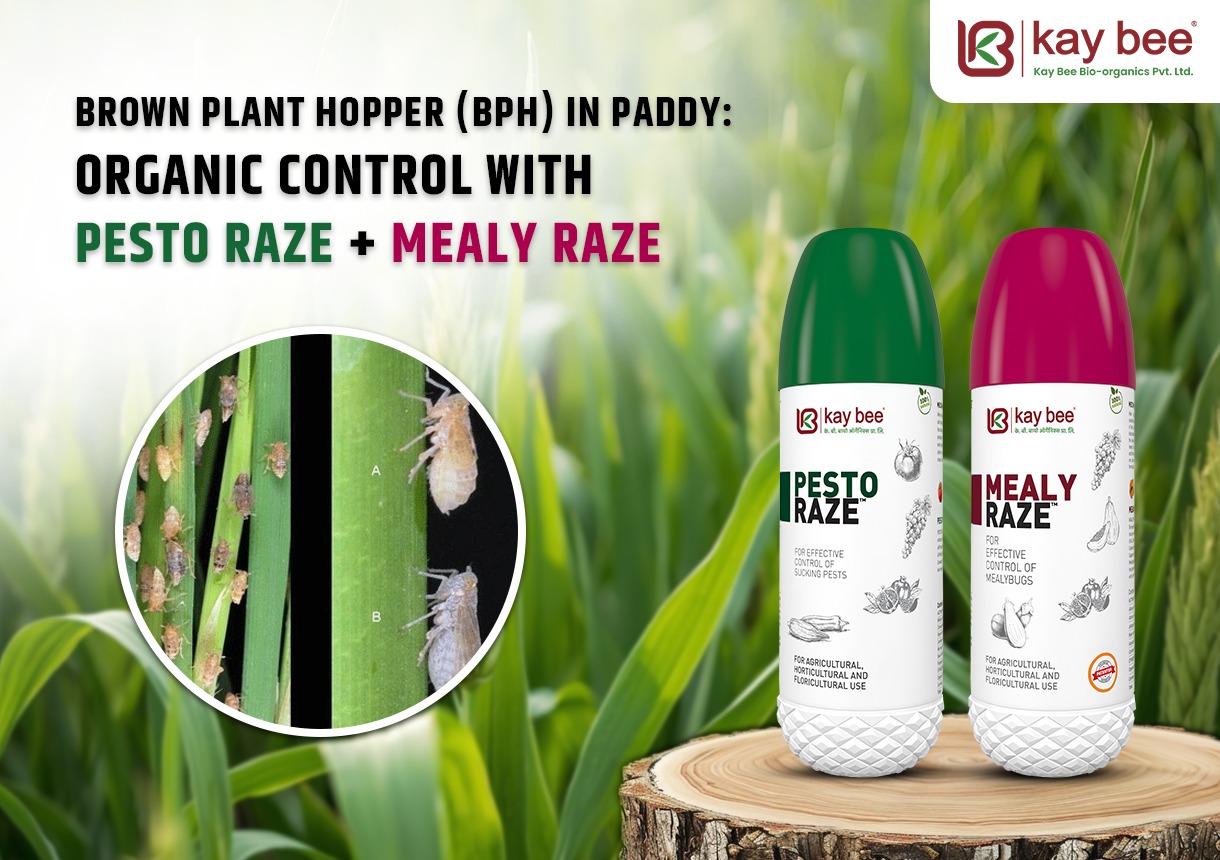
Brown Plant Hopper Paddy Organic Control with Pesto Raze & Mealy Raze
Introduction
Rice (Oryza sativa L.) is one of the world’s most important food crops and serves as the staple diet for more than half of the global population. India is among the leading producers and consumers of rice, contributing significantly to food security, employment, and the agricultural economy. Healthy rice production is essential for ensuring stable farmer income and meeting the increasing demand for food.
However, rice cultivation is affected by several insect pests throughout its growth stages. Among them, the Brown Plant Hopper (BPH) (Nilaparvata lugens) is one of the most destructive sucking pests, especially during the tillering to flowering stages. BPH populations multiply rapidly under warm, humid conditions and in fields receiving excessive nitrogen fertilizer. Both nymphs and adults suck sap from the base of rice plants, weakening them and causing a characteristic symptom known as hopper burn. Severe infestations can result in heavy yield losses and may also transmit viral diseases such as grassy stunt and ragged stunt. Therefore, adopting sustainable and organic management practices is essential for protecting rice yields while conserving beneficial insects and the environment. For a broader look at important paddy diseases and pests to watch during kharif, read our guide on top 10 crop diseases in June.
Economic Importance of Brown Plant Hopper
Brown Plant Hopper is considered one of the most economically important insect pests of paddy because of its ability to multiply rapidly and cause widespread damage.
The pest causes economic losses by:
- Sucking phloem sap from rice plants, reducing plant vigor.
- Decreasing tiller production and grain filling.
- Causing complete drying of plants during severe infestations.
- Transmitting grassy stunt and ragged stunt viruses.
- Reducing grain yield by 25–70% or even causing complete crop failure during outbreaks.
BPH outbreaks are commonly observed in fields with dense crop canopies, standing water, excessive nitrogen fertilization, and indiscriminate insecticide use, which destroys natural enemies and encourages pest resurgence. For more on why biopesticides preserve natural enemies better than chemical alternatives, read our guide on why India needs biopesticides in agriculture.
Life Cycle of Brown Plant Hopper
Egg Stage
Female BPH lays eggs in clusters inside the leaf sheath or midrib of rice plants. Eggs hatch within 4–8 days, depending on environmental conditions.
Nymph Stage
Freshly hatched nymphs are creamy white and gradually become brown. They pass through five nymphal instars over a period of approximately 12–15 days while continuously feeding on plant sap.
Adult Stage
Adults are brown in colour and occur in both short-winged and long-winged forms. Adult females can lay several hundred eggs during their lifetime. Under favourable conditions, the complete life cycle is completed within 18–30 days, allowing several overlapping generations in a single cropping season.
Nature of Damage and Symptoms
Both nymphs and adults remain at the lower portion of the rice plant near the water level and continuously suck plant sap.
Nature of Damage
- Continuous sap sucking weakens the plant.
- Feeding occurs mainly at the base of tillers.
- Heavy infestation blocks nutrient movement within the plant.
- Honeydew secretion encourages the growth of black sooty mould.
- The pest also acts as a vector of viral diseases.
Symptoms
- Yellowing of leaves during the early stages.
- Reduced tillering and poor plant growth.
- Circular patches of drying plants in the field.
- Brown, scorched appearance known as hopper burn.
- Presence of numerous brown insects at the base of the plant.
- Sooty mould near the lower stem due to honeydew.
- Poor grain filling and reduced yield under severe attack.
Healthy root development and strong plant structure help crops better tolerate sucking pest pressure. Read our guide on better soil before paddy transplanting for how good establishment reduces vulnerability to BPH.
Organic Control of Brown Plant Hopper Using Pesto Raze + Mealy Raze
Organic pest management plays an important role in maintaining ecological balance and preventing pesticide resistance. Botanical formulations are effective alternatives for controlling sucking pests while being safe to beneficial insects when used as recommended. For a broader look at how neem-based botanical products support sustainable paddy farming, read our guide on best neem-based pesticides for agricultural crops.
Recommended Organic Solution
Pesto Raze + Mealy Raze
- Pesto Raze — 1.5 ml per litre of water
- Mealy Raze — 1.5 ml per litre of water
Apply as a uniform foliar spray, ensuring thorough coverage of the lower stem and base of the rice plants where Brown Plant Hoppers usually hide. For better spray adhesion and coverage, add Balanstick (0.4 ml/l) to the spray mix.
How Pesto Raze + Mealy Raze Works
Pesto Raze and Mealy Raze are botanical-based bio-pesticides specially developed using advanced botanical marker compound technology for the effective organic management of Brown Plant Hopper (BPH) in rice. This powerful combination provides effective control of BPH within 48 hours of application, helping to suppress both nymphs and adult hoppers. Applied at the recommended dose of Pesto Raze 1.5 ml + Mealy Raze 1.5 ml per litre of water, it protects rice crops from severe sap-sucking damage, reduces the risk of hopper burn, and promotes healthy crop growth during the tillering and vegetative stages. As an organic solution, it is ideal for sustainable rice cultivation and can be integrated into eco-friendly pest management programs.
Mode of Action — Contact, Systemic and Fumigant:
Stomach Poisoning, Anti Moulting hormonal changes, Neurotoxicity, IGR activity for late instar, muscle contraction and multilevel target action lead to a bewildering detoxification system the insect body fails to survive and never develops resistance to this product. Repellent, Desiccation, Cytolysis activity and knockout effect can be seen in neonates and early instars.
Benefits of Pesto Raze + Mealy Raze
- Effective organic management of Brown Plant Hopper.
- Controls both nymphs and adults.
- Reduces feeding damage.
- Helps prevent hopper burn.
- Safe for beneficial insects when used correctly.
- Suitable for organic and residue-conscious farming.
- Supports healthy crop growth during the critical tillering stage.
Additional Integrated Organic Management Practices
For better results, combine botanical sprays with the following practices:
- Monitor fields regularly from the tillering stage onwards.
- Avoid excessive nitrogen fertilizer application.
- Maintain proper plant spacing to improve air circulation.
- Drain standing water for 3–4 days when infestation begins.
- Preserve natural predators such as spiders, mirid bugs, and parasitoids.
- Remove heavily infested patches if localized.
- Avoid unnecessary broad-spectrum insecticide applications that destroy beneficial insects.
Conclusion
Brown Plant Hopper is one of the most serious sucking pests affecting rice production. Its rapid multiplication, ability to cause hopper burn, and transmission of viral diseases make timely management essential for protecting crop yield. Sustainable and organic management not only reduces pest pressure but also preserves beneficial insects and environmental health.
The combination of Pesto Raze (1.5 ml/L) and Mealy Raze (1.5 ml/L) offers an effective organic solution for managing BPH during the tillering stage. When combined with proper nutrient management, field sanitation, water management, and regular pest monitoring, this botanical approach helps farmers achieve healthier crops, improved productivity, and sustainable rice cultivation while minimizing dependence on chemical insecticides.
For complete paddy crop protection this Kharif season, also read our guides on paddy stem borer — a major threat to rice cultivation, root rot in paddy — causes, symptoms and organic treatment, and paddy nematode control — protect rice roots for a full-season paddy health programme.
Latest Blogs
 Mycorrhiza Technical Manufacturer in India | Kay Bee Bio-Organics Pvt. Ltd.
 Cotton Whitefly Management During Square Formation Stage: Effective Control with Pesto Raze & OrgaNeem
 Calcium for Cabbage Head Formation: How Calboost (Ca-11%) Ensures Tight & Crack-Free Heads
 Citrus Canker Organic Control: A Complete Farmer’s Guide
 Orthosilicic Acid (OSA) for Monsoon Stress: Building Crop Strength & Resilience
COPYRIGHT © 2026 - ALL RIGHTS RESERVED. MADE BY WebAppGigs