
Soybean Girdle Beetle in Kharif: Stem Damage, Lifecycle and Organic Control with Larvo Raze
Soybean is one of the most important oilseed crops cultivated during the kharif season. However, its productivity is frequently threatened by insect pests, among which the soybean girdle beetle (Oberea brevis) is one of the most destructive stem-boring insects. Unlike defoliators that cause visible leaf damage, the girdle beetle soybean pest attacks the stem internally, disrupting vascular tissues responsible for water and nutrient transport. Consequently, affected plants exhibit poor growth, stem breakage, premature drying, and significant yield losses.
The incidence of the soybean girdle beetle is generally higher during periods of high humidity and moderate temperatures, especially from the vegetative to reproductive growth stages. Since larvae remain concealed inside the stem, damage often goes unnoticed until irreversible injury has occurred.
This article discusses the biology, soybean girdle beetle life cycle, economic importance, soybean girdle beetle symptoms, soybean girdle beetle nature of damage, and sustainable soybean girdle beetle management, including the use of Larvo Raze for effective larval pest management.
What is Soybean Girdle Beetle?
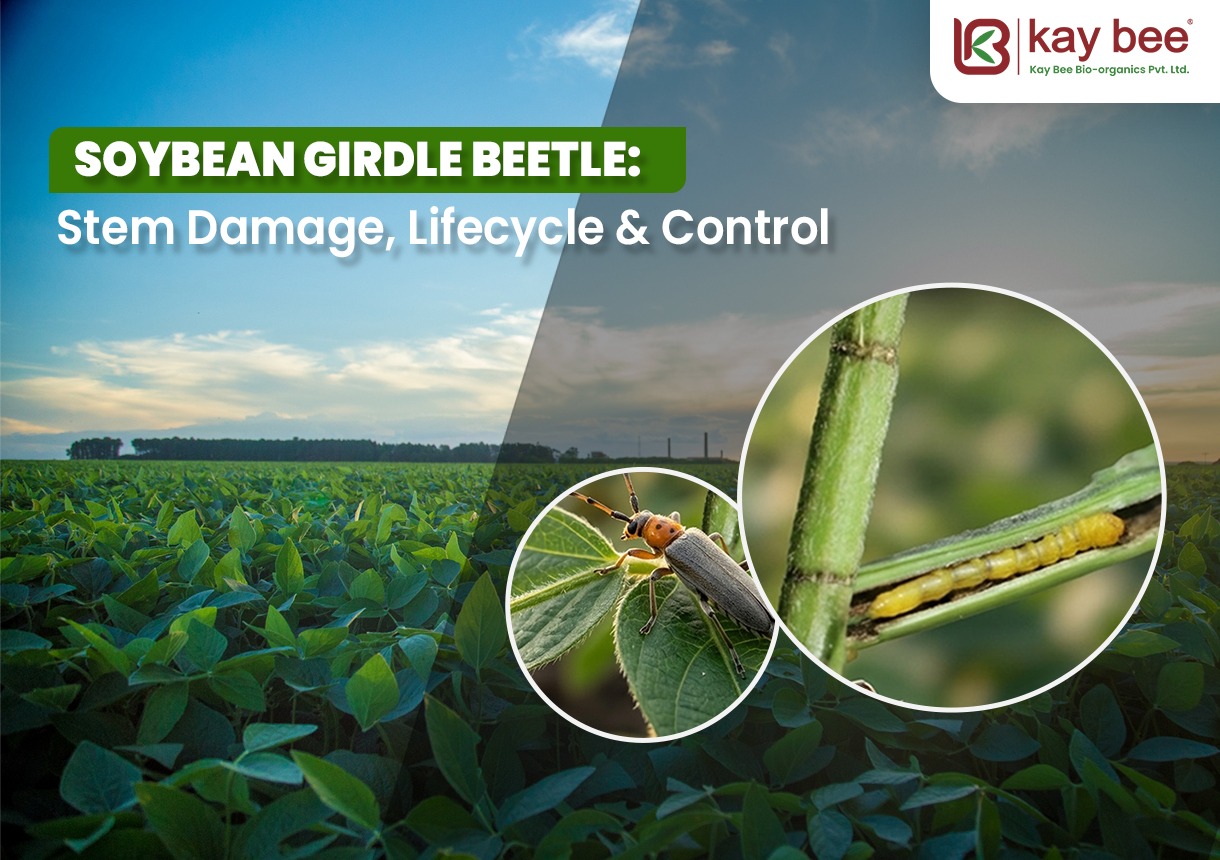
The soybean girdle beetle belongs to the family Cerambycidae (Longhorn beetles) and is widely distributed across soybean-growing regions of India. The pest derives its name from the characteristic circular girdling cuts made by the adult female around the stem before egg laying.
Once eggs hatch, larvae tunnel inside the stem where they remain protected from environmental factors and many conventional insecticides. This concealed feeding habit makes soybean girdle beetle control particularly challenging after infestation becomes established.
Identification of Soybean Girdle Beetle
Adult Beetle
- Slender, elongated longhorn beetle
- Greyish-brown to black body
- Long antennae exceeding body length
- Active during early morning and evening
Egg
- Creamy white
- Oval shaped
- Deposited beneath the bark near girdled portions
Larva
- Legless
- Creamy white
- Soft-bodied with brown head capsule
- Lives entirely inside the stem
Pupa
- Formed inside the stem tunnel
- Cream coloured initially
- Develops into the adult beetle
Soybean Girdle Beetle Life Cycle
Understanding the soybean girdle beetle life cycle helps farmers implement timely management practices.
Egg Stage (5–8 days)
Adult females create circular girdling rings on stems before laying eggs beneath the cuts.
Larval Stage (25–45 days)
This is the most destructive stage.
Larvae enter the stem immediately after hatching and tunnel downward through the pith. Internal feeding damages vascular tissues, restricting water and nutrient movement.
Pupal Stage (8–15 days)
Pupation occurs inside the stem tunnel.
Adult Stage
Adults emerge through exit holes, feed, mate and begin another generation.
Under favourable kharif conditions, the soybean girdle beetle life cycle is completed within 45–65 days.
Soybean Girdle Beetle Nature of Damage
The soybean girdle beetle nature of damage is mainly internal, making early diagnosis difficult.
Major symptoms include:
- Circular girdling rings on stems
- Egg-laying punctures
- Internal stem tunnelling
- Reduced nutrient movement
- Sudden wilting
- Weak stems
- Lodging during wind and rain
- Dry upper shoots
- Poor pod filling
- Reduced seed size
- Premature maturity
When infestation becomes severe, stems break exactly at the girdled region causing major yield loss.
Soybean Girdle Beetle Symptoms
Early identification of soybean girdle beetle symptoms is essential for preventing severe crop losses.
Typical soybean girdle beetle symptoms include:
- Stem girdling marks
- Wilting plants
- Dry upper branches
- Stem breakage
- Internal stem galleries
- Sawdust-like frass near stem openings
- Poor pod development
- Reduced seed formation
Economic Importance
Research indicates unmanaged soybean girdle beetle infestations may reduce yield by 20–40%, while severe outbreaks can cause even greater losses.
Yield reduction occurs because of:
- Reduced photosynthesis
- Poor nutrient transport
- Lower pod formation
- Smaller seeds
- Lodging
- Harvest losses
Favourable Conditions
The girdle beetle soybean pest develops rapidly under:
- Temperature of 25–30°C
- High humidity
- Dense crop canopy
- Continuous soybean cultivation
- Delayed sowing
- Alternate host plants
- Poor sanitation
Monitoring
Begin scouting around 25–30 DAS.
Observe for:
- Fresh girdling marks
- Stem cracks
- Wilting
- Dry shoots
- Broken stems
- Stem frass
Inspect 20–25 plants per acre every week for early detection.
Soybean Girdle Beetle Management
Effective soybean girdle beetle management requires Integrated Pest Management (IPM).
-
Timely Sowing
Early sowing helps avoid peak infestation.
-
Crop Rotation
Avoid continuous soybean cultivation.
-
Field Sanitation
Destroy infested stems and crop residues.
-
Balanced Fertilization
Avoid excessive nitrogen and maintain adequate potassium and micronutrients.
-
Regular Monitoring
Weekly scouting enables timely intervention before larvae enter deep inside stems.
Organic Girdle Beetle Control in Soybean
Growing demand for residue-free agriculture has increased interest in girdle beetle control in soybean using botanical insecticides.
Advantages include:
- Plant-derived ingredients
- Lower pesticide residues
- Safer to beneficial insects
- Suitable for IPM
- Reduced resistance risk
- Environment-friendly
The best girdle beetle control in soybean is achieved when applications target adult beetles or newly hatched larvae before extensive stem tunnelling begins.
Soybean Girdle Beetle Control with Larvo Raze
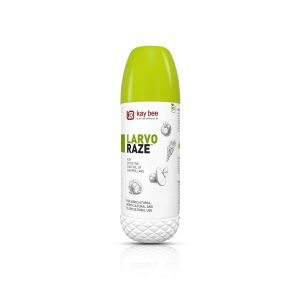
For effective soybean girdle beetle control, Larvo Raze provides a botanical solution formulated for managing early larval stages of stem-boring insects.
USP/Benefits of the Larvo Raze (Best Larvicide):
-
- Larvo Raze is known as the best insecticide product for all types of larval pests of various crops.
- Larvo Raze is the best insecticide for brinjal fruit borer, stem borer, shoot borer, and paddy stem borer product.
- It is an authenticated bio pesticide for the effective treatment of the larval pests of various plant species.
- Larvo Raze reduces the various stresses and induces the phtytotonic effects.
- Larvo Raze is an organic pesticide product that is residue-free and suitable for organic farming and export production.
Buy Now : Larvo Raze – Best Larvicide | Insecticide For Brinjal Fruit Borer & Rice Stem Shoot Borer
Mode of Action:
Contact, Systemic, and Fumigant:
Antifeedant, Desiccation, Cytolysis activity and Knockout effect can be seen in neonates and early instars. Stomach poisoning, anti-moulting hormonal changes, neurotoxicity, IGR activity for late instar, and multilevel target action lead to a bewildering detoxification system of the insect body which fails to survive & never develops resistance to this product.
Its plant-derived bioactive compounds reduce feeding activity and suppress larval development before severe internal damage occurs, making it an important component of soybean girdle beetle management.
Key Benefits
- Botanical formulation
- Effective against early larval stages
- Reduces stem tunnelling
- Supports IPM
- Helps reduce crop loss
- Environment-friendly
- Suitable for residue-conscious farming
Best Management Schedule
| Sr.no. | Crop Stage | Recommended Action |
| 1 | 20–25 DAS | Begin field scouting |
| 2 | 25–35 DAS | Monitor adult beetle activity and girdling symptoms |
| 3 | Initial infestation | Apply Larvo Raze @ 2.5 ml/l |
| 4 | 7–10 days later | Reassess field and repeat application if required |
| 5 | Throughout season | Maintain field sanitation and balanced nutrition |
Conclusion
The soybean girdle beetle is a concealed stem-boring pest capable of causing serious yield losses through internal feeding and stem girdling. Since larvae remain hidden inside the stem, early identification of soybean girdle beetle symptoms, understanding the soybean girdle beetle life cycle, and recognizing the soybean girdle beetle nature of damage are essential for timely action. An integrated approach combining field scouting, sanitation, crop rotation, balanced nutrition, and soybean girdle beetle control using botanical solutions like Larvo Raze offers sustainable protection. Effective soybean girdle beetle management and timely girdle beetle control in soybean can significantly reduce crop losses, improve plant health, and enhance soybean productivity.
Read More Blogs:
Soybean: A Vital Kharif Crop and the Threat of Pod Borer Infestation
Latest Blogs
 Brown Plant Hopper Paddy Organic Control with Pesto Raze & Mealy Raze
 Mycorrhiza Technical Manufacturer in India | Kay Bee Bio-Organics Pvt. Ltd.
 Cotton Whitefly Management During Square Formation Stage: Effective Control with Pesto Raze & OrgaNeem
 Calcium for Cabbage Head Formation: How Calboost (Ca-11%) Ensures Tight & Crack-Free Heads
 Citrus Canker Organic Control: A Complete Farmer’s Guide
COPYRIGHT © 2026 - ALL RIGHTS RESERVED. MADE BY WebAppGigs