
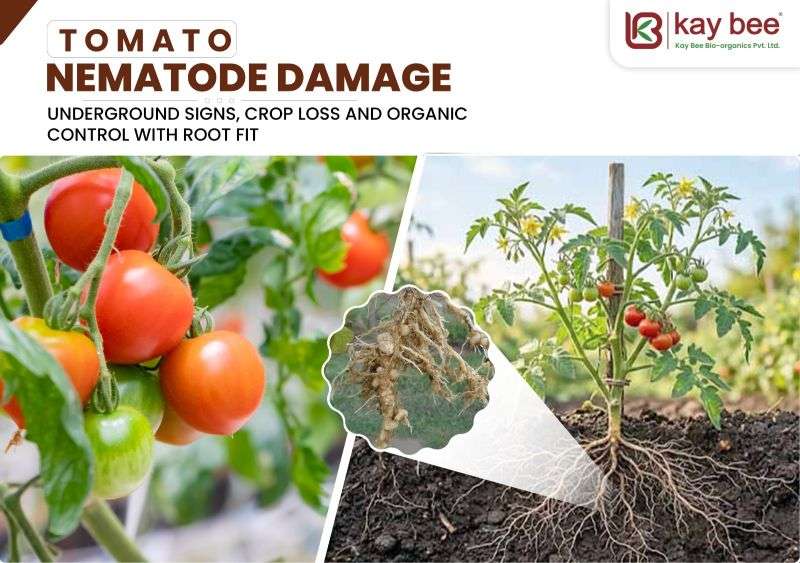
Tomato Nematode Damage: Underground Signs, Crop Loss and Organic Control with Root Fit
Tomato (Solanum lycopersicum L.) is one of the most widely cultivated vegetable crops worldwide and plays a significant role in the horticultural economy. Despite advances in cultivation practices, tomato productivity is often limited by soil-borne pests, particularly nematodes in tomato cultivation. Among these, the root-knot nematode in tomato (Meloidogyne spp.) is considered one of the most destructive pests, causing severe tomato nematode damage in both open-field and protected cultivation.
Unlike foliar insect pests, nematodes attack the root system below the soil surface, making early detection difficult. They feed on root tissues, interfere with water and nutrient uptake, and induce the formation of characteristic root galls, commonly known as root knot of tomato. As a result, infected plants become stunted, wilt easily, produce fewer flowers and fruits, and ultimately suffer significant yield losses. Healthy root development is the foundation of a productive crop. To understand why strong white roots are essential for better nutrient uptake and higher yields, also read our guide on The Significance of White Root Development in Enhancing Crop Health and Yield.
Since nematodes remain hidden underground for most of their life cycle, effective tomato nematode control depends on preventive measures, soil health improvement, and the use of biological solutions such as Root Fit, a biological nematicide designed to suppress nematode populations while promoting healthy root development. For a broader understanding of sustainable crop protection practices, also read our guide on Importance of Organic Farming in India.
What are Root-Knot Nematodes?
Root-knot nematodes in tomato (Meloidogyne incognita, M. javanica, and M. arenaria) are microscopic roundworms that parasitize plant roots.
These nematodes:
- Live in soil
- Attack more than 2,000 plant species
- Invade young feeder roots
- Complete several generations in one growing season
- Thrive in warm, moist soils
Because they remain underground, farmers usually recognize the problem only after severe tomato nematode damage has already occurred.
Identification of Root-Knot Nematodes
Although nematodes themselves are microscopic, the symptoms they produce are easily recognized.
Juveniles
- Transparent
- Worm-like
- Microscopic
- Infective stage responsible for root invasion
Adult Females
- Pear-shaped
- White
- Embedded inside root tissues
Adult Males
- Slender
- Worm-like
- Rarely cause direct feeding damage
Underground Signs of Root Knot of Tomato
The most characteristic feature of root knot of tomato is the development of abnormal swellings on roots.
Tomato Root Galls
Healthy roots become swollen due to nematode feeding.
Typical symptoms include:
- Small root knots
- Large irregular galls
- Thickened feeder roots
- Reduced root branching
- Decayed feeder roots
- Brown lesions under severe infection
Large numbers of galls reduce the plant’s ability to absorb water and nutrients. Improving soil biology and maintaining healthy roots helps crops tolerate soil-borne pests more effectively. Learn more in our article on Best Organic Farming Products in India.
Above Ground Tomato Nematode Symptoms
Although the damage begins underground, visible tomato nematode symptoms gradually appear above the soil.
Common symptoms include:
- Stunted plant growth
- Yellowing of older leaves
- Midday wilting despite adequate irrigation
- Poor flowering
- Reduced fruit set
- Small fruit size
- Nutrient deficiency-like symptoms
- Premature plant decline
These tomato nematode symptoms are often confused with fertilizer deficiencies or water stress, delaying appropriate management. Regular crop monitoring helps distinguish pest damage from nutritional disorders. For more insights into identifying crop problems early, also read our guide on Top 10 Crop Diseases in June and Their Organic Management.
Lifecycle of Root-Knot Nematode in Tomato
Understanding the biology of root-knot nematode in tomato helps in designing effective management strategies.
Egg Stage
Female nematodes lay 300–1,000 eggs in a gelatinous egg mass attached to the root surface.
Juvenile Stage
Second-stage juveniles (J2) hatch from eggs and actively move through soil toward tomato roots.
This is the infective stage.
Root Penetration
Juveniles enter young feeder roots and establish permanent feeding sites.
They stimulate abnormal cell enlargement, resulting in root knot of tomato.
Adult Stage
Female nematodes remain inside roots and continue laying eggs.
The complete lifecycle is completed within 25–35 days under favourable temperatures.
Several generations may develop during one tomato crop.
Understanding pest life cycles is essential for timely intervention and sustainable pest management. To explore more botanical crop protection solutions, also read our guide on Best Neem-Based Pesticides for Agricultural Crops.
Crop Loss Due to Nematodes in Tomato Plants
Severe tomato nematode damage affects crop productivity in several ways.
Losses occur because nematodes:
- Reduce water absorption
- Limit nutrient uptake
- Suppress root growth
- Reduce flowering
- Decrease fruit number
- Lower fruit weight
- Increase susceptibility to fungal and bacterial root diseases
Yield losses of 20–60% are common, while severe infestations may cause even greater reductions. Maintaining healthy soil biology is one of the most effective ways to reduce soil-borne pest pressure. To learn more about sustainable crop production, also read our guide on Importance of Organic Farming in India.
Conditions Favouring Nematode Infestation
Root-knot nematodes multiply rapidly under:
- Soil temperature between 25–30°C
- Sandy or light-textured soils
- Continuous tomato cultivation
- Poor crop rotation
- Presence of alternate weed hosts
- Infected nursery seedlings
Monitoring and Diagnosis
Since nematodes in tomato plants are invisible to the naked eye, diagnosis depends on careful field observations.
Inspect plants showing:
- Stunted growth
- Wilting during hot afternoons
- Uneven crop growth
- Yellow foliage
Carefully uproot affected plants and examine the roots.
The presence of numerous tomato root galls confirms root-knot nematode in tomato infestation. Regular field scouting and early diagnosis play an important role in Integrated Pest Management. For more practical crop protection insights, also read our guide on Best Organic Farming Products in India.
Integrated Tomato Nematode Control
Effective tomato nematode control requires multiple preventive practices.
- Healthy Seedlings
Use nematode-free nursery plants.
- Crop Rotation
Rotate with cereals such as maize or sorghum to reduce nematode populations.
- Organic Matter
Apply well-decomposed farmyard manure and compost to improve soil biological activity. Healthy soils with active microbial populations contribute significantly to stronger root systems. Learn more in our article on The Significance of White Root Development in Enhancing Crop Health and Yield.
- Weed Management
Remove alternate host weeds that support nematode survival.
- Soil Solarization
In nurseries, soil solarization during summer helps reduce nematode populations.
- Nematode Resistant Tomato Varieties
Where available, cultivate nematode resistant tomato varieties possessing resistance against root-knot nematodes to minimize infestation and improve crop performance.
Organic Control of Tomato Nematodes
Increasing emphasis on sustainable agriculture has encouraged the adoption of organic methods for tomato nematode control through botanical products.
Botanical nematicides:
- Suppress nematode multiplication
- Reduce root damage
- Enhance root regeneration
- Improve nutrient uptake
- Support long-term soil health
These approaches integrate well with organic farming and Integrated Pest Management (IPM). To explore how botanical crop protection products support sustainable farming while reducing chemical pesticide dependency, also read our guide on Best Neem-Based Pesticides for Agricultural Crops.
Root Fit – Botanical Protection against Root-Knot Nematode in Tomato
Root Fit is a botanical nematicide formulated to support effective tomato nematode control by reducing nematode population and improving root health.
Root Fit is a nematicide manufactured using marker compounds from botanicals. It is a nematicide with proven efficacy against plant parasitic nematodes in tomato. Botanical crop protection products are increasingly preferred by growers seeking sustainable and residue-conscious farming practices. Learn more in our article on Why Export Farmers Choose Neem Insecticides.
Mode of Action
In Plant Parasitic Nematode
- Contact: It stops feeding and is paralyzed within 24 to 48 hours.
- Systemic: It acts as a repellent, resists stylet insertion through anti-enzymatic activities, and protects against gall formation on roots.
- Fumigant: Enters through the semipermeable body walls of nematodes and acts on pseudocoelomic fluid, leading to cryptobiosis (hibernation) breaking and reducing nematode inoculum.
Recommended Application
Root Fit may be applied through:
- Soil drenching
- Drip irrigation
- Root-zone application during transplanting
Benefits of Root Fit
- Botanical solution for sustainable agriculture
- Supports effective tomato nematode control
- Helps suppress root-knot nematode in tomato
- Reduces formation of root knots of tomato
- Improves root growth and branching
- Enhances nutrient and water absorption
- Promotes healthier plant establishment
- Compatible with Integrated Pest Management (IPM)
- Improves soil microbial activity
- Environmentally friendly with no harmful chemical residues
For even better results, botanical nematicides should be combined with healthy soil management and organic farming practices. Read more in our guide on Importance of Organic Farming in India.
Recommended Management Schedule
| Crop Stage | Recommended Practice |
| Before transplanting | Apply Root Fit in nursery @ 0.5 ml/L |
| At transplanting | Root-zone application @ 0.5 ml/L |
| 15–25 DAT | Soil drenching or drip application @ 250–500 ml |
| 30 DAT | Soil drenching or drip application @ 750–1000 ml/acre |
| Every 20–30 days | Repeat application based on infestation level |
| Throughout season | Maintain crop rotation and use nematode resistant tomato varieties wherever available. Combining crop rotation with biological crop protection products improves long-term soil health and suppresses nematode populations. To learn more, read our guide on Best Organic Farming Products in India. |
Conclusion
Root-knot nematode in tomato is often overlooked because the pest attacks underground, yet it can severely reduce plant growth, fruit production, and overall profitability. The presence of root knot of tomato, poor root development, and characteristic tomato nematode symptoms are clear indicators of infestation. Healthy roots are the foundation of a healthy crop. To understand the importance of vigorous root development for nutrient uptake and higher yields, also read our guide on The Significance of White Root Development in Enhancing Crop Health and Yield.
An integrated approach involving healthy seedlings, crop rotation, organic matter management, nematode resistant tomato varieties, and biological products offers sustainable tomato nematode control. The application of Root Fit, a botanical nematicide, helps suppress nematodes in tomato plants, reduces tomato nematode damage, improves root health, and supports higher yields with long-term soil productivity.
Botanical crop protection products are becoming an essential part of sustainable agriculture by reducing dependency on conventional chemical pesticides while protecting soil health. For more insights into eco-friendly pest management, also read our guide on Best Neem-Based Pesticides for Agricultural Crops.
If you’re looking to build a more sustainable farming system with healthier soil and stronger crops, explore our article on Importance of Organic Farming in India.
Latest Blogs
 Brown Plant Hopper Paddy Organic Control with Pesto Raze & Mealy Raze
 Mycorrhiza Technical Manufacturer in India | Kay Bee Bio-Organics Pvt. Ltd.
 Cotton Whitefly Management During Square Formation Stage: Effective Control with Pesto Raze & OrgaNeem
 Calcium for Cabbage Head Formation: How Calboost (Ca-11%) Ensures Tight & Crack-Free Heads
 Citrus Canker Organic Control: A Complete Farmer’s Guide
COPYRIGHT © 2026 - ALL RIGHTS RESERVED. MADE BY WebAppGigs