
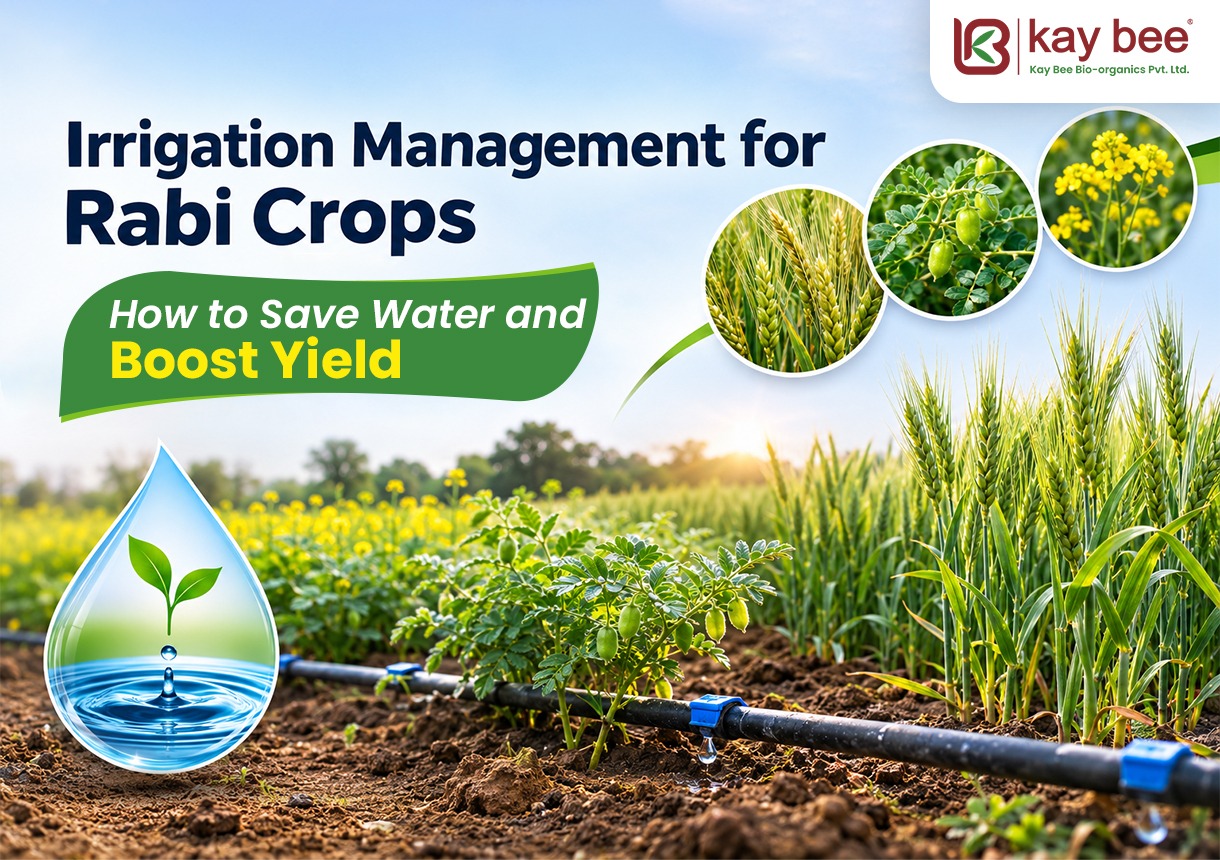
Irrigation Management for Rabi Crops: How to Save Water and Boost Yield
Introduction: Irrigation Management for Rabi Crops
Rabi crops live on the moisture already stored in the soil and a few well-timed irrigations, so every round of watering counts. With groundwater sinking and electricity bills going up, there is little room for waste. The hopeful part is that better irrigation doesn’t have to mean more irrigation. Water at the right stage, in the right amount, and with the right method, and you can often use less water while still bringing home a bigger harvest. Here is a practical guide to help you do that. This guide on irrigation management for rabi crops covers every winter crop in India, from wheat to mustard.
Rabi crops depend on stored soil moisture and a few well-timed irrigations. Water wheat at crown root initiation, tillering, flowering, and dough stage; check soil moisture before each irrigation; and use drip or sprinklers to save water and boost yield.
-
Why Water Management Matters in Rabi
- Little rainfall: Rabi crops depend mostly on irrigation, so how well you plan your water largely determines the harvest.
- Falling water tables: Flooding fields drains borewells and open wells a little faster every year.
- Rising costs: Pumping hours, diesel and electricity all eat into your profit.
- Yield risk: Too little water damages the crop, and so does too much. Both pull down yield and quality.
That is why water management in rabi crops is now as much a money question as a farming one.
-
Know Your Crop’s Critical Stages
A crop doesn’t need the same amount of water all the time. There are a few short windows when a shortage costs you heavily, and those are the ones you should never miss.
Wheat
- Crown root initiation, CRI (20 to 25 days after sowing): If you can only give one irrigation to wheat, this is the one.
- Tillering and jointing (40 to 65 days): Water here helps the plant build tillers and grow strong stems.
- Flowering and milking (80 to 105 days): This protects both grain number and size.
- Dough stage (115 to 120 days): A light last watering, mainly useful on very light soils.
These are the critical stages of wheat irrigation, and crown root initiation is the most important.
Other rabi crops
- Potato: Keep the soil evenly moist while tubers form and bulk up. Stop irrigating about 10 days before haulm cutting.
- Chickpea: One or two irrigations are usually enough, at branching and at pod filling. Overwatering makes the plant leafy and reduces pods.
- Mustard: Water at branching and again at flowering or pod formation.
- Onion: It prefers light, frequent watering while bulbs develop. Hold back water before harvest. Follow the onion growth stages when planning this.
-
Read the Soil, Not Just the Calendar
A fixed schedule is a fine starting point, but the soil tells you what is really going on.
- The feel test: Take a handful of soil from root depth and squeeze it. If it forms a loose ball that crumbles, it has enough moisture. If it won’t hold together at all, it’s time to irrigate.
- Know your soil type: Sandy soils dry out quickly and need light, frequent watering. Black cotton soils hold water longer, so they need fewer but deeper irrigations. Loamy soil for plants sits in the middle: it drains well yet holds moisture, so a medium schedule usually works. To better understand your field, read our guide to different soil types.
- Keep an eye on the weather: If rain is forecast, skip or postpone the irrigation. If a cold wave or dry wind is drying out the field fast, you may need to add one.
- Watch the plants: Leaves that roll up or turn dull and bluish in the afternoon signal crop stress.
-
Ways to Save Water
Change how water is applied.
- Drip irrigation: Water goes straight to the root zone. It suits potatoes, onions, and vegetables, and can save a lot of water. Drip irrigation for rabi crops is the most direct way to cut water use.
- Sprinklers: Good for wheat, chickpea and mustard, with even coverage and less loss.
- Ridges and furrows or raised beds: Water runs only in the furrows, so less is wasted, and roots get better aeration.
- Check basins and short furrows: Dividing the field into small basins or short furrows creates smaller plots, which stop water from collecting at one end of the field.
Improve the field itself.
- Laser land levelling: A level field spreads water evenly and significantly shortens irrigation time.
- Mulching: A layer of straw or crop residue cuts evaporation and keeps soil temperature steadier.
- Weed control: Weeds drink your water, so keep the field clean.
- Organic matter: Compost and FYM help the soil hold on to moisture. They also work as a natural organic soil conditioner.
-
Right Amount, Right Time
- Don’t overdo it: Standing water cuts off oxygen to the roots, turns leaves yellow and invites disease.
- Go light the first time: In wheat, give a light watering at CRI so young roots don’t get a shock.
- Pick cooler hours: Irrigating in the early morning or evening reduces evaporation.
- Protect against frost: A light irrigation on a frosty evening can keep the field a little warmer and protect potato and vegetable crops.
- Ease off near maturity: Cutting back water as the crop nears maturity helps the grain ripen evenly.
Right timing is also the simplest form of crop stress management, because both too little and too much water put stress on the plant.
-
How Many Irrigations Does a Crop Really Need?
The number varies with soil, season, variety and atmospheric conditions, so take these as rough guides and adjust to your local conditions. So, how many irrigations does wheat need? Usually four to five, as shown below.
- Wheat: Usually, four to five. Light soils incline toward the higher end, heavy soils toward the lower.
- Chickpea: One or two, and only if the winter is dry.
- Mustard: Two to three, mainly at branching and pod formation.
- Potato: Frequent light irrigations, often six to eight, depending on soil and weather.
- If water is scarce: With only one irrigation, give it at CRI in wheat. With two, add the second at flowering.
-
Take Care of Your Pump and Channels
Even the best schedule fails if water is lost on its way to the crop. A little maintenance can save you hours of pumping.
- Fix leaks: Repair cracks in pipes and channels, and consider lined channels or underground pipelines.
- Use the right pump: An oversized or worn-out pump wastes electricity. Get it serviced before the season starts.
- Clean the filters: In drip systems, clogged filters and emitters cause uneven watering.
- Keep a record: Note the date, hours and crop stage for each irrigation. After one season, you’ll clearly see where water was wasted.
-
Water and Nutrients Work Together
If nutrients are missing, extra water won’t rescue the crop. And if water is short, the plant can’t take up the nutrients that are there.
- Split your nitrogen: Apply part of the urea with the first irrigation and the rest later, not all at once.
- Don’t flood right after fertiliser: Heavy irrigation at that point leaches nutrients and wastes money.
- Mind the micronutrients: A zinc deficiency can look like water stress, so get your soil tested. Read more on zinc deficiency in crops and on micronutrient deficiency in rabi crops.
- Check your water quality: Borewell water in many areas is alkaline. High pH water can affect nutrient availability and the performance of foliar sprays, so test your irrigation water. If the pH is high, a water pH reducer such as pH Tunner, also sold as an organic soil enhancer, can help.
- Support the roots: Strong roots find water and nutrients more easily. A mycorrhizal bio-fertiliser for strong roots, such as Mycoris, helps build a healthy root zone.
Water shortage, cold and nutrient deficiency are all abiotic stresses. Abiotic stress management in plants works best when water and nutrition are handled together.
-
Water-Saving Checklist
| Step | What to do |
|---|---|
| Before sowing | Level the field and prepare ridges or beds |
| At sowing | Give a pre-sowing irrigation only if the soil is dry |
| During growth | Irrigate at critical stages, guided by soil moisture |
| Every irrigation | Check the pump, channels and pipes for leaks |
| Near maturity | Stop water on time and avoid late flooding |
-
Common Mistakes to Avoid
- Irrigating out of habit: Watering every week without checking the soil wastes water.
- Missing the critical stage: Skipping the CRI irrigation in wheat can cost more yield than the water you saved.
- Leaky channels: Unlined earthen channels lose a large share of the water before it reaches the crop.
- Uneven fields: One end floods while the other stays dry.
- Poor drainage: Waterlogging after rain or irrigation can quickly damage roots.
-
Government Support
Many states, Maharashtra included, offer subsidies on drip and sprinkler systems under schemes such as the Pradhan Mantri Krishi Sinchayee Yojana. This can reduce the upfront cost of drip irrigation for rabi crops. Before buying any equipment, visit your local agriculture office and ask about current eligibility rules and subsidy rates.
Water Saved Is Money Earned
Every irrigation you skip saves pumping hours, electricity or diesel, and labour. Across a whole season, those savings make a real difference to your profit. The water you leave in the ground also helps your neighbours and your own wells in the years ahead.
Frequently Asked Questions (FAQs)
Q1. How many irrigations does wheat need?
Usually four to five. Light soils need more, heavy soils fewer. If you can give only one irrigation, give it at crown root initiation, 20 to 25 days after sowing.
Q2. What is the critical stage of irrigation in wheat?
Crown root initiation is the most important. Tillering and jointing, flowering and milking, and the dough stage are also critical.
Q3. Which method saves the most water in rabi crops?
Drip irrigation suits potato, onion and vegetables. Sprinklers suit wheat, chickpea and mustard. Ridges and furrows and laser land levelling also reduce water loss.
Q4. How do I know when to irrigate using soil moisture?
Squeeze a handful of soil from root depth. If it forms a loose ball that crumbles, the soil is moist enough. If it won’t hold together, irrigate.
Q5. How many irrigations do chickpea and mustard need?
Chickpea needs one or two, at branching and pod filling. Mustard needs two to three irrigations, at branching and during flowering or pod formation.
Q6. Is there a subsidy for drip and sprinkler irrigation in Maharashtra?
Yes, under schemes such as the Pradhan Mantri Krishi Sinchayee Yojana. Check eligibility and current rates at your local agriculture office.
Q7. Does irrigation water pH matter for rabi crops?
Yes. High pH water can affect nutrient availability and spray performance. Test your water, and use a pH reducer if it’s high.
Final Thoughts
Good irrigation is less about how much water you give and more about timing, method and observation. That is the heart of irrigation management for rabi crops. Know your crop’s critical stages, check the soil before every watering, choose efficient methods, and keep your fields level and well managed. Do that, and your rabi crop will make the most of every drop, giving you a stronger yield, lower costs and a healthier water table for the seasons ahead.
Latest Blogs
 Efficient Nutrient Management: How to Reduce Crop Production Costs
 Gram Pod Borer Control in Chickpea: How to Control Gram Pod Borer in Chickpea: Symptoms, Life Cycle, and Organic Management
 Zinc Deficiency in Crops: Importance of Zinc in Wheat, Potato and Other Rabi Crops
 Red Gram Pod Fly Management: Identify Pod Damage and Protect Tur Crop Yield
 Bunch Rot Of Grapes: Symptoms, Causes, Control And Best Effective Treatment Strategies
COPYRIGHT © 2026 - ALL RIGHTS RESERVED. MADE BY WebAppGigs