
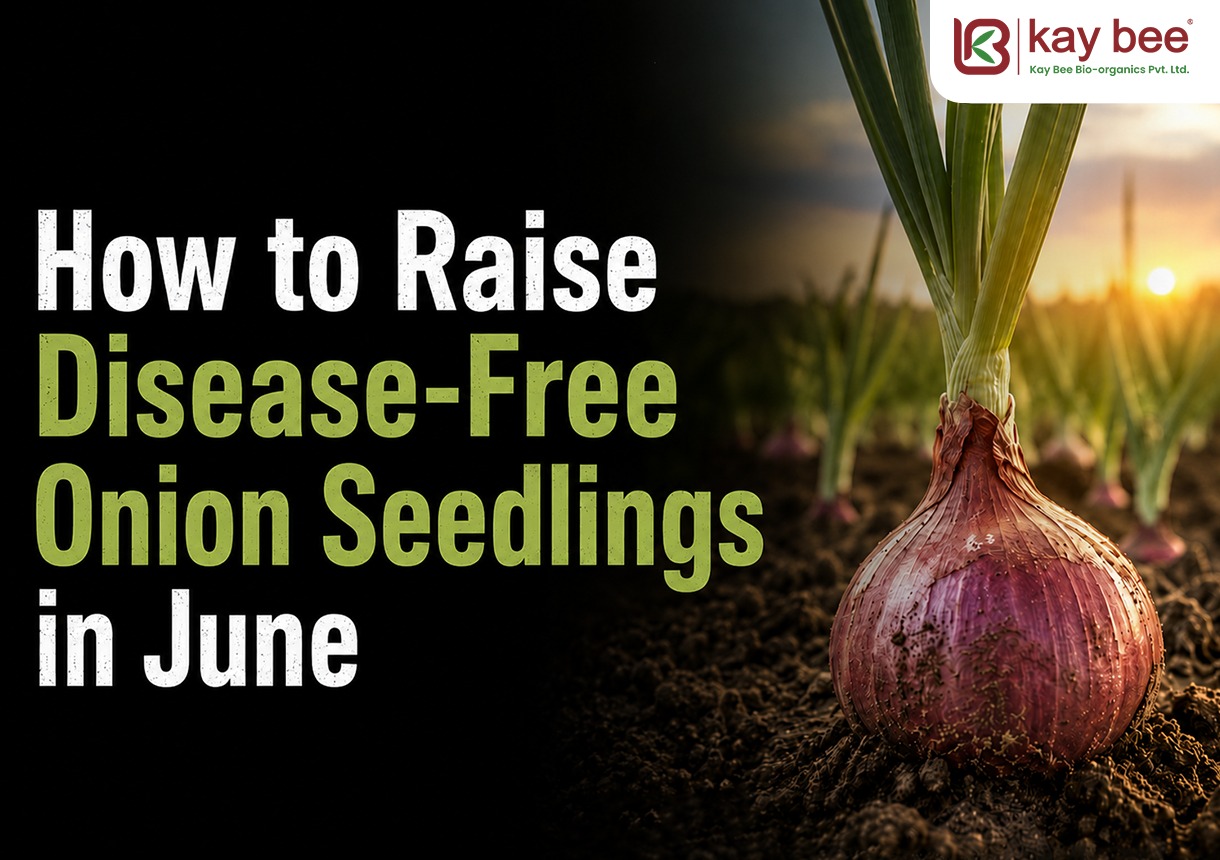
How to Raise Disease-Free Onion Seedlings in June
Step-by-Step Secret to Grow Disease Free Onion Seedlings
Many farmers debate whether it is better to raise seedlings at home or buy them from a nursery. The reality is simple: disease free onion seedlings are not determined by where they are grown but by how they are grown.
Whether you manage your own nursery or source seedlings from a professional grower, the fundamentals remain the same: strong roots, disease protection, balanced nutrition, and timely care. When these steps are followed consistently, seedlings establish faster, survive transplant stress better, and give the crop a stronger start in the field.
Because every successful onion crop begins with a well-managed nursery.
Build the Bed Like You Build a Foundation
Good onion nursery management starts not with seed: it starts with soil.
Choose a spot with good morning sunlight and natural drainage. Prepare a raised bed: 1 meter wide, raised 15 cm above ground level. Raised beds are non-negotiable. Waterlogging is the silent killer of young onion seedlings, and a raised bed drains excess water before it does damage.
Break every soil clump. Mix well-rotted compost into the top layer. The final seedbed should feel like fine powder: soft, loose, and uniform. This one step determines everything that follows.
Treat the Seed Before It Touches Soil
This is the step most farmers skip. It is also the step that separates a strong nursery from a failing one.
On Day 0, treat your seeds with Mycoris Premium – 100 grams per 3 kg of seed. Mycorrhizal fungi in Mycoris attach to the seed immediately, building root networks from the very first moment of germination. The seedling emerges stronger, more resilient, and far better at absorbing nutrients.
For one acre, 3 kg of treated seed is sufficient.
After treatment:
- Shade dry the seed for 30 minutes
- Sow in lines with 5–7 cm row spacing
- Maintain uniform seed distribution
- Water gently after sowing
Line sowing improves airflow, simplifies weeding, and produces more uniform seedlings for transplanting.
The first signs of germination generally appear within 4–5 days.
The Disease Window – Days 10 to 20
This is the most dangerous phase of your nursery. This is when onion seedling damping off strikes : and when it does, it is fast, invisible at first, and devastating.
Damping off is a fungal condition that rots the seedling stem at soil level. One day the seedling stands. The next day it collapses. By the time you notice it, it has already spread.
Day 10–12: Drench with Root Fit @ 0.5 ml per litre of water. This is your first and most important defence against damping off and early root diseases.
Day 13–15: Spray 19:19:19 @ 1 gm + Nutrix @ 1 gm per litre. Balanced nutrition at this stage builds cell wall strength making seedlings physically harder for fungal pathogens to penetrate.
Day 15 onwards: Remove weeds by hand. After weeding, apply zinc and humic acid to restore disturbed soil nutrition. Never use chemical weedicide at this stage.
Onion Root Disease Treatment: The Right Schedule
Healthy roots are your only insurance against crop failure. Weak roots invite every disease in the field.
Day 20: Spray Sulphur 1 gm + 19:19:19 @ 2 gm per litre ,early fungal prevention.
Day 20–25: Drench Root Fit 2 ml + Nova Drip 1 ml per litre. This is your onion root disease treatment checkpoint, strengthening root architecture before transplanting stress hits.
Day 20–30: Spray Thrips Raze 1 ml + Fungo Raze 1 ml per litre. Thrips arrive silently. Prevent before you see damage.
Day 30–35: Spray Fungo Raze 1 ml + Organeem 3000 PPM @ 1 ml + 13:00:45 @ 2 gm per litre. This final combination protects, nourishes, and prepares every seedling for successful transplanting.
Always spray in the early morning or evening. Never in peak afternoon sun.
The Crop Is Already Decided Before Transplanting
Most farmers think the onion crop begins on transplanting day.
It doesn’t.
By the time a seedling reaches the field, much of its future has already been decided. A seedling with a strong root system, balanced nutrition, and healthy early growth adapts faster, withstands stress better, and establishes itself more quickly after transplanting.
The field only reveals the results. The nursery is where those results are created.
The Seedling That Survives Is the One That Was Cared For
A nursery is not just a patch of soil with seeds in it. It is thirty-five days of daily decisions, each one either building a stronger plant or allowing a weaker one.
Disease free onion seedlings do not happen by chance. They happen because a farmer stood in his nursery at dawn, mud on his hands, checking every row knowing that what grows here determines everything that comes after.
Latest Blogs
 Brown Plant Hopper Paddy Organic Control with Pesto Raze & Mealy Raze
 Mycorrhiza Technical Manufacturer in India | Kay Bee Bio-Organics Pvt. Ltd.
 Cotton Whitefly Management During Square Formation Stage: Effective Control with Pesto Raze & OrgaNeem
 Calcium for Cabbage Head Formation: How Calboost (Ca-11%) Ensures Tight & Crack-Free Heads
 Citrus Canker Organic Control: A Complete Farmer’s Guide
COPYRIGHT © 2026 - ALL RIGHTS RESERVED. MADE BY WebAppGigs