
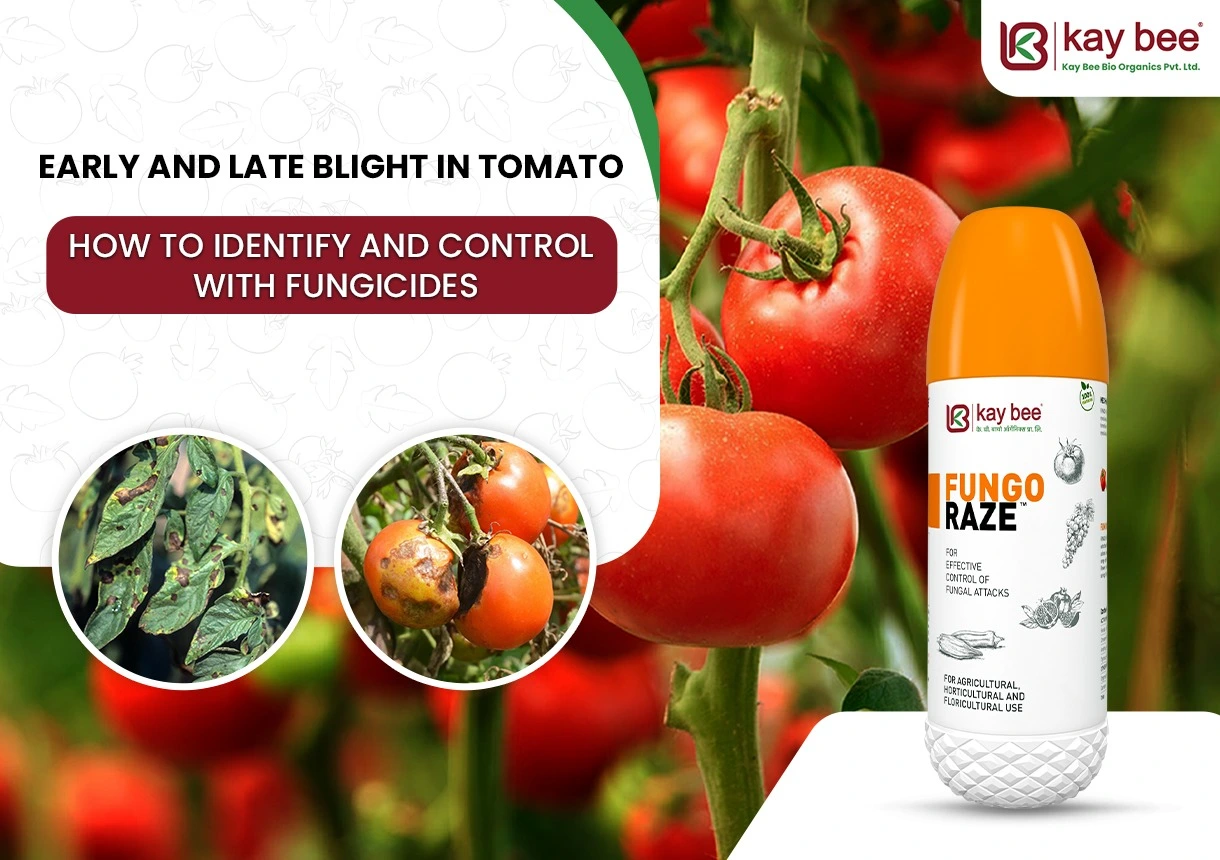
Early and Late Blight in Tomato: How to Identify and Control with Fungicides
Introduction
Tomato (Solanum lycopersicum) is one of the most widely cultivated and economically important vegetable crops worldwide. It ranks second after potato and can be grown throughout the year, providing a steady income to farmers. However, tomato cultivation is highly affected by several fungal, bacterial, and viral diseases that reduce both yield and fruit quality.
Among these, early blight and late blight tomato diseases are the most destructive. Tomato blight spreads rapidly under favorable conditions and often becomes difficult to control if not managed at the right time. Many farmers are unaware of the symptoms, environmental conditions, and proper tomato disease management practices, which directly impacts productivity. Therefore, adopting effective tomato blight control measures is essential for profitable tomato cultivation.
What is Early Blight of Tomato?
Early blight is a fungal disease which is caused by fungus Alternaria solani – commonly referred to as Alternaria blight. It mainly attacks the leaves, stems, and sometimes fruits of tomato plants, especially during warm and humid conditions. In blights it comes early on field soon after transplanting or during early growth stages of crop. It is a slow spread disease compared to other blight.
How to Identify Symptoms of Early Blight in Tomato
Early blight first attack on older leaves produce a dark brown colour concentric ring like target board symptom on leaves, fruit and stem. These spots enlarge, turn yellow, leaves become dry and start to fall. On fruit infection occurs mostly on calyx or at stem end. Fruit dropping and fruit become unfit for market.
Early detection and use of a suitable early blight fungicide are critical for effective control.

Blight On Leaves

Blight On Stem

Blight On Fruits
What is Late Blight of Tomato?
Late Blight also known as Phytophthora blight which is caused by fungus Phytophthora infestans. often referred to as Phytophthora tomato disease. It is a more dangerous disease than early blight. It spreads by air and destroys complete tomato cultivation within a few days. It attack to crop after an early blight
View Product Details – Fungo Raze
How to Identify Symptoms of Late Blight in Tomato
-
- Large water soaked lesion on leaves
- White fungal growth on lower side of leaves
- Brown patches form on fruit and fruit become firm and rot.

Cottony growth on lower side of Leaves

Cottony Growth on Fruits

Cottony Growth on Fruits
Timely tomato blight control is essential to prevent complete crop loss.
Ideal Condition for Disease Development
Early blight of tomato require warm and humid climate, temperature ranges from 24-30°C and poor aeration in field
Late blight of tomatoes requires a cool and highly humid climate. Favourable temperature for disease development is 10-20°C and more than 90% humidity. Cloudy weather and continuous rainfall and continuous wetting on leaves at least for 12 hrs. ideal condition for development and spread of disease. Understanding these conditions helps in better tomato disease management.
Control Measures for Blight of Tomato
Deep Ploughing
Deep Ploughing in summer helps to expose soil to sunlight which helps to kill spore present in soil which cause disease to next crop
Destroy Infected Plant Parts
After harvesting, if an infected plant part remains in the field it will transmit a disease to the next crop. Soil is a natural medium for the development of spores, so that’s why destruction and decomposition of infected plant parts is necessary to stop a cycle of disease.
Crop rotation:
Avoid continuous cultivation of solanaceous crops (tomato, chilli, brinjal). Rotate with non-solanaceous crops to reduce Alternaria blight and Phytophthora tomato incidence.
Maintain Plant Spacing
Early and late blight disease progresses by high humidity so proper plant to plant and row to row spacing should be maintained to avoid crowding of plants and reduce humidity in the field.
Irrigation Management:
Avoid sprinkler irrigation because when water droplets disperse on plant leaves it makes a moist condition which is most favourable for early and late blight of tomato. So use drip irrigation over sprinkler irrigation.
Fungicidal Control
Kay Bee Bio Fungo Raze is a broad-spectrum vegetable fungicide which gives 100% organic solutions for control of all air borne fungal diseases like tomato blight control. It contains a 5-10 marker compound which is extracted from different plant species which show antifungal property. It has multiple site of action that’s why does not cause any resistance to pathogen and showing no residual effect on a Tomato
How It Works
Fungo Raze is a broad spectrum fungicide. It has contact and systemic type mode of action Contact fungicides known as protective fungicide and systemic fungicide act as a curative fungicide. As contact fungicide Fungo Raze inhibits the sporulation and growth of hyphae of Alternaria and Phytophthora by coming in direct contact with spot or lesion and directly controlling a pathogen on site. In systemic mode of action Fungo raze absorb by plant leaves, transmit in entire plant system and controls pathogenic fungi already present inside the plant by preventing spore germination (Antisporulant activity) and damage a cell wall of fungi so prevent the growth and development of hyphae. This dual systemic and contact action makes it an effective choice for both preventive and curative control of early blight.
Dose: Fungo Raze 2 ml/litre water
Conclusion:
Early blight and late blight tomato diseases may show different symptoms but often occur in the same field. Effective tomato disease management requires a combination of cultural practices and the right fungicide application.
Extreme use of chemical fungicides can harm the environment and beneficial microbes while also leading to resistance in pathogens. Therefore, adopting an organic approach like Fungo Raze provides a sustainable and effective solution for tomato blight control, ensuring healthy crops and better yields.
Also Read: Bio-Fungicide Solution for Powdery Mildew in Fruit Crops & Vegetables
Latest Blogs
 Boost Your Cotton Yield: A Practical Guide to Soil Nutrient Mobilization
 The Neem Miracle: How We Extract Azadirachtin from Neem
 Stop Fall Armyworm Before It Destroys Your Maize Farms
 Red Spider Mite Control for Citrus Orchards With R-Mite
 Understanding Mycorrhizal Fungi and Their Role in Modern Agriculture
COPYRIGHT © 2026 - ALL RIGHTS RESERVED. MADE BY WebAppGigs