
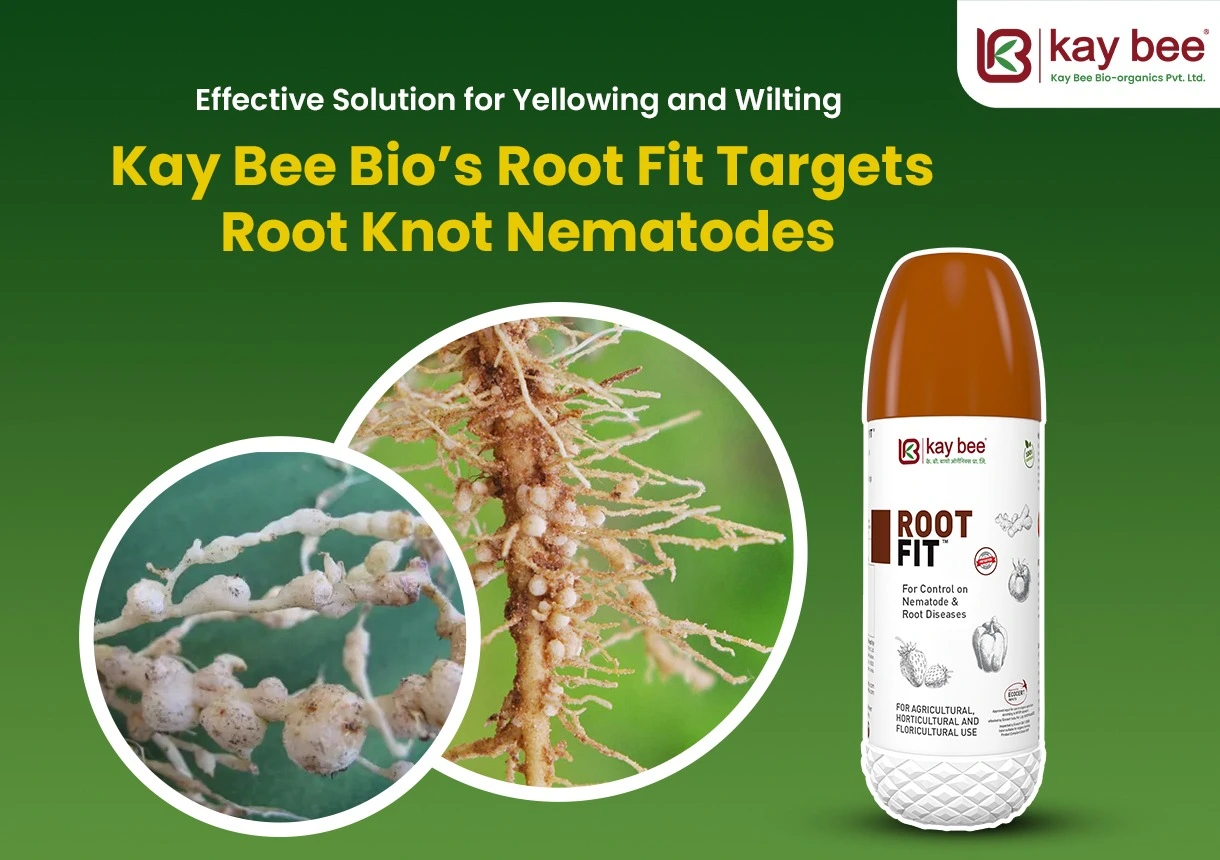
Effective Solution for Yellowing and Wilting: Kay Bee Bio’s Root Fit Targets Root Knot Nematodes
Have you ever noticed yellowing in crops while planning your farm activities? Did you ever pause to consider what might be causing it? Sometimes, even when the roots appear healthy with no visible signs of decay, crops still wilt and die. This puzzling situation raises several questions for farmers. Just as soil-borne fungal pathogens can cause sudden crop mortality, another silent killer is at work beneath the surface, microscopic organisms known as root-knot nematodes. Many farmers often wonder: What exactly are root knot nematodes? How do they damage crops?
How Do Root Knot Nematodes Invade and Harm Crops?
Root knot nematodes are tiny parasitic worms that live in the soil and penetrate the roots of plants for survival. They are invisible to the naked eye, which makes them difficult to detect. These nematodes typically enter the root tip and settle inside, forming abnormal swellings called galls, a clear symptom of root knot nematode infestation.
Impact of Galls on Plant Roots:
Once inside the root system, root knot nematodes feed on vital root cells, drawing out nutrients meant for the plant’s development. This feeding disrupts root function, leading to the formation of gall-like structures. As these galls multiply, they impair the plant’s ability to absorb and transport water and nutrients. Despite proper fertilization and irrigation, the crop begins to exhibit symptoms such as yellowing, stunted growth, and eventual wilting. In severe infestations, even the xylem and phloem are responsible for internal water and nutrient transport, are damaged, leading to significant yield loss. Such destruction is a hallmark of advanced root knot nematode attack.
How to Identify Root Knot Nematode Galls?
While plant death can result from multiple factors like fungal infection, nutrient deficiency, or erratic watering, root knot nematodes must not be overlooked. Not every root swelling is harmful. Legumes like chickpea, soybean, pigeon pea, green gram, and groundnut often develop nitrogen-fixing nodules on their roots. These are beneficial and typically appear pinkish. On the other hand, root knot nematode galls appear pale or white and cause damage. If a single plant within the field appears weak or yellow, it’s essential to uproot it and inspect the roots. Wash the roots thoroughly, if you observe white swellings of the same color as the roots, those are likely root knot nematode galls. These galls hinder nutrient flow, ultimately leading to plant death. Identifying the difference between beneficial nodules and harmful root knot nematode galls is crucial for effective crop management.
Root Fit – Best Fungicide and Nematicide for Root Rot
Click here to buy this product – Root Fit
Proven Methods to Control Root Knot Nematodes:
1) Deep Summer Ploughing:
Conducting deep ploughing during the summer months helps expose and destroy various soil-borne pathogens, including root knot nematodes. This practice disrupts their lifecycle and reduces their population before planting.
2) Crop Rotation:
Rotating crops annually breaks the lifecycle of pests and pathogens. Regular rotation prevents the buildup of root knot nematode populations and improves overall soil health, thereby boosting yields.
3) Use of Root Fit by Kay Bee Bio Organics: A Reliable Organic Solution
Although the market offers several chemical and biological products to control root knot nematodes, most fail to deliver consistent results. Often, farmers misdiagnose the issue and buy separate products for fungal wilt and nematode infestations, doubling their input costs. Furthermore, chemical treatments can eliminate beneficial microbes in the soil, degrading its fertility over time. To address this, Kay Bee Bio has developed a specialized bio-based solution called Root Fit. Root fit has systemic, contact, and fumigant in modes of action. This dual-action product targets both fungal wilt and root-knot nematode infestations effectively with white root development. Farmers can use it repeatedly without the risk of resistance buildup, unlike many synthetic pesticides. Moreover, Root Fit helps preserve essential soil organisms and supports sustainable farming.
For application, mix 750 ml to 1 liter of Root Fit per acre with 200 liters of water and apply through root drenching. This ensures the elimination of root knot nematodes both in the soil and inside the roots. After treatment, farmers often notice a renewed vigor and greener appearance in their crops.
The presence of root knot nematodes in agricultural soils can go unnoticed until it’s too late. Their ability to silently damage root systems and mimic symptoms of other diseases makes them one of the most dangerous hidden threats in crop production. Early detection and an integrated management approach are crucial for protecting yield potential. With trusted solutions like Root Fit, farmers can take decisive action against root knot nematode infestations and restore the health and productivity of their fields.
Latest Blogs
 Brown Plant Hopper Paddy Organic Control with Pesto Raze & Mealy Raze
 Mycorrhiza Technical Manufacturer in India | Kay Bee Bio-Organics Pvt. Ltd.
 Cotton Whitefly Management During Square Formation Stage: Effective Control with Pesto Raze & OrgaNeem
 Calcium for Cabbage Head Formation: How Calboost (Ca-11%) Ensures Tight & Crack-Free Heads
 Citrus Canker Organic Control: A Complete Farmer’s Guide
COPYRIGHT © 2026 - ALL RIGHTS RESERVED. MADE BY WebAppGigs