
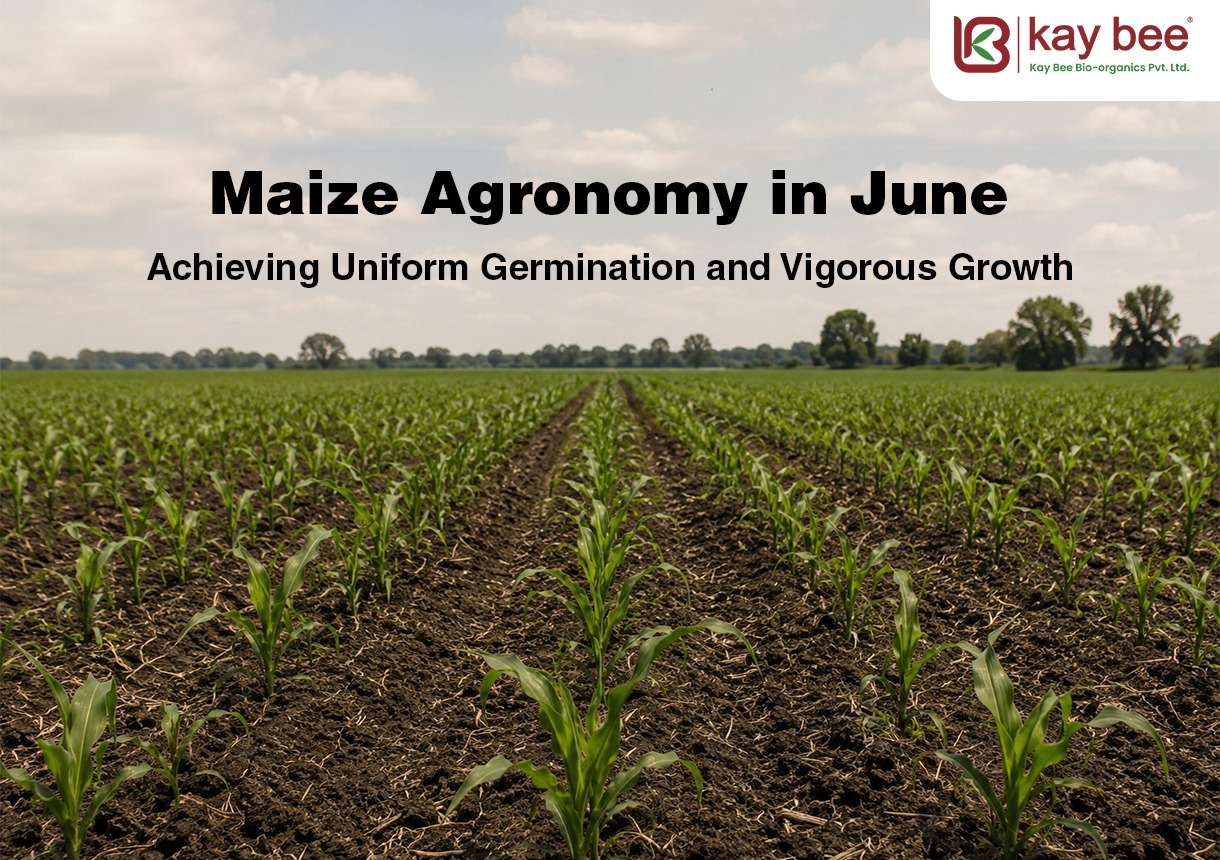
Maize Agronomy in June: Achieving Uniform Germination and Vigorous Growth
In Maize, the First 10 Days Are Everything: Here Is How to Get Them Right
The Thing Most Maize Farmers Underestimate
Ask any experienced maize farmer when his crop is won or lost. He will point to harvest time or perhaps the flowering stage. But agronomists know a different truth.
Maize germination in June sets the foundation for everything that follows. The first 10 days after sowing determine germination percentage, seedling vigor, root depth, and crop uniformity. A field that emerges unevenly in this window carries that unevenness all the way to harvest: uneven canopy, uneven cob development, and uneven yield.
No amount of fertilizer, irrigation, or crop protection applied later can fully correct what went wrong in those first 10 days underground.
Why June Soil Is a Hidden Challenge for Maize
June feels like the perfect month to sow maize. The rains arrive. Soil has moisture. Temperatures are warm. Conditions look ideal on the surface.
But inside the soil, June creates a set of challenges that work directly against uniform germination in maize.
Heavy early monsoon rains compact the soil surface, reducing aeration and creating a physical barrier that emerging seedlings struggle to push through. Soil pH becomes erratic as rainwater interacts with soil chemistry. Beneficial microbial populations drop in waterlogged conditions. Nutrients that the germinating seed desperately needs : phosphorus, zinc, and micronutrients, become chemically locked and unavailable.
A maize seed sitting in June soil is not just germinating. It is fighting. And without soil preparation, many seeds lose that fight silently, producing the gap rows and uneven stands that frustrate farmers every Kharif season.
Neutralite: Building Soil That Welcomes Every Seed
Solving the June soil challenge starts before the seed goes in.
Neutralite is India’s first product that works simultaneously as a soil conditioner and natural bond breaker, correcting the chemical and physical barriers that June soil builds against germinating maize seeds.
What Neutralite does before sowing:
- Make unavailable nutrient available: unlocking phosphorus and zinc that trap away from seedling roots
- Improves soil porosity and aeration: giving emerging seedlings a physically open path through the soil
- Releases trapped nutrients and makes them immediately plant-available
- Improves soil structure: reducing compaction caused by pre-sowing rainfall
When Neutralite conditions the soil before sowing, every maize seed, regardless of where it sits in the row, finds the same balanced, open, nutrient-available environment. That consistency is what produces + uniform germination in maize.
Mycoris: Connecting Every Seedling Root to the Soil
Even well-conditioned soil has nutritional limits that roots cannot cross alone.
Mycoris contains both Endo and Ecto Mycorrhizal Fungi that colonise maize seedling roots from the very first days of germination, building a fungal network through the soil that extends the root’s reach far beyond its physical boundaries. This network accesses phosphorus, zinc, and water from soil zones the root itself could never explore.
For corn seedling establishment in June, this mycorrhizal connection is especially critical. When monsoon rains leach nutrients downward and soil conditions fluctuate daily, the Mycoris network maintains a consistent nutrition supply to every seedling, supporting vigorous early growth even through rainfall stress and temperature variation.
The result is seedlings that emerge together, grow at the same pace, and build the uniform crop stand that high-yielding maize demands.
Dose:
Neutralite 4 kg + Mycoris 2 kg mix together with basal dose fertilizers and apply to soil before sowing.
Apply during morning or evening hours. Ensure sufficient soil moisture or irrigate after application.
Sowing Distance and Seed Calculation Guide
Getting soil preparation right is only half the equation. Sowing geometry determines how well each plant uses the space, light, and nutrition available to it.
Recommended spacing for Kharif maize:
- Row to row: 60 to 75 cm
- Plant to plant: 20 to 25 cm
Easy seed calculation formula:
Divide 43,560 by the product of your row spacing and plant spacing: both measured in inches.
For example, 60 cm rows and 20 cm plant spacing convert to approximately 24 inches x 8 inches. Dividing 43,560 by 192 gives roughly 22,700 plants per acre.
Quick reference:
- 60 cm x 20 cm spacing – approximately 33,000 seeds per acre
- 75 cm x 20 cm spacing – approximately 26,000 seeds per acre
- 60 cm x 25 cm spacing – approximately 26,700 seeds per acre
Always add 10 percent extra seed to your calculation to account for germination variation and field losses.
Wider rows allow better mechanization and airflow. Closer plant spacing suits high-fertility soils where each plant has enough nutrition to perform without competing. Choose your geometry based on your soil, your hybrid recommendation, and your irrigation availability.
Maize Growth in June Starts With What You Do Before Sowing
Maize growth in June Kharif is not determined by rainfall alone, or by seed quality alone, or by fertilizer alone. It is determined by whether the soil was ready to receive the seed on day one.
Neutralize conditions that soil. Mycoris activates the root network inside it. Together they protect the most critical 10-day window in your maize season, ensuring every seed gets the same fair start, every seedling establishes with equal vigour, and your field emerges the way a high-yielding maize crop should.
Uniform. Strong. Ready.
Because maize germination in June handled with the right doeses not just fill your rows, it fills your harvest.
Latest Blogs
 Brown Plant Hopper Paddy Organic Control with Pesto Raze & Mealy Raze
 Mycorrhiza Technical Manufacturer in India | Kay Bee Bio-Organics Pvt. Ltd.
 Cotton Whitefly Management During Square Formation Stage: Effective Control with Pesto Raze & OrgaNeem
 Calcium for Cabbage Head Formation: How Calboost (Ca-11%) Ensures Tight & Crack-Free Heads
 Citrus Canker Organic Control: A Complete Farmer’s Guide
COPYRIGHT © 2026 - ALL RIGHTS RESERVED. MADE BY WebAppGigs