
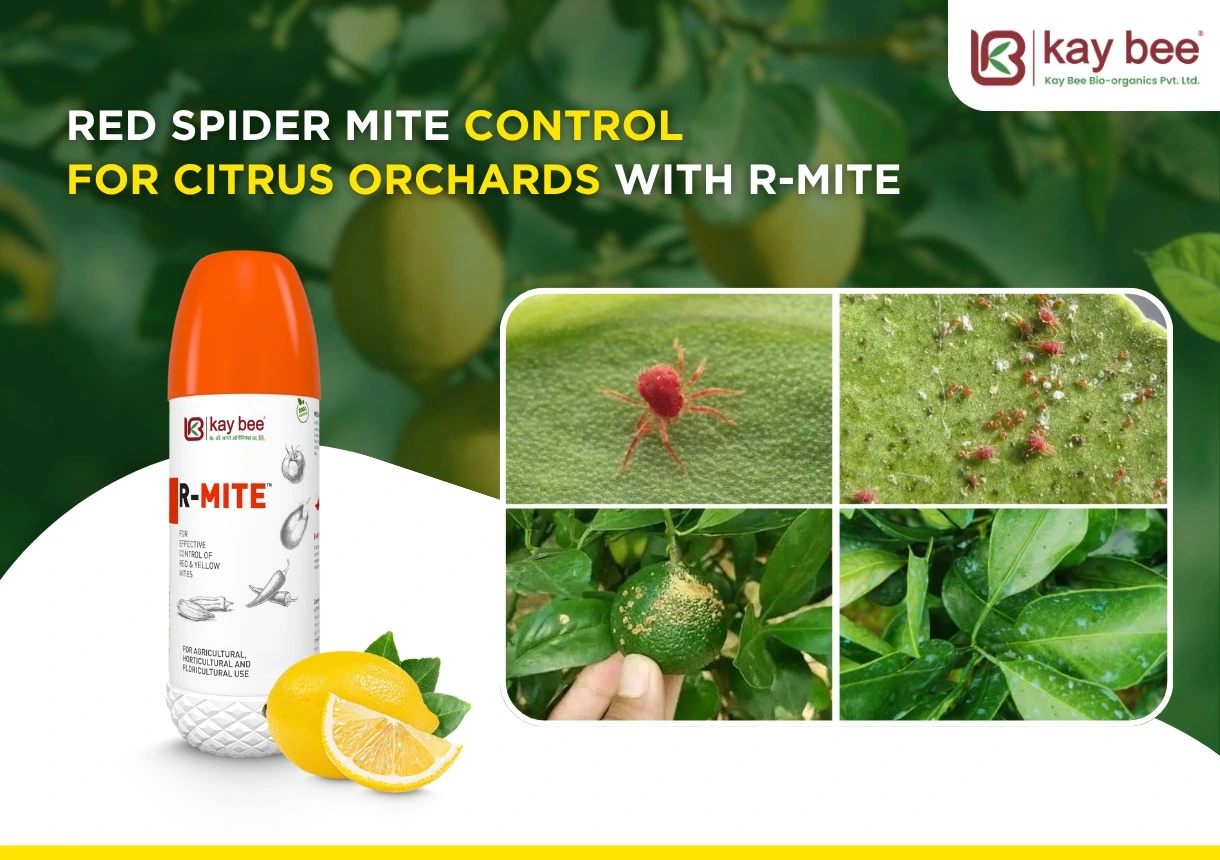
Red Spider Mite Control for Citrus Orchards With R-Mite
India stands as a global leader in citrus production, contributing significantly to the agricultural economy with an annual production of 127.46 lakh metric tonnes. However, maintaining this productivity is a constant battle against silent invaders: citrus mites.
These tiny, persistent pests, particularly the Red Spider Mite, can severely impact the quality, yield, and market value of oranges, lemons, and mandarins. If you are a citrus grower looking to protect your orchard sustainably, understanding how to identify and manage these pests is crucial.
What Exactly is a Mite?
Before getting into control methods, it is important to understand the enemy. Mites are not insects; they are tiny arachnids (often less than 1 mm in size) belonging to the Acariformes and Parasitiformes orders. They are highly adaptable, living in diverse environments ranging from soil to the delicate surfaces of your citrus leaves and fruit.
Understanding the Mite Lifecycle
Mites multiply at an alarming rate, often completing multiple generations within a single season. Understanding their lifecycle is the key to timely intervention:
- Egg: A female lays 5–6 eggs daily (60–100 total) on the underside of leaves. These hatch in 3–6 days.
- Pre-larva: A non-feeding, resting stage inside the egg.
- Larva: The active, initial feeding stage.
- Protonymph & Deutonymph: Growth stages with eight legs; highly active and ravenous.
- Tritonymph: A final nymph stage in some species.
- Adult: The reproductive stage; typically lives for about 30 days.

Identification: Knowing Your Citrus Mites
Because these pests are microscopic, you will need a hand lens for proper inspection. Here are the four most common species that threaten citrus orchards:
| Mite Species | Visual Identification | Typical Damage Symptoms |
| Citrus Red Mite | Reddish/dark pink, round body with long bristles. | Seen mostly on the upper leaf surface. |
| Rust Mite | Minute, wedge-shaped, yellowish. | Found on fruit rind, leaves, and young shoots. |
| Two-spotted Spider Mite | Greenish-yellow to reddish with two dark spots. | Fine webbing, yellow speckling, and bronzing. |
| Broad Mite | Translucent/pale yellow (hard to see). | Leaves curl, thicken, distort, and look glossy. |
The Economic Reality and Impact of Mites
The citrus industry in India is a cornerstone of horticulture, providing livelihoods to millions. However, the unchecked proliferation of mites can result in yield losses ranging from 20% to 50% in severe, untreated cases. When mites feed, they remove chlorophyll from the leaves by piercing plant cells and sucking the sap, effectively “starving” the tree of its ability to photosynthesize.
This stress ripples throughout the plant, resulting in reduced fruit size, the dropping of young fruits, and overall tree senescence. Furthermore, the aesthetic damage- specifically the russeting and browning caused by rust mites, downgrades high-quality produce to “cull” or processing grade, drastically slashing market value and export potential.
Strategies for Proactive Monitoring
Effective management starts with eyes on the ground. A common mistake among orchardists is waiting for visual damage (yellowing or bronzing) to appear before taking action. By the time these symptoms are visible, the population density is likely already at an “economic injury level,” meaning the damage is already done.
Growers should adopt a weekly scouting routine, especially during the dry summer months when mite activity peaks. Focus your inspection on the “canopy interior”, mites prefer the sheltered, humid underside of leaves. Use a 10x hand lens to inspect leaves randomly across different sectors of the orchard. A simple threshold of 3–5 mites per leaf is often the trigger for intervention. Early detection turns a potential disaster into a manageable situation.
The Necessity of Resistance Management
Over-reliance on synthetic acaricides is a known driver of resistance. When the same chemical class is used repeatedly, mite populations develop survival mechanisms, rendering the treatment ineffective over time. This is where an Integrated Pest Management (IPM) strategy becomes vital.
By incorporating botanical solutions like R-Mite into your rotation, you interrupt the selection pressure. R-Mite offers a multi-target, plant-based approach, making it significantly harder for mites to develop resistance compared to single-mode-of-action synthetic products. It also complements other biological control agents, such as predatory mites and ladybird beetles, which act as natural allies in your orchard.
Sustainability is not just about the current harvest; it is about long-term orchard health. Excessive chemical inputs degrade soil biology and contaminate water run-off. Transitioning toward bio-based products ensures that your citrus farming practices are future-proof, maintaining a balanced micro-ecosystem where beneficial organisms can thrive. Furthermore, the phytotonic effects of R-Mite mean trees are better equipped to withstand abiotic stresses like heatwaves and drought, which are increasingly common in major citrus-growing regions.
Sustainable Management: The R-Mite Solution
Integrated Pest Management (IPM) is essential for sustainable citrus cultivation.
Cultural Practices
- Irrigation: Maintain proper watering schedules to reduce plant stress.
- Sanitation: Remove heavily infested twigs and leaves to reduce the spread.
- Orchard Hygiene: Prune overcrowded branches to improve air circulation and reduce dust accumulation on pathways.
Botanical Control: Why Choose R-Mite?
For growers seeking a residue-conscious, highly effective solution, R-Mite offers a breakthrough. It is a novel bio-acaricide formulated from specialized plant extracts.
Key Benefits of R-Mite:
- Broad-Spectrum Control: Highly effective against Red Spider Mites and other sucking pests.
- Phytotonic Effects: Beyond killing mites, it stimulates the plant’s natural defense system and secondary metabolites, improving leaf greenness and fruit shine.
- Residue-Friendly: Being botanical-based, it is an excellent choice for sustainable farming and meets market standards for quality fruit.
- Safe Interaction: When used correctly, it is safe for beneficial insects, preserving the ecological balance of your orchard.
Application Instructions for Best Results
- Dose: Mix 2 ml of R-Mite per litre of water.
- Coverage: Ensure thorough spray coverage, specifically targeting the underside of the leaves and fruits.
- Timing: For best results, spray at high temperatures after 10:00 am.
- Consistency: Apply at 7–8 day intervals, depending on the severity of the infestation.
FAQs on Citrus Mite Control
1. What are the early symptoms of mite infestation in citrus?
Ans: Mite infestation typically manifests as yellowing, speckling, or bronzing on leaves. You may also notice fine webbing on the foliage or rough, russeted patches on the fruit skin.
2. Which is the best botanical spider mite insecticide for citrus?
Ans: Kay Bee Bio’s R-Mite is a highly recommended botanical-based acaricide designed specifically to manage spider mites while enhancing overall crop health.
3. When is the best time to apply acaricide in a citrus orchard?
Ans: For maximum efficacy, apply acaricides at the very first sign of infestation. Early intervention is critical because mites multiply rapidly.
4. Why is the mite lifecycle important in pest management?
Ans: Because mites have a very short lifecycle (hatching in just a few days), their population can explode quickly. Understanding this allows you to time your sprays to break the reproductive cycle effectively.
5. How can I improve overall fruit crop protection from mites?
Ans: Combine regular field monitoring (using a hand lens) with cultural practices like proper pruning and irrigation, and utilize eco-friendly botanical solutions like R-Mite to maintain a sustainable, high-yield orchard.
Latest Blogs
 Boost Your Cotton Yield: A Practical Guide to Soil Nutrient Mobilization
 The Neem Miracle: How We Extract Azadirachtin from Neem
 Stop Fall Armyworm Before It Destroys Your Maize Farms
 Understanding Mycorrhizal Fungi and Their Role in Modern Agriculture
 Early and Late Blight in Tomato: How to Identify and Control with Fungicides
COPYRIGHT © 2026 - ALL RIGHTS RESERVED. MADE BY WebAppGigs