
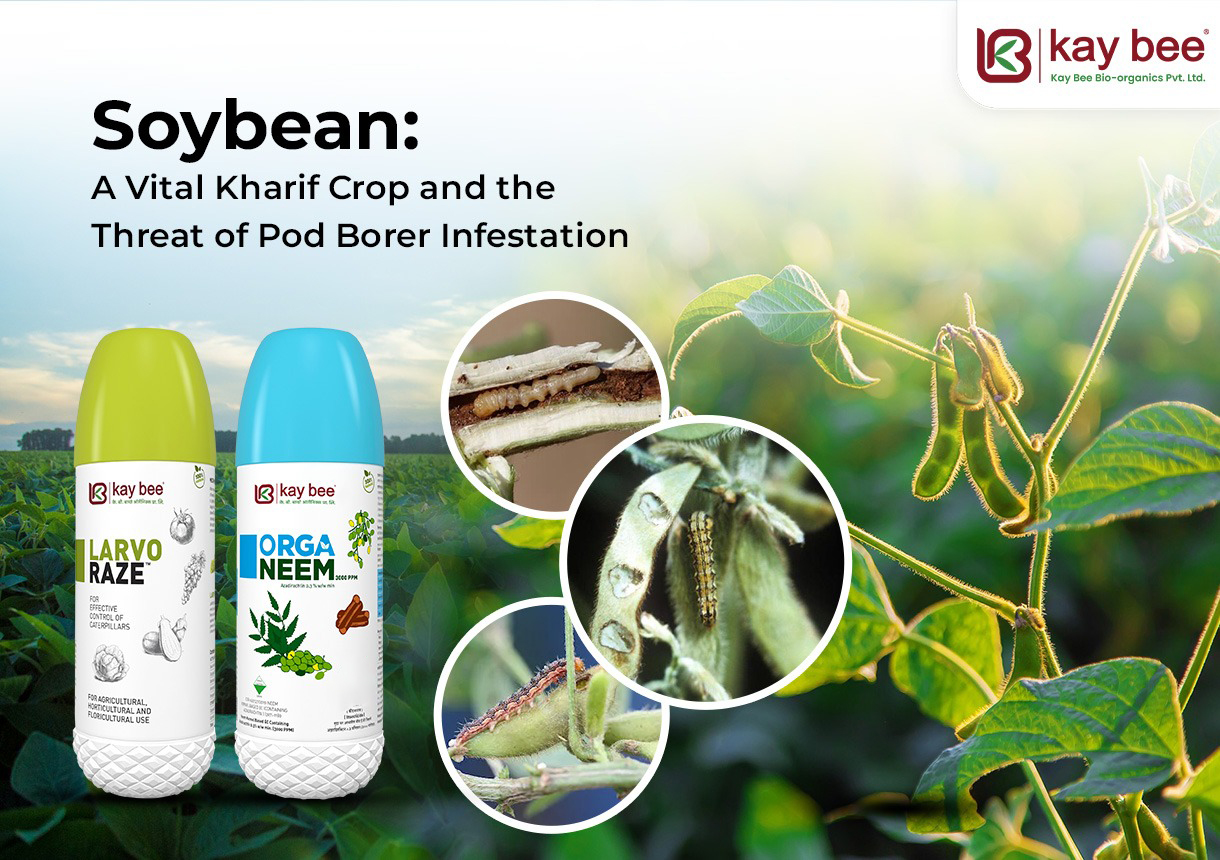
Soybean: A Vital Kharif Crop and the Threat of Pod Borer Infestation
Soybean is one of the most important crops cultivated during the kharif season. However, while planning soybean cultivation, farmers often encounter several challenges, including the rapid spread of sap-sucking pests and fungal diseases, which significantly contribute to yield reduction. When farmers are asked about the most devastating pest that leads to severe yield loss, the answer is almost always the same; the pod borer caterpillar and stem borer caterpillar, which is responsible for up to 70–80% loss in yield. Farmers are often willing to invest heavily in controlling this pest, yet despite their efforts, the desired results are frequently not achieved. This raises a fundamental question like Where does this pest originate from? And are there any reliable solutions available in the market that can offer effective and lasting control?
Favorable Conditions for Infestation and Lifecycle of the Pod Borer:
This pest predominantly emerges during persistent cloudy and humid weather, which proves highly favorable for its growth and development. It completes its life cycle in four stages: egg, larva, pupa, and adult moth. The female moth lays eggs on tender shoot tips, leaves, flowers, buds, and eventually on the pods of the soybean crop. These eggs are yellowish in colour and spherical in shape, with a flat base and dome-shaped top, having vertical ridges on their surface. A single female moth can lay approximately 650 to 800 eggs. The egg stage typically lasts for 3 to 4 days. The emerging larva is yellowish-green with faint, parallel stripes on its body. Fully grown larvae measure about 45 to 50 mm in length, and though usually light green, larvae in various colour shades are also observed. The larva has seven pairs of legs, fine hair on its body, and broken greyish lines along the sides. It passes through six larval instars, completing this stage in 20–25 days. The pupa is dark brown and shaped like a bullet. Pupation occurs in the soil and may last anywhere from one week to one month, depending on environmental conditions. The adult moth is robust and yellowish, with forewings measuring approximately 37 mm in length, featuring distinctive dark spots. Female moths are generally larger than males. The complete lifecycle of the pest spans 4 to 5 weeks, during which the caterpillar inflicts substantial damage to the crop.
Nature and Extent of Damage:
To understand the impact of this pest, one must observe its behavior from the larval stage. The newly hatched larva initially feeds on tender leaves and stems. As the plant enters the flowering stage, the larva begins to damage buds and flowers. By the pod formation stage, infestation becomes severe. The larva bores irregular holes into the pods and feeds on both immature and mature seeds, causing damage to 60–80% of the internal grain. A single larva may damage 30 to 40 pods before completing its development.
Preventive Measures and Sustainable Management:
To effectively manage this pest, particularly through organic and integrated approaches, it is essential to understand its lifecycle and target each stage accordingly. Successful soybean cultivation is based on minimizing input costs while maximizing yield, thus providing farmers with satisfactory returns and market value. For this reason, pest prevention must begin right from the pre-sowing stage. Key practices include
1) Deep ploughing during field preparation to eliminate pupae from the soil and enhance soil fertility.
2) Removal of previous crop residues, which could harbor pest eggs and larvae.
3) Avoiding the continuous cultivation of crops from the same family, as this supports uninterrupted pest cycles.
4) Crop rotation is strongly recommended to disrupt the pest’s lifecycle and prevent recurrent infestations.
5) After sowing, maintain the field in a weed-free condition, as weeds serve as alternative hosts.
6) Destroy wild vegetation and grasses present on field bunds and borders.
70 Furthermore, installing 3–4 pheromone traps per acre helps in monitoring and trapping adult moths, thus reducing the pest population before they lay eggs.
Effective Organic Solution with Kay Bee Bio’s Larvo Raze and Organeem:
For the complete and reliable management of the pod borer, Kay Bee Bio-Organics offers an effective combination of Larvo Raze and Organeem (3000 ppm).
Dosage and Application: Mix 2.5 ml of Larvo Raze and 1 ml of Organeem per litre of water. Spray this solution uniformly across the soybean field. This application significantly controls larval infestation, helps preserve the overall health and safety of the crop, and enhances the greenness and vigour of the plant throughout the season.
In the soybean crop, with proper planning, timely intervention, and the use of reliable organic solutions, farmers can effectively protect their soybean crops from pod borer infestation. A combination of preventive cultural practices and bio-based control products not only ensures higher yields but also aligns with the principles of sustainable agriculture, offering long-term benefits for both farmers and the environment.
Latest Blogs
 Boost Your Cotton Yield: A Practical Guide to Soil Nutrient Mobilization
 The Neem Miracle: How We Extract Azadirachtin from Neem
 Stop Fall Armyworm Before It Destroys Your Maize Farms
 Red Spider Mite Control for Citrus Orchards With R-Mite
 Understanding Mycorrhizal Fungi and Their Role in Modern Agriculture
COPYRIGHT © 2026 - ALL RIGHTS RESERVED. MADE BY WebAppGigs