
Understanding Mycorrhizal Fungi and Their Role in Modern Agriculture
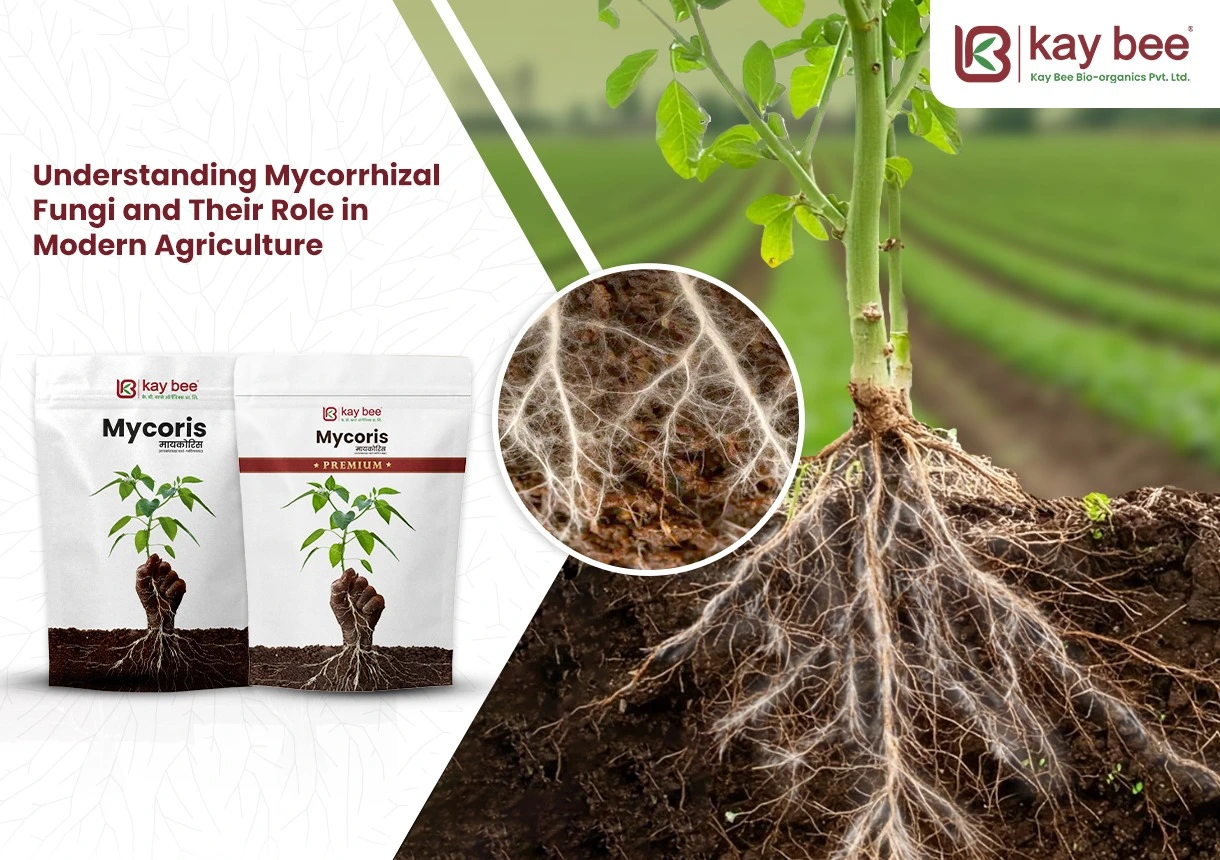
Mycorrhiza is a beneficial fungus that forms a symbiotic relationship with plant roots. In this relationship, the fungus helps plant roots absorb water and essential nutrients like zinc, phosphorus, nitrogen, potassium, and iron, whereas plants provide food (carbohydrates) and shelter to mycorrhiza. This symbiotic relation improves plant growth, stress tolerance ability, and disease resistance; provides immunity to plants; and enhances root structure.
The fungus grows its hyphae to form networks in the depleted zones near the roots. It serves as an environmental bridge connecting roots to the soil.
Type of Mycorrhiza in Agriculture
There are several types of mycorrhizae, mainly classified based on how the fungal hyphae interact with plant roots.
- Endomycorrhiza (Arbuscular Mycorrhiza – AM): Endomycorrhiza hyphae penetrate inside root cells and form structures called arbuscles and vesicles. Arbuscles are for nutrient exchange, and vesicles are for storage.
- Endomycorrhiza is found in agricultural crops like wheat, rice, and maize. Endomycorrhizae are very important for phosphorus absorption.
- Ectomycorrhiza (ECM): Ectomycorrhiza hyphae do not penetrate in root cells; they form a sheath called mantle around the root surface.
- A network called Hartig net forms between root cells. Ectomycorrhiza is commonly found in roots of pine, oak and eucalyptus. Ectomycorrhizae helps in nutrient uptake (especially nitrogen and phosphorus).
- Ectendomycorrhiza: Ectendomycorrhiza hyphae partially penetrate in root cells and also form an external sheath around the root surface. Ectendomycorrhiza shows features of both ecto and endomycorrhiza.
- Ericoid Mycorrhiza: Ericoid mycorrhiza is found in plants of the Ericaceae family like blueberry, heather. Ericoid mycorrhiza helps plants to survive in acidic and nutrient-poor soils.
- Orchid Mycorrhiza: Orchid mycorrhiza is specially associated with orchid plants. Orchid mycorrhiza is essential for seed germination because orchid seeds lack sufficient nutrients. In this association mycorrhiza provides carbon and nutrients in early stages.
How does Mycorrhiza Work?
Once mycorrhizal fungi are introduced into the soil, this fungus attaches to plant roots. Grow thread-like structures called hyphae into soil, which access nutrients to reach the roots. Mycorrhiza expand the effective root area up to 100–1000 times
Production of Mycorrhiza:
Traditionally production of mycorrhiza in agriculture was done using pot culture technique. In pot culture technique, host plants such as maize or sorghum are grown in pots. Soil was inoculated with mycorrhizal fungi. The fungi multiply along with plant roots; the final product consists of soil, roots and spores.
There are major drawbacks of the pot culture technique, which are as follows:
- There is a high risk of contamination by unwanted microbes, which leads to low purity.
- The quality of spores is often inconsistent because their number and effectiveness vary between batches.
- The production process takes a long time, usually several weeks to months.
- It has a low spore density, meaning fewer viable propagules are produced.
- The material is bulky because it contains soil and root debris.
- Storage is difficult due to a short shelf life and sensitivity to environmental conditions.
- It is hard to scale up production because it requires large space and a lot of labour.
To overcome these drawbacks, there is an advanced technology known as Root Organ Culture (ROC).
Root Organ Culture is a technique where plant roots are grown in the lab, without using soil and used for multiplication of mycorrhizal fungi.
In simple words: It is a soil-free method to grow beneficial fungi using living roots in the laboratory.
MYCORIS (KayBee Bio)

How ROC Technology Works
ROC technology works by growing sterile plant roots (usually carrot roots), introducing mycorrhizal fungi to them, allowing the fungi to colonize and multiply, producing spores.
Key Features of ROC Technology
- The final product is completely free from contamination as it does not require soil.
- It produces pure mycorrhizal fungus having a high spore count and density.
- Using the ROC technique, final products have high spore viability and are very effective.
- It is suitable for commercial-scale production.
Advantages of ROC over Traditional Methods
- It provides higher quality and more consistent results.
- It allows faster multiplication compared to pot culture methods.
- It has a longer shelf life. It is easy to standardize.
- It performs better in the field.
Why ROC is Important in Agriculture
- ROC technology helps in producing reliable biofertilizers.
- It supports sustainable farming practices.
- It reduces dependency on chemical fertilizers.
- It improves crop productivity and soil health.
Benefits of Mycorrhiza in Agriculture
- Mycorrhizal fungi improve the uptake of nutrients like phosphorus, zinc, copper, and nitrogen, especially in low-fertility soils.
- They help plants absorb water better, which improves drought tolerance and water-use efficiency.
- They increase crop yield by improving root growth, biomass, and overall productivity.
- They protect plant roots from diseases by competing with harmful microbes.
- They improve soil structure by enhancing aggregation, increasing aeration, and reducing erosion.
Applications of Mycorrhizal Fungi
Application of mycorrhiza can be done on Field crops such as wheat, rice, maize; horticultural crops such as fruits and vegetables; Nurseries Organic farming systems and plantations.
Application Methods
| Method | Description | Dose |
| Seed Treatment | Coating seeds with mycorrhiza fungus | 5–10 g/kg seeds |
| Soil Application | Mixing with compost or soil | 2–5 kg/acre |
| Root Dip | Dipping roots before transplanting | 5–10 g/litre |
| Drip Irrigation | Liquid application via drip system | As per formulation |
When to Apply Mycorrhiza
- The best time to apply mycorrhiza is during sowing or transplanting and early root development.
- Late application reduces its effectiveness.
Factors Affecting Performance of Mycorrhiza
- Soil pH should be maintained between 6.0 and 7.5 for best results.
- Excessive use of chemical fertilizers should be avoided.
- Avoid using fungicide for drenching, after application of Mycorrhiza for 10-15 days.
Mycorrhiza vs Chemical Fertilizers
- Mycorrhiza provides nutrients in a natural and slow-release manner, while chemical fertilizers act fast but temporarily.
- Mycorrhiza improves soil health, whereas chemical fertilizers degrade it over time.
- Mycorrhiza is a one-time investment, while chemical fertilizers require repeated costs.
- Mycorrhiza is eco-friendly, while excessive use of chemical fertilizers is harmful.
Common Crops That Respond Well
- Crops like maize, wheat, sugarcane, tomato, onion, and banana respond well to mycorrhiza.
- These crops show strong improvement when mycorrhiza is applied.
Challenges in Using Mycorrhiza
- Mycorrhiza is sensitive to chemical input such as chemical fungicides and chemical fertilizers.
- Mycorrhiza requires proper storage conditions.
- The results may take time to appear.
- Product quality plays an important role in effectiveness.
Future of Mycorrhizal Fungi in Agriculture
- The demand for mycorrhizal fungi is increasing due to the rise of organic farming.
- It is gaining importance in sustainable agriculture.
- It helps in restoring soil health.
Kay Bee Bio’s mycorrhiza – Mycoris:
Products like Mycoris from Kay Bee Bio-Organics, which have been produced utilizing sophisticated Root Organ Culture (ROC) technology, guarantee high spore count, viability, and trustworthy field performance for a variety of crops. By focusing on scientifically proven strains like Rhizophagus irregularis, Rhizophagus clarus, Glomus mosseae, and Glomus efanicatum, Kay Bee Bio-Organics has made a name for itself in the mycorrhiza industry. Large-scale manufacture of quality biofertilizers is made possible by their technologically advanced production facilities, which include sterile growing rooms, controlled environment laboratories, and sophisticated quality control systems.
Conclusion
Mycorrhizal fungi become an important part of sustainable agriculture, providing a safe, natural way to boost soil health and crop output. Mycorrhiza enhances soil health and nutrient uptake while lowering dependency on chemical fertilizers. When applied correctly, they boost long-term soil fertility, lower input costs, and increase production. Because of these advantages, they are an essential element of advanced farming systems that do their best for sustainability and productivity.
ROC-based production is more efficient, consistent, and scalable than traditional approaches, which makes it ideal for commercial agriculture. Mycoris continues to contribute significantly to the advancement of resilient and sustainable farming methods in response to the growing demand for environmentally friendly inputs.
Latest Blogs
 Boost Your Cotton Yield: A Practical Guide to Soil Nutrient Mobilization
 The Neem Miracle: How We Extract Azadirachtin from Neem
 Stop Fall Armyworm Before It Destroys Your Maize Farms
 Red Spider Mite Control for Citrus Orchards With R-Mite
 Early and Late Blight in Tomato: How to Identify and Control with Fungicides
COPYRIGHT © 2026 - ALL RIGHTS RESERVED. MADE BY WebAppGigs