
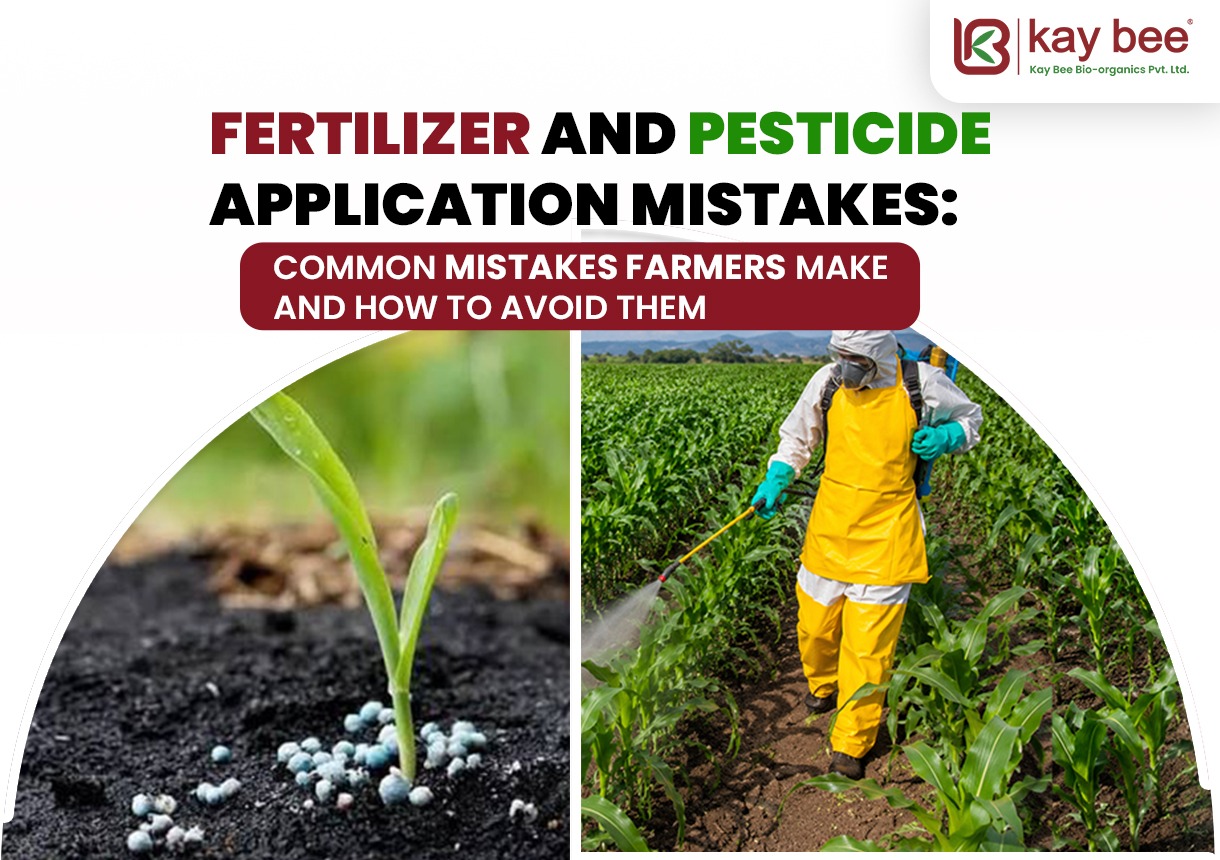
Fertilizer and Pesticide Application Mistakes: Common Mistakes Farmers Make and How to Avoid Them
Introduction: Fertilizer and Pesticide Application Mistakes
Fertilizers and pesticides play an important role in modern agriculture. Fertilizers supply essential nutrients for plant growth, flowering, fruit development, and improved crop productivity, while pesticides help protect crops against insects, diseases, mites, and other harmful organisms.
However, even the best-quality agricultural inputs may not deliver the desired results if they are not applied correctly. Incorrect dosage, improper application timing, unsuitable weather conditions and poor spraying techniques can reduce product effectiveness, increase cultivation costs and negatively affect crop health.
Many farmers focus on selecting the right fertilizer or pesticide but overlook the importance of correct application practices. Understanding and avoiding these common mistakes can help farmers improve input efficiency, reduce unnecessary expenses and achieve better crop performance. Let’s discuss the most common mistakes farmers make when applying fertilizers and pesticides and practical ways to prevent them. These fertilizer and pesticide application mistakes are easy to fix once you know them.
Common fertilizer and pesticide application mistakes include using the wrong dosage, skipping soil tests, spraying in unsuitable weather, ignoring water pH, mixing incompatible products, poor spray coverage, and repeating the same pesticide. Following label directions avoids most of them.
-
Applying Fertilizers and Pesticides Without Understanding Crop Requirements
One of the most common mistakes is applying agricultural inputs without properly identifying the crop’s actual nutritional or plant-protection needs. Excessive fertilizer use can cause nutrient imbalances and poor crop development, while misidentifying pests or diseases can lead to ineffective pesticide application. An accurate diagnosis underpins effective plant pest control.
How to avoid it:
- Conduct soil testing to understand nutrient availability.
- Observe crop growth and identify visible nutrient deficiencies.
- Monitor pest and disease incidence regularly.
- Select fertilizers and pesticides based on crop requirements and target problems.
- Follow Integrated Pest Management (IPM) practices.
-
Using Incorrect Dosage
Using more fertilizer or pesticide than the recommended dosage does not necessarily improve results. Some farmers believe that increasing the dosage will provide faster or better results. However, excessive application can cause crop injury, phytotoxicity, nutrient toxicity, unnecessary residues and increased production costs. Similarly, applying less than the recommended dosage may result in inadequate pest or disease management.
How to avoid it:
- Always follow the manufacturer’s recommended dosage.
- Measure products accurately before mixing.
- Avoid increasing the dosage without technical guidance.
- Use calibrated measuring equipment.
- Consider crop stage, pest pressure and application method.
-
Applying Fertilizers Without Soil Testing
Soil testing is essential to understand the soil’s nutrient status and fertility before applying fertilizers. However, many farmers apply fertilizers based on past practices or general recommendations without knowing their soil’s actual nutritional needs. This can lead to unnecessary fertilizer application, nutrient imbalances and failure to address existing nutrient deficiencies.
How to avoid it:
- Conduct soil testing before planning fertilizer application.
- Analyse soil test reports to identify nutrient deficiencies and existing nutrient levels.
- Select suitable fertilizers based on soil conditions and crop nutritional requirements.
- Follow soil-test-based fertilizer recommendations to ensure balanced nutrient management.
For deficiency symptoms and timing, read our guide on micronutrient deficiency in rabi crops.
-
Ignoring Weather Conditions During Application
Weather conditions significantly influence fertilizer and pesticide application efficiency. Spraying during high temperatures, strong winds or immediately before rainfall can reduce application effectiveness. High temperatures can increase spray evaporation and the risk of leaf injury. Strong winds can cause spray drift, resulting in uneven application and unwanted exposure to nearby crops. Rainfall shortly after spraying may wash away the product before it can be absorbed or deposited. A spreader sticker can improve rainfastness, but it does not replace the label’s rain-free period.
How to avoid it:
- Prefer suitable morning or late-afternoon conditions, as indicated by the product label.
- Avoid spraying during strong winds.
- Check the weather forecast before application.
- Follow the recommended rain-free period mentioned on the product label.
- Avoid spraying during extreme temperatures.
-
Incorrect Water pH and Water Quality
Water is one of the most important components of pesticide and foliar fertilizer application. However, farmers often overlook its quality and pH. Using highly alkaline, hard or contaminated water may affect the compatibility, stability and performance of certain agricultural formulations. This matters even more for foliar spray fertilizer, because the whole dose goes through the spray water.
How to avoid it:
- Test the pH and quality of spray water.
- Use clean water for spray preparation.
- Adjust water pH only when required and according to product recommendations.
- Use suitable water conditioners where necessary. A pH reducer such as pH Tunner can help when water is alkaline, and a soil test should guide any soil pH-reducer approach.
- Always check product compatibility before preparing tank mixtures.
To understand how water quality affects the whole crop, read our guide on irrigation management for rabi crops.
-
Mixing Incompatible Fertilizers and Pesticides
Tank mixing multiple products can save time and labour. However, mixing products without checking their compatibility is a common mistake. Certain fertilizers, pesticides, fungicides, micronutrients and biological formulations may not be compatible with each other. This reduces product stability or effectiveness. Mixing pesticides in a tank without checking compatibility can also injure crops.
How to avoid it:
- Read the product label before mixing.
- Check compatibility with the manufacturers.
- Conduct a small jar test before preparing a large tank mixture. A jar test for pesticides means mixing small, proportionate quantities in a clear jar and watching for clumps, layers or heat.
- Follow the recommended mixing sequence.
- Avoid mixing products unless you have established their compatibility.
Always follow the label. For example, Zilite should not be mixed with products containing copper or sulphur.
-
Poor Spraying Techniques and Uneven Coverage
Even when the correct pesticide and dosage are selected, improper spraying techniques can result in inadequate pest and disease management. Many farmers focus only on spraying the upper surface of leaves and overlook the undersides, growing points, flowers and other pest-infested plant parts. Several insects, including thrips, whiteflies, mites and aphids, may occupy hidden areas of plants. Similarly, fungal infections may develop on leaf undersides, stems and other plant surfaces.
How to avoid it:
- Ensure uniform spray coverage throughout the plant canopy.
- Cover both upper and lower leaf surfaces wherever required.
- Maintain suitable spray pressure and nozzle selection.
- Avoid excessive spraying that causes unnecessary runoff.
- Consider a spreader sticker. Balanstick improves spray coverage, spreading, sticking, and rainfastness, helping as a sticker for insecticides and as a general sticker for plant sprays. See our stickers and spreaders.
-
Repeatedly Using the Same Pesticide
Repeated application of pesticides with the same mode of action can increase the risk of resistance development in pest populations. Over time, certain pest populations may become less sensitive to the pesticide, reducing control. Pesticide resistance management starts with rotating modes of action.
How to avoid it:
- Rotate pesticides based on their IRAC (Insecticide Resistance Action Committee) or FRAC (Fungicide Resistance Action Committee) mode-of-action groups, as applicable.
- Avoid unnecessary repeated applications.
- Follow the recommended application interval and label directions.
- Include bio-pesticides for plants in the rotation where suitable, as per label.
Conclusion: Correct Application Practices Lead to Better Crop Performance
Successful crop production is not just about selecting high-quality fertilizers and pesticides. It also depends on how, when, and where these inputs are applied. Avoiding common mistakes such as incorrect dosage, unsuitable weather conditions, poor water quality, incompatible tank mixtures and improper spraying techniques can help farmers improve input-use efficiency, protect crop health and reduce unnecessary cultivation expenses. Farmers should focus on balanced crop nutrition, regular field monitoring, responsible pesticide use and scientific application practices.
Remember: The right product, at the right dose, at the right time and with the right application method makes a significant difference in crop performance.
Kay Bee Bio Organics Products for Correct Application
At Kay Bee Bio Organics, we believe that sustainable agriculture begins with scientific crop management, responsible input application and effective farming practices. As a key manufacturer of agricultural solutions, we offer a diverse portfolio of micronutrients, speciality fertilizers, nutrient-use efficiency enhancers, spray adjuvants and botanical-based crop protection products.
Our crop nutrition portfolio includes Nutrix, a multi-micronutrient formulation containing Zinc, Copper, Iron, Manganese, Boron, and Molybdenum; Silixil (Ortho-Silicic Acid); Zilite (Zn); Calboost (Ca); and Calbolite (Ca, Zn, B). Additionally, Neutralite Granules improve nutrient-use efficiency when blended with NPK and other fertilizers, potentially reducing fertilizer requirements by 20–25% when used as recommended (see our granule-based products). At the same time, pH Tunner helps manage soil and water pH, particularly alkalinity, and Balanstick enhances pesticide spray coverage, spreading, sticking and rainfastness. Alongside these solutions, Kay Bee Bio Organics manufactures CIBRC-registered, botanical-based pesticides to manage various insect pests and crop diseases. By combining appropriate agricultural inputs with recommended application practices, farmers can improve input-use efficiency, promote healthier crop growth, reduce unnecessary input use and achieve sustainable productivity.
Kay Bee Bio Organics – Supporting smarter crop nutrition, effective crop protection and sustainable agriculture.
Frequently Asked Questions (FAQs)
Q1. What are the common mistakes in fertilizer and pesticide application?
Wrong dosage, skipping soil tests, spraying in unsuitable weather, ignoring water pH, mixing incompatible products, poor spray coverage and repeating the same pesticide.
Q2. What happens if you use more pesticide than the recommended dose?
It can cause crop injury, phytotoxicity, unnecessary residues and higher costs. A higher dose does not guarantee better control.
Q3. Does water pH affect pesticide sprays?
Yes. Highly alkaline, hard or contaminated water can affect the stability and performance of some formulations. Test the water and adjust pH only as the product label recommends.
Q4. How do I check if two products can be tank mixed?
Read the labels, ask the manufacturer, and do a small jar test before mixing a full tank. Follow the recommended mixing sequence.
Q5. What is the best time to spray pesticides?
Choose the morning or late afternoon, as the label indicates. Avoid strong winds, extreme heat, and spraying before rain; follow the rain-free period on the label.
Q6. What does a spreader sticker do?
It improves spray coverage, spreading, sticking and rainfastness. Balanstick is one such product.
Q7. How can farmers prevent pesticide resistance?
Rotate pesticides by IRAC or FRAC mode-of-action group, avoid unnecessary repeat sprays, and follow label intervals.
Latest Blogs
 Onion Twister Disease Prevention and Integrated Disease Management Strategies
 Sesame Phyllody Disease: Symptoms, Disease Cycle and Organic Management Strategies
 Nutrient Management for Mustard and Gram Crops: Best Micronutrient Practices
 Mustard Crop Management: Fertiliser Schedule, Micronutrients and Effective Pest Control
 Efficient Nutrient Management: How to Reduce Crop Production Costs
COPYRIGHT © 2026 - ALL RIGHTS RESERVED. MADE BY WebAppGigs