
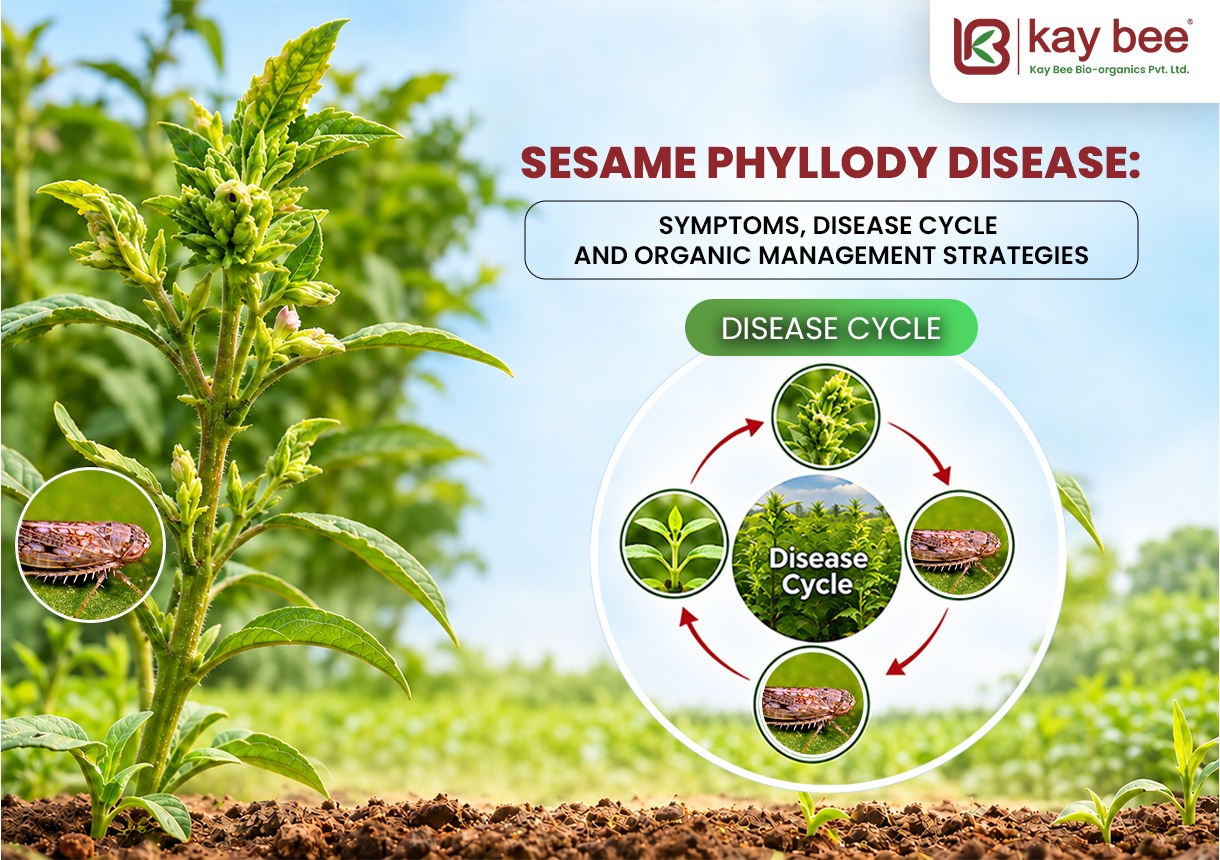
Sesame Phyllody Disease: Symptoms, Disease Cycle and Organic Management Strategies
Introduction: Sesame Phyllody Disease
Sesame (Sesamum indicum L.), one of the oldest oilseed crops cultivated worldwide, belongs to the family Pedaliaceae. It is an economically important crop grown extensively across tropical and subtropical regions of Asia, Africa and South America. In India, sesame is cultivated over approximately 1.62 million hectares, with an annual production of 0.66 million tonnes and an average productivity of around 405 kg/ha. Sesame is grown mainly in the kharif season in India, with summer and rabi sowings in some states. Among the various biotic stresses affecting sesame cultivation, sesame phyllody is one of the most destructive diseases, significantly affecting crop growth, flowering, capsule formation and overall productivity. This guide to sesame phyllody disease covers its symptoms, disease cycle and organic vector management.
Sesame phyllody disease is caused by a phytoplasma spread by the leafhopper Orosius albicinctus. Infected flowers turn into green, leaf-like structures and produce no seed. Manage it by controlling the vector, rogueing infected plants and removing alternate hosts.
Cause and Economic Importance of Sesame Phyllody
The disease is caused by phytoplasma, a specialised plant pathogen that inhabits the phloem tissues and is primarily transmitted by the leafhopper Orosius albicinctus. Infected plants exhibit abnormal floral development, where normal floral structures are transformed into green, leaf-like structures, accompanied by excessive vegetative growth. Phyllody can cause yield losses ranging from 34% to complete crop loss under severe disease incidence. Studies have reported that every 1% increase in disease intensity can reduce sesame yield by approximately 8.36 kg/ha.
Therefore, early identification, effective vector management and integrated disease management practices are essential to minimise the spread of sesame phyllody and protect crop productivity.
Symptoms of Sesame Phyllody Disease
Sesame phyllody symptoms are generally more prominent during the flowering stage. The disease interferes with normal reproductive development, resulting in malformed flowers and poor capsule formation.
-
Phyllody (Floral Malformation)
- The floral parts are transformed into green, leaf-like structures.
- Flowers become malformed and lose their reproductive ability.
- Clusters of small leaves develop at the tips of branches.
- Infected flowers generally become sterile and fail to produce seeds.
-
Leaf Deformation
- Leaves become distorted, curled or abnormally enlarged.
- Infected leaves may become thick and leathery.
- Yellowing or chlorotic symptoms may appear on the foliage.
-
Excessive Vegetative Growth
- Abnormal proliferation of shoots and leaves occurs.
- Infected plants develop a bushy appearance due to excessive branching.
- Internodes become shortened, resulting in stunted plant growth.
-
Reduced Flowering and Capsule Formation
- Normal flowering is significantly reduced.
- Flowers become malformed and fail to develop into healthy capsules.
- If capsules develop, they may contain poorly developed or inferior-quality seeds.
-
Stunting and Overall Plant Decline
- Infected plants exhibit reduced plant height and abnormal growth.
- Severe infections may result in premature plant decline and substantial yield reduction.
Disease Cycle and Transmission of Phytoplasma in Sesame
Sesame phyllody is caused by phytoplasma, which survives in infected host plants and is transmitted from plant to plant through insect vectors. The primary vector responsible for transmitting sesame phyllody is the leafhopper Orosius albicinctus. The phytoplasma can survive in several cultivated and weed hosts, which act as reservoirs of infection. Reported alternate hosts include Brassica campestris var. toria, Brassica rapa, Cicer arietinum (chickpea), Crotalaria species, Trifolium species and Arachis hypogaea (groundnut). The phytoplasma multiplies and circulates within the insect vector before it becomes capable of transmitting the disease. Nymphs that have not acquired the pathogen cannot transmit the disease. This is why controlling the vector is as important as spotting phytoplasma in sesame early.
Favourable Conditions for Sesame Phyllody Development
The incidence and spread of sesame phyllody are influenced by environmental conditions and leafhopper population dynamics. Conditions generally associated with increased disease incidence include dry weather conditions, moderate temperatures around 25°C, relatively low humidity (approximately 65%), low rainfall, and dry-season conditions particularly during February–March in endemic regions.
Botanical Vector Management for Sesame Phyllody Using Pesto Raze + Mealy Raze
Organic pest management plays an important role in maintaining ecological balance, protecting beneficial insects and supporting sustainable crop production. Botanical based biopesticides are one option for organic farming in India. Botanical formulations offer an alternative approach for managing sucking insect pests, including leafhoppers, which play a major role in transmitting plant diseases.
Sesame phyllody is a serious phytoplasma-associated disease transmitted by the leafhopper Orosius albicinctus. Since the disease spreads through insect vectors, effective management of leafhopper populations is an important preventive strategy to minimise disease transmission and protect sesame crops. Spray controls the leafhopper vector. It cannot cure a plant that is already infected, so infected plants should be removed.
Recommended Organic Solution for Leafhopper Control in Sesame
Pesto Raze + Mealy Raze
- Pesto Raze — 1.5 ml per litre of water
- Mealy Raze — 1.5 ml per litre of water
Apply as a uniform foliar spray, ensuring thorough coverage of the foliage and tender plant parts where leafhoppers are likely to feed. For improved spray coverage, spreading and adhesion, add Balanstick at 0.4 ml per litre of water. This is a botanical insecticide for sucking pest management. See Pesto Raze, our stickers and spreaders, and read about common fertiliser and pesticide application mistakes. Pesto Raze is also used for aphids in our guide on mustard crop management.
How Pesto Raze + Mealy Raze Works
Pesto Raze and Mealy Raze are botanical-based bio-pesticide formulations developed using advanced botanical marker compound technology for managing important sucking insect pests. As bio pesticides, together they act as a bioinsecticide for sucking pests such as leafhoppers.
The combination is intended to provide multiple biological actions against susceptible insect pests, targeting different developmental stages and helping reduce leafhopper populations when applied according to recommended directions.
In sesame cultivation, this combination can be incorporated into an integrated vector management programme targeting Orosius albicinctus, the primary vector responsible for transmitting sesame phyllody.
Mode of Action
The botanical bioactive compounds in Pesto Raze and Mealy Raze contribute to multiple biological activities against susceptible insect pests, including:
- Contact Activity: Acts through contact with susceptible insects.
- Feeding Disruption: Antifeedant properties help reduce insect feeding activity.
- Neurophysiological Effects: Interferes with normal insect nervous system functioning.
- Insect Growth Regulation: Affects normal growth, development and moulting processes.
- Repellent Activity: Helps discourage insect settling and feeding.
- Multiple Target Activity: Different bioactive compounds contribute to the overall insecticidal action.
Benefits of Pesto Raze + Mealy Raze
- Supports botanical management of sucking insect pests, including leafhoppers.
- Helps manage susceptible nymphal and adult stages.
- Reduces insect feeding activity.
- Supports integrated management of the sesame phyllody vector, Orosius albicinctus.
- Helps reduce vector pressure and the potential for further disease transmission.
- Provides a botanical approach to sustainable crop protection.
- Can be incorporated into organic and residue-conscious farming programmes, subject to applicable certification and label requirements.
Used as per label, these organic pesticides products support a residue-conscious approach.
Additional Integrated Management Practices for Sesame Phyllody
For better disease prevention and vector management, combine botanical applications with the following plant pest control practices:
- Monitor sesame fields regularly, particularly during early crop growth and flowering.
- Inspect the undersides of leaves and tender shoots for leafhopper activity.
- Rogue out and destroy phytoplasma-infected plants to reduce sources of infection (uproot them and destroy them away from the field).
- Remove weeds and alternate host plants that may harbour phytoplasma and insect vectors.
- Avoid excessive nitrogen fertiliser application, which may encourage excessive vegetative growth and pest susceptibility.
- Maintain proper plant spacing and field sanitation.
- Monitor leafhopper populations and apply recommended botanical vector-management products when necessary.
- Preserve natural predators and beneficial insects by avoiding unnecessary broad-spectrum insecticide applications.
- Follow locally recommended sowing schedules in areas with a history of sesame phyllody.
Frequently Asked Questions (FAQs)
Q1. What is sesame phyllody disease?
It is a disease caused by a phytoplasma that lives in the phloem. Flowers turn into green, leaf-like structures, and plants become bushy and produce little or no seed.
Q2. What are the symptoms of sesame phyllody?
Look for green, leaf-like flowers, clusters of small leaves at branch tips, distorted or leathery leaves, excessive branching, shortened internodes and poor capsule formation.
Q3. How does sesame phyllody spread?
The phytoplasma is transmitted from plant to plant by the leafhopper Orosius albicinctus. Nymphs that have not acquired the pathogen cannot transmit it.
Q4. What weather favours sesame phyllody?
Dry weather, moderate temperatures around 25°C, relatively low humidity, low rainfall and dry-season conditions, particularly February–March in endemic regions.
Q5. How to control sesame phyllody organically?
Control the vector and remove sources of infection. Monitor fields, rogue out infected plants, remove weeds and alternate hosts, and use Pesto Raze at 1.5 ml/L with Mealy Raze at 1.5 ml/L and Balanstick at 0.4 ml/L, as per label.
Q6. Can sesame phyllody be cured once the plant is infected?
Spray targets the leafhopper, not the infection inside the plant. Infected plants should be rogued out and destroyed to reduce sources of infection.
Conclusion
Sesame phyllody is one of the most destructive diseases affecting sesame cultivation, primarily due to its impact on flowering, capsule formation and seed development. The leafhopper Orosius albicinctus plays a major role in spreading the disease by transmitting phytoplasma from infected plants to healthy plants. Therefore, timely management of the insect vector is an essential component of an integrated sesame phyllody management programme.
The combination of Pesto Raze (1.5 ml/L) and Mealy Raze (1.5 ml/L), along with Balanstick (0.4 ml/L), can be considered as a botanical approach for managing susceptible sucking insect pests, including leafhoppers. When combined with regular field monitoring, removal of infected plants, weed management and good agronomic practices, botanical vector management can contribute to sustainable sesame cultivation and help reduce the risk of sesame phyllody spread. Early action, from the first weeks of the crop, gives sesame phyllody disease the least chance to spread.
Latest Blogs
 Onion Twister Disease Prevention and Integrated Disease Management Strategies
 Nutrient Management for Mustard and Gram Crops: Best Micronutrient Practices
 Fertilizer and Pesticide Application Mistakes: Common Mistakes Farmers Make and How to Avoid Them
 Mustard Crop Management: Fertiliser Schedule, Micronutrients and Effective Pest Control
 Efficient Nutrient Management: How to Reduce Crop Production Costs
COPYRIGHT © 2026 - ALL RIGHTS RESERVED. MADE BY WebAppGigs