
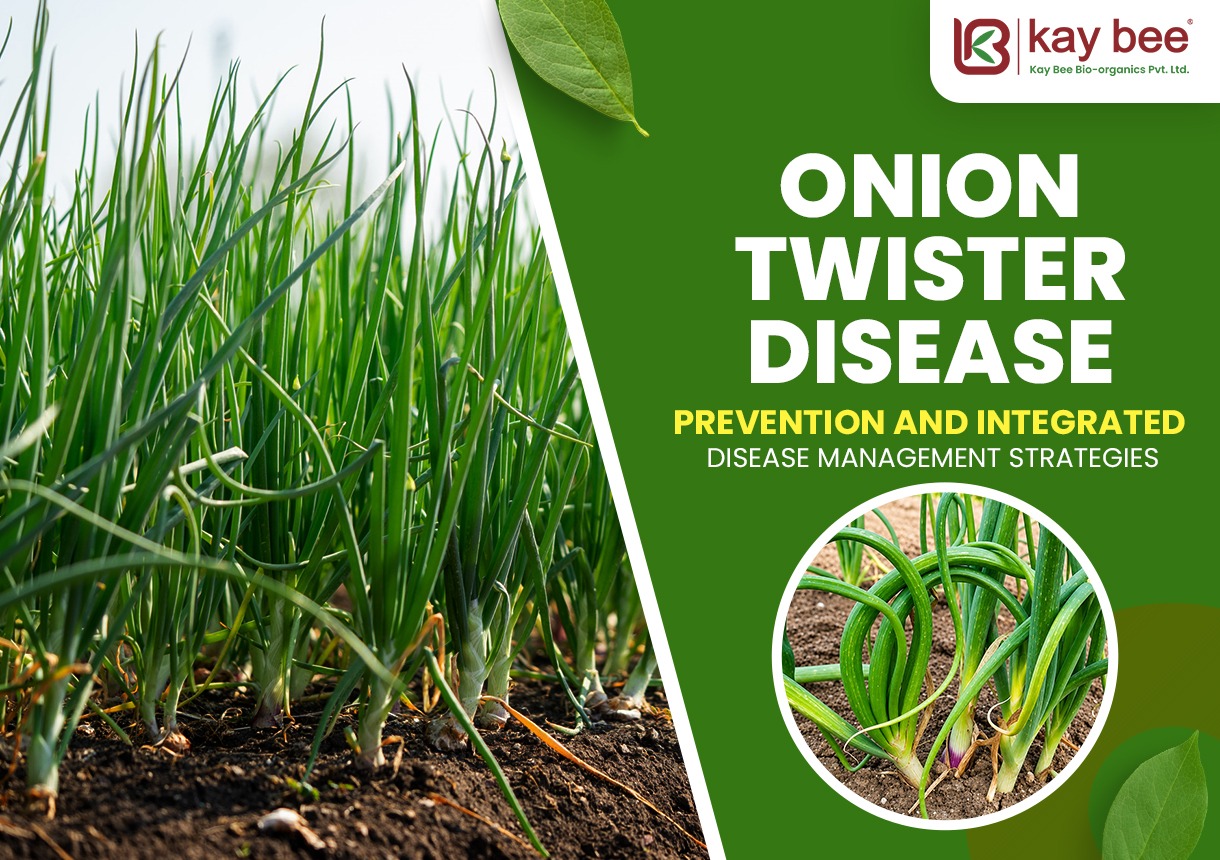
Onion Twister Disease Prevention and Integrated Disease Management Strategies
-
Introduction : Onion Twister Disease
Onion (Allium cepa L.) is one of the most important commercial vegetable crops, cultivated worldwide for its culinary, nutritional and medicinal properties. However, onion production is affected by several fungal diseases, among which Anthracnose-Twister Disease is considered a serious constraint, particularly during the Kharif and Rabi season. Onion twister disease is most severe in the kharif (monsoon) season. Onion Twister Disease is commonly associated with the anthracnose pathogen complex involving Colletotrichum gloeosporioides and Gibberella moniliformis. The disease affects leaves, necks and bulbs, resulting in severe leaf curling, twisting, chlorosis, premature drying and bulb rotting. The disease is favoured by warm, humid weather, prolonged leaf wetness and frequent rainfall. Under favourable environmental conditions, it can spread rapidly throughout the field, resulting in significant reductions in bulb yield and quality. In severe cases, reported yield losses can be substantial. Kharif onion yields are much lower than rabi yields mainly because of this disease, which is worsened by monsoon rain and high humidity, and estimated losses of up to 80–100% have been reported. Early identification, preventive measures and integrated disease management are essential for successful onion cultivation.
Onion twister disease is an anthracnose-twister complex caused mainly by Colletotrichum gloeosporioides, often with Gibberella moniliformis, Fusarium and root-knot nematodes. It causes leaf twisting, neck elongation and bulb rot, and spreads fast in warm, humid, wet weather. Manage it with sanitation, drainage, balanced nutrition, and foliar and soil protection.
-
Symptoms of Onion Anthracnose and Twister Disease
2.1 Anthracnose Symptom Development
- Initial lesions: Small, whitish, water-soaked and slightly sunken spots appear on leaf blades and leaf sheaths. The spots gradually enlarge and become dark, oval or elliptical lesions.
- Concentric rings: Mature lesions may develop concentric patterns with characteristic salmon-pink or orange-coloured spore masses.
- Necrosis: Infected tissues gradually turn brown or black, resulting in extensive necrotic areas along the leaf. Severely affected leaves become brittle, papery and eventually collapse or dry.
- Bulb infection: In advanced infections, the pathogen may affect the neck and bulb tissues, resulting in rotting and reduced storage quality.
2.2 Onion Twister Symptoms
- Leaf twisting and curling: Young and developing leaves become twisted, curled and distorted, losing their normal upright growth pattern.
- Abnormal leaf elongation: Infected leaves may show excessive elongation and abnormal growth.
- Chlorosis: Leaves develop yellowing, particularly along the affected portions.
- Neck elongation: The neck region becomes unusually elongated, resulting in weak and deformed plants.
- Leaf deformation: Leaves become crinkled, narrow and irregular in shape.
-
Etiology: Causal Organisms of Onion Twister Disease
Onion anthracnose-twister disease is associated with a complex of fungal pathogens, primarily:
- Colletotrichum gloeosporioides – responsible for characteristic anthracnose symptoms, including sunken lesions, necrosis and the development of salmon-orange conidial masses. A recent pot study found that C. gloeosporioides is the main cause of the disease, while Fusarium increased its severity.
- Gibberella moniliformis – associated with the twisting, abnormal elongation and deformation symptoms of onion plants. An excess of gibberellin produced by these fungi is suspected to cause the twisting and abnormal neck elongation.
- Root-knot nematodes (Meloidogyne spp.) are also reported in twister disease complexes, weakening roots and increasing plant stress and vulnerability to soil-borne and foliar pathogens. Field work in Karnataka noted a scanty root system with galls, and inoculating seedlings with Colletotrichum, Fusarium and root-knot nematodes, alone or together, produced twister symptoms.
- Epidemiology and Disease Development
The development and spread of onion anthracnose-twister disease are strongly influenced by environmental conditions, crop growth stages, pathogen inoculum and field management practices.
Environmental factors
High relative humidity, prolonged leaf wetness, frequent rainfall, warm and humid weather, and poor field drainage favour disease development. Temperature around 23 to 30°C with a relative humidity of 80% has been reported to be the most optimum conditions for the successful establishment of the disease. In studies, the disease was most prevalent in the monsoon months from August to November.
Sources of primary inoculum
- Infected crop residues and plant debris.
- Previously infected plants remaining in the field.
- Contaminated planting material and associated sources of inoculum.
- Infected tissues that facilitate pathogen survival between cropping seasons.
-
Integrated Disease Management (IDM)
Effective management of onion anthracnose-twister disease requires an integrated approach combining cultural, biological, nutritional and chemical management practices.
5.1 Cultural Management Practices
Cultural practices are the first line of defence against onion twister and anthracnose disease.
-
Field sanitation
- Remove and destroy infected plant debris after harvesting.
- Avoid leaving severely infected onion plants in the field.
- Maintain proper field sanitation throughout the cropping season.
-
Crop rotation
- Practise crop rotation with non-host crops.
- Avoid continuous onion cultivation in fields with a history of severe anthracnose-twister disease.
-
Proper spacing and drainage
- Maintain recommended plant-to-plant and row-to-row spacing.
- Ensure proper drainage to prevent water stagnation.
- Avoid excessive irrigation and prolonged leaf wetness. See our guide on irrigation management for rabi crops.
-
Healthy planting material
- Select healthy, disease-free seedlings and quality seeds.
- Avoid transplanting seedlings showing twisting, chlorosis or anthracnose symptoms.
- Inspect nursery beds regularly for early disease symptoms.
-
Balanced nutrient management
- Maintain balanced fertilizer application based on soil testing.
- Avoid excessive nitrogen application, which may encourage susceptible, excessive vegetative growth.
- Ensure adequate availability of potassium, calcium and micronutrients.
- Maintain appropriate boron nutrition, as it is important for normal plant growth and development. For symptoms and timing, read our guide on micronutrient deficiency in rabi crops.
5.2 Botanical Management of Onion Twister Disease Complex Using Fungo Raze and Root Fit
-
Fungo Raze: Organic Bio Fungicide for the Foliage
Fungo Raze is a broad-spectrum botanical-based fungicide designed to provide comprehensive protection against fungal pathogens associated with onion twister disease complex, including Colletotrichum gloeosporioides. Its multi-site mode of action targets different stages of fungal development, helping to suppress pathogen growth, reduce disease progression and minimise the development of secondary infections. It is formulated with botanical extracts of Ferula asafetida and Cinnamomum cassia. As an organic bio fungicide and a biological fungicide for plants, it is used as a foliar spray, and its product page lists anthracnose in onion.
Mode of Action of Fungo Raze
Fungo Raze offers multiple protective and disease-suppressing activities:
- Contact Action: Forms a protective layer on treated leaf and stem surfaces, helping to control fungal spores and other pathogen structures that come into contact with the treated plant tissues.
- Systemic Activity: Its plant-absorbed components support internal protection and help suppress fungal development within plant tissues. This makes it an organic systemic fungicide option.
- Anti-Sporulant Activity: Suppresses fungal sporulation, reducing the production of new spores and thereby helping to limit secondary infection and disease spread.
- Inhibition of Spore Germination and Germ Tube Formation: Interferes with the early stages of fungal development, restricting spore germination and germ tube growth and reducing the chances of successful infection.
- Anti-Mycelial Activity: Disrupts fungal growth and development by interfering with essential metabolic processes, helping to restrict mycelial growth and further colonisation of plant tissues.
- Induced Systemic Resistance (ISR): Helps activate the plant’s natural defence responses, supporting its ability to withstand pathogen attack.
Recommended Application
- Fungo Raze: 2.5 ml per litre of water (label range 1.5–2.5 ml/L, depending on crop stage and disease severity)
- Balanstick: 0.4 ml per litre of water
- Application schedule: Two foliar sprays at an interval of 4 days.
Spray in the cool morning or evening hours and avoid noon. Fungo Raze is not compatible with sulphur, copper-based fungicides or Bordeaux mixture. Balanstick is a silicon-based sticker spreader. See our stickers and spreaders, and read about common fertiliser and pesticide application mistakes.
-
Root Fit — Organic Protection against Fungal Diseases and Nematodes
Root Fit is Kay Bee Bio Organics’ advanced botanical formulation for soil application, developed using proprietary Marker Compound Technology and Nano Formulation Technology. It effectively manages soil-borne fungal pathogens and plant-parasitic nematodes, including those responsible for anthracnose-twister complex in onion. Its broad-spectrum action provides reliable protection against major soil-borne diseases including Gibberella moniliformis, Fusarium sp., Macrophomina phaseolina and Pythium sp., making it an ideal solution for sustainable and residue-free onion cultivation. As a fungicide for soil and a plant root fungicide, it has contact, systemic and fumigant action, and works as a bio nematicide against root knot nematodes. For a detailed breakdown of how Root Fit works, read our pillar guide on Root Fit — a breakthrough in soil-borne fungal disease and nematode control.
Benefits of Root Fit
- Helps to manage twister disease causing fungal pathogens.
- Suppresses plant-parasitic nematodes.
- Encourages healthy white root development.
- Promotes bulb development in onion.
- Improves nutrient absorption. Healthy white root development is the base of a vigorous onion crop.
Recommended Dosage:
For effective management of onion twister complex, apply Root Fit as a soil drench around the root zone. Soil drenching works best when the soil is moist.
| Crop Age | Root Fit (per acre) |
|---|---|
| Below 1 month | 250-500 ml |
| Above 1 month | 750-1000 ml |
The product page also gives 2–3 ml per litre of water for drenching or drip. Apply in the cool morning or evening hours followed by light irrigation, and repeat every 7–8 days or as needed. Root Fit is not compatible with sulphur, copper-based fungicides or Bordeaux mixture.
-
Conclusion
Effective management of onion twister disease complex requires an integrated approach targeting both foliar and soil-borne pathogens. Fungo Raze and Root Fit complement each other in this strategy by supporting disease suppression and overall crop health. Fungo Raze helps suppress fungal spore germination, mycelial growth and sporulation, thereby limiting disease development and secondary infections, while Root Fit supports root-zone health by helping manage soil-borne fungal pathogens and plant-parasitic nematodes. Integrating both products with proper field sanitation, balanced nutrition, good drainage and regular crop monitoring can contribute to healthier plants, reduced disease pressure, improved root development and better bulb yield. Early action against onion twister disease protects both yield and bulb quality.
Protect the foliage, strengthen the roots and build a healthier onion crop with Fungo Raze and Root Fit.
Seeing twisted leaves or elongated necks in your onion field? Talk to the Kay Bee Bio Organics team for free crop advice. Call 1800 532 2612 or visit kaybeebio.com.
Frequently Asked Questions (FAQs)
Q1. What is onion twister disease?
It is an anthracnose-twister complex caused mainly by Colletotrichum gloeosporioides, often with Gibberella moniliformis, Fusarium and root-knot nematodes. It causes leaf twisting, neck elongation and bulb rot.
Q2. What are the symptoms of onion twister disease?
Twisted, curled and distorted leaves, chlorosis, abnormally elongated necks, crinkled narrow leaves, and sunken water-soaked lesions on leaves that may spread to the neck and bulb.
Q3. Which weather favours onion twister disease?
Warm, humid weather, prolonged leaf wetness, frequent rainfall and poor drainage. It is most severe in the kharif (monsoon) season.
Q4. How is onion twister disease managed?
Combine field sanitation, crop rotation, drainage, healthy seedlings and balanced nutrition with foliar protection and a soil treatment.
Q5. What is the dose of Fungo Raze for onion?
The label range is 1.5–2.5 ml per litre of water. The suggested spray mix is 2.5 ml per litre with Balanstick at 0.4 ml per litre. Follow the label for the schedule.
Q6. How is Root Fit applied?
As a soil drench or through drip around the root zone, in the cool morning or evening, followed by light irrigation. The doses are 250 ml per acre for crops below 1 month and 750 ml per acre for crops above 1 month, or 2–3 ml per litre of water.
Latest Blogs
 Sesame Phyllody Disease: Symptoms, Disease Cycle and Organic Management Strategies
 Nutrient Management for Mustard and Gram Crops: Best Micronutrient Practices
 Fertilizer and Pesticide Application Mistakes: Common Mistakes Farmers Make and How to Avoid Them
 Mustard Crop Management: Fertiliser Schedule, Micronutrients and Effective Pest Control
 Efficient Nutrient Management: How to Reduce Crop Production Costs
COPYRIGHT © 2026 - ALL RIGHTS RESERVED. MADE BY WebAppGigs