
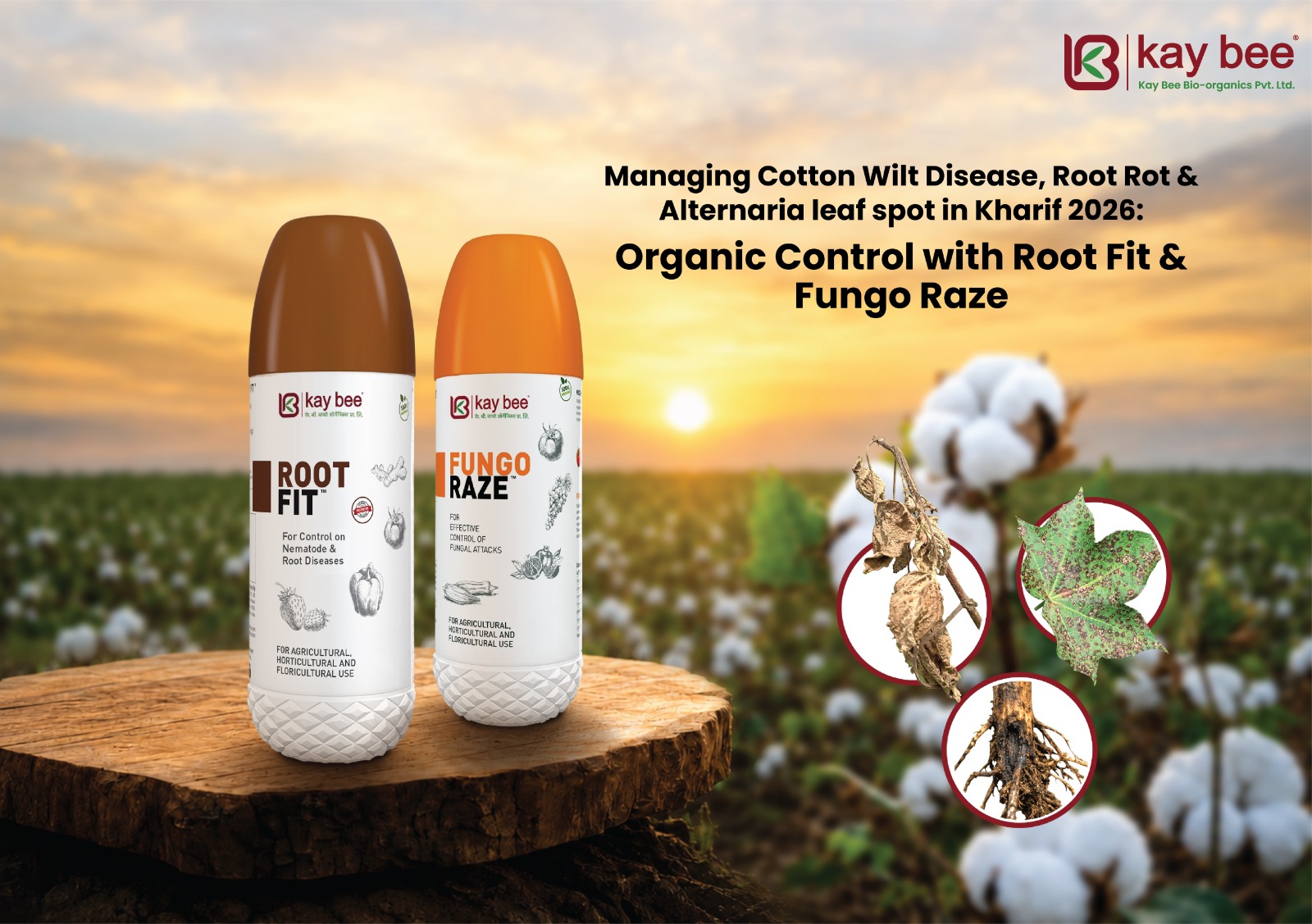
Managing Cotton Wilt Disease, Root Rot & Alternaria Leaf Spot in Kharif 2026: Organic Control with Root Fit & Fungo Raze
Cotton is the backbone of many farms during the Kharif season. However, as we head into Kharif 2026, farmers are facing tough challenges from soil and leaf diseases that can destroy crop yields before the bolls even form. Among these, cotton wilt disease and root rot are the most destructive. For a broader look at seasonal cotton challenges, read our guide on cotton crop care in Kharif.
If you notice your cotton plants suddenly dropping, drying up, or showing strange leaf spots, you are not alone. In this guide, we will break down what causes wilt in cotton, how to spot the symptoms early, and how you can protect your field organically using a powerful combination: Root Fit and Fungo Raze.
What Causes Cotton Wilt, Root Rot and Alternaria Spot?
These diseases are caused by tiny, harmful fungi that live in the soil or spread through the air. To understand how fungal and bacterial diseases affect cotton, the main culprits behind these problems are:
- The Cotton Wilt is of two types —
- Fusarium Wilt — Caused by the fungus Fusarium oxysporum. This is the main reason behind devastating cotton fusarium wilt outbreaks.
- Cotton Verticillium Wilt — Caused by Verticillium dahliae, another soil fungus that blocks the plant’s water supply, leading to cotton wilt.
- Root Rot — Caused by soil-borne fungi like Rhizoctonia and Pythium, which attack and rot the plant’s roots.
- Alternaria Spot of Cotton — Caused by Alternaria macrospora and Alternaria alternata, a fungus that attacks the leaves rather than the roots, weakening the plant’s ability to make food.
Symptoms: How to Spot the Disease in Your Field
Fusarium Wilt vs Verticillium Wilt
Both Fusarium wilt and Verticillium wilt are destructive, soil-borne vascular fungal diseases affecting cotton. While they share similar symptoms like leaf yellowing, wilting, and internal stem discoloration, they have distinct differences in their causal organisms, environmental preferences, and physical manifestations.
| Feature | Fusarium Wilt | Verticillium Wilt |
| Causal Organism | Fusarium oxysporum f. sp. Vasinfectum | Verticillium dahliae |
| Host Range | Highly host-specific (primarily attacks cotton and closely related species). | Very wide host range (attacks hundreds of plant species). |
| Optimal Temperature | Favors warm temperatures (28°C to 32°C / 82°F to 90°F). | Favors cooler temperatures (21°C to 25°C / 70°F to 77°F). |
| Soil Preference | Prefers sandy, acidic, or light soils with low moisture. | Prefers heavy, alkaline, or clay soils with higher moisture. |
| Nematode Association | Strongly associated with Root-knot nematodes (nematode damage accelerates infection). | Not strictly dependent on or associated with nematodes. |
| Onset of Symptoms | Can appear early at the seedling stage up through the budding stage. | Usually appears later, typically starting around flowering and boll-fill stages. |
| Foliar Symptoms | Yellowing starts near leaf margins and progresses inward, causing distinct “plaques” between veins while the rest of the leaf stays green. | Leaves show a yellow or dead V-shaped pattern starting from the tip. Leaves develop a mottled, “tiger-stripe” pattern (chlorosis/necrosis between main veins). Defoliating strains cause sudden leaf drop. |
| Vascular Discoloration | Stem cross-sections show a continuous, dark-brown to black ring inside the wood. | Stem cross-sections show scattered, light-brown flecks or broken streaks instead of a solid ring. |
Root Rot
- Sudden Wilting: Affected plants show a rapid, sudden wilting of leaves, often starting from the top of the plant and moving downward, typically during the warmer parts of the day.
- Yellowing and Browning: Leaves quickly turn yellow, then brown, dry up, and die, but they often remain firmly attached to the plant rather than shedding.
- Root Discoloration and Decay: The taproot and lateral roots turn brown to black, become soft, and rot. The outer bark (cortex) of the root can easily be shredded or peeled away.
- Vascular Browning: If you cut open the lower stem or taproot longitudinally, you will see a distinct dark brown discoloration of the internal vascular tissues.
Alternaria Leaf Spot
- Target-Like Spots: Small, circular brown or tan spots on leaves featuring distinct concentric rings.
- Purple Margins: Lesions are typically ringed by a prominent purplish or dark brown border.
- Shot-Holes: The dead, dry centers of older spots frequently crack and fall out, leaving actual holes in the leaf.
- Yellowing & Leaf Drop: Foliage surrounding the spots turns yellow, leading to severe drying and premature leaf drop (starting from the bottom of the plant upward).
- Boll & Seedling Damage: Can cause sunken dark spots on bolls (leading to rot) and circular brown lesions on seedling cotyledons.
How Root Fit Controls Wilt and Root Rots
Root Fit is an advanced botanical-based bio-fungicide specially designed to protect your cotton crop from underground enemies. Instead of using harsh chemicals that damage the soil, Root Fit uses beneficial, friendly microbes to guard the plant.
Root Fit Triple Action
Fungicidal Action: It destroys soil-borne fungi (like Fusarium and Pythium) by dissolving their cell walls on contact, sanitizing the soil with bio-vapors, and clearing internal root infections systemically.
Nematicidal Action: It controls root-knot nematodes by rapidly paralyzing them, disrupting their egg cycles via fumigant vapors, and chemically repelling them from piercing the roots. Learn more about managing soil-borne wilt and nematodes.
White Root Development: It acts as a growth catalyst by eliminating root-damaging pests and triggering natural plant signaling pathways to stimulate a massive explosion of healthy, nutrient-absorbing white feeder roots. Read more about the significance of white root development.
Mode of Action: How Root Fit Works
Root Fit works using a 3-way action plan to fight cotton wilt disease:
- Contact Action: When it comes into direct contact with the fungal pathogens in the soil, it degrades their cell walls. This directly inhibits spore germination and restricts mycelial growth.
- Systemic Action: It is absorbed by the plant roots via the xylem tissues. Once inside, it translocates upward to destroy active pathogen spores that have already managed to infect the plant’s internal root system.
- Fumigant Action: It releases botanical vapors within the air spaces of the soil. This effectively inactivates hibernating fungal spores and minimizes the overall fungal inoculum before they can germinate.
Controlling Leaf Spots: How Fungo Raze Defeats Alternaria Spot
While Root Fit protects the plant from underground attacks, your cotton leaves still need protection from above. This is where Fungo Raze comes in.
Fungo Raze is a broad-spectrum fungicide. Its comprehensive protection comes from a multi-site mode of action that targets the fungal life cycle at every critical stage.
Mode of Action: Fungo Raze
- Contact Action: It creates a protective chemical barrier on the leaf and stem surfaces. Any blowing or splashing fungal spores that land on the plant are killed instantly upon physical contact.
- Systemic Action: It is rapidly absorbed by the plant tissue and translocated internally. This ensures that even if a pathogen has already penetrated the plant or attacks new growth, the fungicide hunts down and destroys the internal infection.
How Fungo Raze Controls Secondary Infection
- Anti-Sporulant Action: This is the “stop-the-bleed” mechanism. It blocks the fungus from producing new spores (reproductive structures). By stopping sporulation, it halts the disease from multiplying and spreading to neighboring healthy crops.
- Anti-Germ Tube Formation: When a fungal spore lands, it normally grows a “germ tube” to pierce the plant cell. Fungo Raze halts this process at the very beginning, preventing the spore from ever establishing an infection.
- Anti-Mycelium Action: If a fungus has already breached the plant, it grows a network of thread-like structures called mycelium. Fungo Raze disrupts the metabolic pathways of this network, stopping the fungus from spreading through the plant tissue and causing further rot or wilt.
Recommendation and Application
For better spray adhesion and coverage, consider adding Balanstick (sticker-spreader) to your Fungo Raze foliar spray mix.
| Feature | Root Fit | Fungo Raze |
| Product Type | Botanical Bio-Fungicide & Nematicide | Botanical Broad-Spectrum Foliar Fungicide |
| Target Area | Root Zone / Rhizosphere (Soil-borne) | Canopy / Foliage (Air-borne) |
| Recommended Dosage | Below 25 days crop age: 0.5 to 1 ml per Liter of water Above 1 month crop age: 750 ml to 1 Liter per acre mixed in 200 Liters of water | 2 ml per Liter of water |
| Application Method | Soil Application | Foliar Application |
| Best Time to Apply | Early morning or late evening. Avoid application during high-temperature noon hours. | Early morning or late evening when temperatures are relatively cool. |
| Key Compatibility Notes | Do not mix with sulphur-based fungicides, copper-based fungicides, or Bordeaux mixture. | Do not mix with sulphur-based fungicides, copper-based fungicides, or Bordeaux mixture. |
Conclusion
Managing wilt in cotton and root rot doesn’t require heavy chemical pesticides that ruin your soil health. To understand why, read about the impact of fungicides on plant roots and soil.
For the Kharif 2026 season, an organic approach using Root Fit & Fungo Raze gives you complete, dual protection. By applying Root Fit to the soil, you secure the roots against cotton wilt disease and rot. By spraying Fungo Raze on the canopy, you keep alternaria spot of cotton from destroying your foliage.
Combine this organic duo with good field drainage and crop rotation to ensure a healthy, green, and high-yielding cotton harvest this year! Also explore our complete guide to boost your cotton yield and sucking pest control in cotton for a full-season protection plan.
Leave a Comment
Leave a Comment
Latest Blogs
 Tomato Nematode Damage: Underground Signs, Crop Loss and Organic Control with Root Fit
 Sugarcane Growth Stages: Root, Tiller & Vegetative Schedule
 Guava Flowering & Fruit Development: Calbolite Powder for Calcium Nutrition
 Management of Cabbage Diamondback Moth with Larvo Raze + OrgaNeem Organic Products
 Papaya Fruit Rot & Powdery Mildew in Monsoon: Identification and Organic Management
COPYRIGHT © 2026 - ALL RIGHTS RESERVED. MADE BY WebAppGigs
Cottan crop mai problem he