
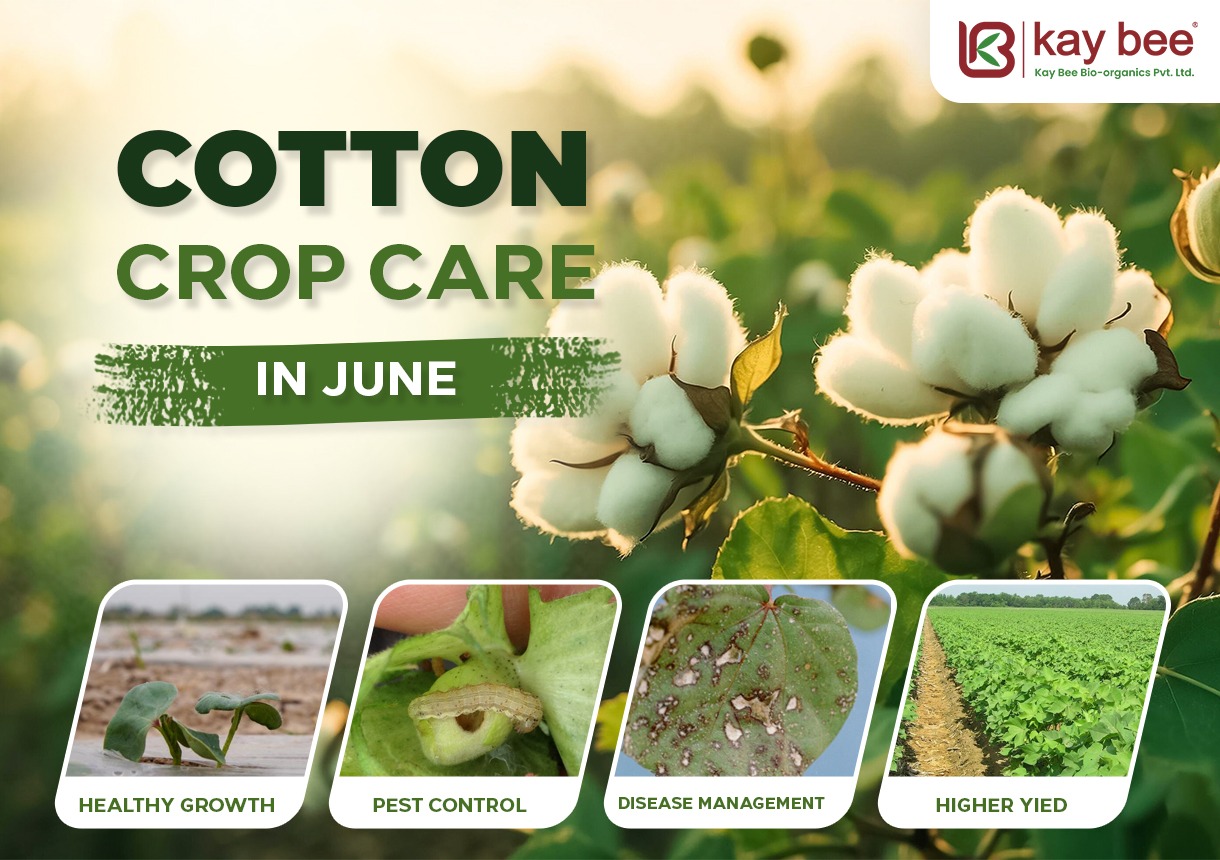
Cotton Crop Care in June: Nutrition, Pest, and Disease Management
June is one of the most important months for every cotton farmer. This is the time when the Kharif season starts, the monsoon begins to arrive, and your cotton seedlings start their journey to become a full crop. What you do in June decides how your entire crop season turns out. That is why understanding cotton crop care in June is so important right from feeding the plant to protecting it from pests and diseases.
Cotton Nutrition in Monsoon — Feed Your Crop Right
When the monsoon starts, cotton plants grow fast. They need proper food (nutrients) to develop strong roots, healthy leaves, and good bolls later. If you skip nutrition or give wrong doses, the plant will look weak, leaves will turn yellow, and your yield will drop badly. This is why cotton nutrition in Monsoon cannot be ignored.
Here is what your cotton plant needs in June and how to give it:
Nitrogen (N) — The Growth Booster
- Nitrogen is the most important nutrient in the early stage. It helps the plant grow green and tall. In June, when the plant is young (3–4 weeks old), it needs a good dose of nitrogen.
- Apply Urea @ 50 kg per acre as the first top dressing after proper germination.
- If you see pale or yellowish leaves, it is a sign of nitrogen deficiency — apply immediately.
Phosphorus (P) — For Strong Roots
- Phosphorus helps the cotton plant build a strong root system. It is mostly applied at the time of sowing, but if you missed it, you can still give it early in June. Phosphorus is a vital part of cotton nutrition in Monsoon.
- Use DAP (Di-Ammonium Phosphate) @ 50 kg per acre as basal dose.
- Strong roots mean the plant can absorb water and nutrients better during the monsoon rains. This is a key outcome of correct cotton nutrition in Monsoon.
Potassium (K) — For Cotton Boll Development
- Potassium improves the quality of cotton fibre and also helps the plant resist diseases. Though it becomes more important in the later stage, applying it early in June gives a strong base.
- Apply Muriate of Potash (MOP) @ 25 kg per acre.
- Potassium also helps the plant handle excess moisture during heavy monsoon rains. This is a key part of cotton crop care in June.
Micronutrients — Do Not Ignore Them
- Most farmers focus only on N-P-K but forget micronutrients. In June, during cotton nutrition in Monsoon, these small nutrients make a big difference:
- Zinc Deficiency is very common in cotton. Spray Zilite @ 1 ml per lt. if you see small leaves with whitish patches.
- Calcium & Boron helps in flower setting. Spray Calbolite @ 1.5 ml per lt.
- Magnesium and Sulphur also help in leaf colour and protein formation.
Growth Regulators — Control Vegetative Growth for Better Yield
In June, with good rains and nitrogen application, cotton plants can grow very fast and tall. Too much vegetative growth means the plant puts energy into leaves and stems instead of bolls. Growth regulators help you control this balance and direct the plant’s energy toward flowering and boll development.
When to Apply Growth Regulators :
Start applying when the crop is 45–60 days old and showing excessive vegetative growth (tall plants with lush green leaves but no squaring).
Recommended Growth Regulator :
Use Nova zyme @ 2 ml per lt. as a foliar spray. This is one of the most widely used and effective growth regulators for cotton. It reduce internode elongation and encourage more lateral branches for higher boll load.
Cotton Pest Management in Kharif — Protect Your Crop Early
June is the starting month of the Kharif season and also the time when many pests become active. If you do not manage pests early, they can destroy your entire crop before it even flowers. Let us look at the most common pests you will see in June and how to deal with them.
-
Thrips :
Thrips are very small insects that suck the juice from young cotton leaves. You can spot thrips damage when you see leaves curling upward or silvery patches on the leaf surface. Managing thrips is a priority in cotton Pest management in Kharif.
- Use Thrips Raze @ 2.0 ml per lt. + Orga Neem (3000 ppm) @ 1 ml per lt.
- Spray during evening hours for better results.
-
Aphids, Jassids & Whitefly:
Aphids are soft-bodied green or black insects that form large colonies on young shoots and undersides of leaves. They suck plant sap and weaken the plant quickly. Controlling aphids is an essential step in cotton Pest management in Kharif. Also Jassids cause ‘hopper burn’ — the edges of leaves turn yellow and brown and curl downward. They are active in June especially during dry spells between rains. Whitefly is one of the most damaging pests. It not only sucks plant sap but also spreads the deadly Cotton Leaf Curl Virus (CLCuV)
- Use Pesto raze (cotton Special) spray @ 2 ml per lt.
-
Red Cotton Bug :
Though red cotton bugs are mostly a problem during boll formation, they can start appearing in late June. Keep an eye on them near soil and plant base.
- Use Pesto raze (cotton Special) spray @ 2 ml per lt.
Cotton Diseases in June — Identify and Act Fast
June brings moisture, warmth, and rains — all conditions that invite fungal and bacterial diseases in cotton. Understanding Cotton Diseases in June is very important because if you catch a disease late, it spreads to the whole field and the loss becomes uncontrollable.
-
Damping Off — A Seedling Killer & Fusarium Wilt — The Silent Killer
This is the first disease you may face in June, especially if you sow cotton in overly moist or poorly drained soil. The seedling looks healthy one day and falls flat the next — this is damping off caused by soil fungi like Pythium and Rhizoctonia.
Fusarium wilt is caused by a soil-borne fungus. It blocks the water vessels inside the plant so the plant wilts even when there is enough moisture in the soil. Infected plants show yellowing of lower leaves which then spreads upward and the plant dies within a few weeks. Fusarium wilt is one of the most dangerous Cotton Diseases in June.
- Upto 25 day’s old crop use use Root fit @ 0.5 to 1.0 ml/lt. For drenching.
- Above 1 month age crop use Root fit @ 750 ml-1 lt./acre of land
-
Alternaria Leaf Spot
This fungal disease causes round, dark brown spots with yellow rings on leaves. It is more common after a few days of continuous rain followed by sunny weather. Alternaria leaf spot is among the common Cotton Diseases in June.
- Spray Fungo Raze @ 2 ml per lt. depending on crop stage and disease intensity.
- Maintain proper plant spacing for good airflow and less humidity around leaves.
Integrated Pest Management (IPM) — A Smarter Way to Protect Cotton
Integrated Pest Management (IPM) is a balanced approach that combines cultural, biological, and chemical methods to manage pests in a sustainable and cost-effective way. In June, when cotton is young and vulnerable, IPM helps you protect the crop without over-relying on pesticides. This keeps your soil healthy, reduces input costs, and prevents pest resistance.
-
Cultural Control :
Sow cotton at the recommended time and avoid late sowing which attracts more pests.
Maintain proper plant spacing (90 cm x 60 cm) to allow good airflow and reduce humidity, which discourages fungal diseases and pest buildup.
Remove and destroy crop debris and weeds around the field regularly to eliminate pest hiding and breeding spots.
Biological Control :
Use Orga Neem (3000 ppm) @ 1 ml per lt. as a neem-based biopesticide to repel and disrupt pest feeding without harming beneficial insects.
Encourage natural predators like ladybird beetles, lacewings, and spiders by avoiding broad-spectrum insecticides unnecessarily.
Install yellow sticky traps @ 10 per acre to monitor and reduce whitefly and thrips populations naturally.
Chemical Control (Use Only When Needed) :
Apply Botanical pesticides only when pest population crosses the Economic Threshold Level (ETL) — avoid calendar-based spraying.
Rotate between different biopesticide groups to prevent resistance. For example, alternate between Thrips Raze and Pesto Raze for better pest control efficiency.
Final Words: June Decides Your Cotton Harvest
Cotton crop care in June is not just about one thing — it is a combination of giving the right nutrition, watching out for pests, and catching diseases before they spread.
- Feed your crop with N-P-K and micronutrients as per crop stage — this is central to cotton crop care in June.
- Scout your field regularly for thrips, whitefly, jassids, and aphids.
- Watch for damping off, bacterial blight, and leaf curl virus — act fast at the first sign.
- Use IPM — mix of cultural, biological, and chemical methods for best results.
- Keep records of what you apply so you can improve your decisions every year.
Latest Blogs
 Brown Plant Hopper Paddy Organic Control with Pesto Raze & Mealy Raze
 Mycorrhiza Technical Manufacturer in India | Kay Bee Bio-Organics Pvt. Ltd.
 Cotton Whitefly Management During Square Formation Stage: Effective Control with Pesto Raze & OrgaNeem
 Calcium for Cabbage Head Formation: How Calboost (Ca-11%) Ensures Tight & Crack-Free Heads
 Citrus Canker Organic Control: A Complete Farmer’s Guide
COPYRIGHT © 2026 - ALL RIGHTS RESERVED. MADE BY WebAppGigs