
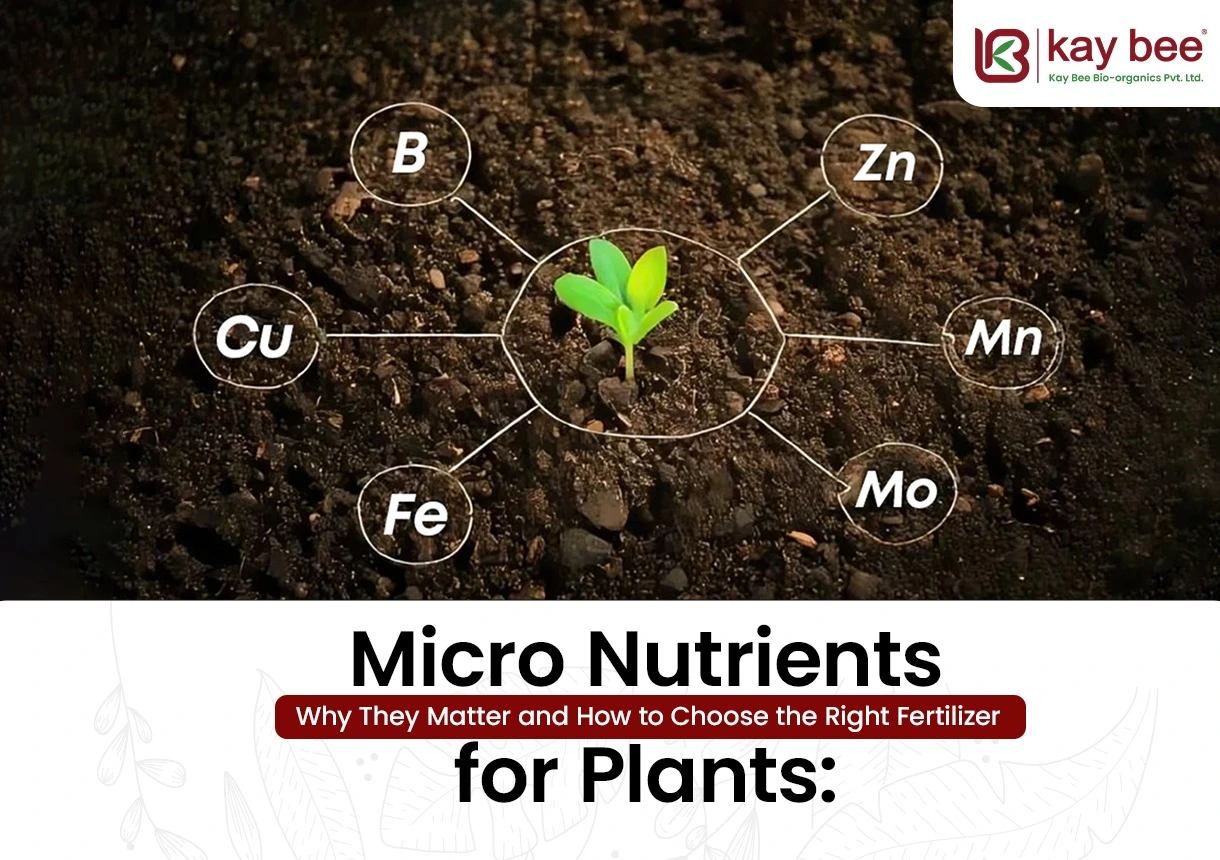
Micronutrients for Plants: Why They Matter and How to Choose the Right Fertilizer
Across farming communities in different regions, one frustration surfaces time and again. Fertilizers were applied on schedule, irrigation was carefully managed, all visible protocols were followed, and yet the crop simply did not deliver what it was expected to. Yields fell short. Quality was inconsistent. Something was clearly off, but nothing obvious pointed to a cause.
In a surprising number of such situations, the answer lies not in major inputs or visible conditions but in something far smaller and far easier to overlook. Micronutrients for plants are the quiet regulators of crop health, and because their absence does not announce itself dramatically, they continue to go unaddressed season after season.
What Are Micronutrients and Why Do Plants Need Them?
Most fertilizer programs are built around NPK, meaning nitrogen, phosphorus, and potassium. These three elements receive the most attention, the most investment, and the most discussion. However, plants are far more complex systems than NPK alone can support.
Micronutrients such as zinc, iron, boron, manganese, and copper are also essential to healthy plant development. They are needed in much smaller quantities than primary nutrients, which is precisely where the misunderstanding begins. A small quantity does not mean small importance. Remove even one of these elements and the plant begins to function at a diminished level, not always visibly, not always dramatically, but consistently below its potential.
It is also worth noting that micronutrients in food crops directly influence the nutritional quality of what reaches the consumer. Deficient soil produces deficient food, which makes this a concern that extends well beyond yield numbers.
Why Micronutrient Deficiencies Are So Easily Missed
The challenge with micronutrient problems is that their symptoms are rarely straightforward. A slight yellowing of leaves might prompt a farmer to assume a nitrogen deficiency, especially when that is the first explanation that comes to mind. But if nitrogen levels are already adequate, the real cause could be an iron deficiency affecting chlorophyll production.
Similarly, poor flowering is often attributed to unfavorable weather conditions. Sometimes that assessment is correct. But sometimes the underlying issue is a shortage of boron, which plays a direct role in the reproductive stages of plant growth. These overlapping and easily misread signals make micronutrient deficiencies one of the more difficult issues to diagnose without proper investigation.
What Each micronutrient Does Inside the Plant
Rather than approaching this as a technical exercise, it helps to think of micronutrients as the plant’s internal operating system. The major nutrients provide the energy and structure, but micronutrients govern how well the plant can actually run its processes.
Iron is responsible for chlorophyll formation. Without sufficient iron, leaves begin to lose their characteristic deep green colour and photosynthesis becomes less efficient. Zinc directly affects cell elongation and overall growth, and when it is deficient, plants fail to develop properly in size and structure. Boron is particularly important during the reproductive phase, influencing flowering quality, fruit set and the development of yield. Manganese and copper, while needed in even smaller amounts, contribute to enzyme activity and overall metabolic function.
Understanding food micronutrients in plants also reveals why crop quality varies so significantly between fields that appear to receive identical treatment. A plant producing fruit or grain under micronutrient stress may look acceptable from a distance but will consistently underdeliver in nutritional density and marketable quality.
The key principle to understand is that plant nutrition is not simply about quantity. It is about balance. An abundance of primary nutrients cannot compensate for the absence of trace elements.
Check Out Our Micronutrients Products
The NPK Trap and the Role of Micronutrients Fertilizer
A common response when yields disappoint is to increase the fertilizer dose. The reasoning feels intuitive. If the crop is underperforming, perhaps it needs more nutrition. In practice, however, this logic often misses the root cause entirely.
When a plant lacks the micronutrients necessary to process and utilize primary nutrients, applying more nitrogen or phosphorus does very little. The plant cannot absorb what it cannot metabolize. Input costs rise, but output does not follow. This is where a targeted micronutrients fertilizer program becomes genuinely valuable. Addressing the micronutrient deficit first allows the existing NPK investment to actually work as intended, rather than passing through the system without delivering results.
Choosing the Right Micronutrients Fertilizer
When selecting a micronutrient fertilizer, the form of the nutrient matters considerably. Chelated micronutrients are bound to organic compounds that protect them from becoming locked in the soil and make them significantly easier for the plant to absorb. While chelated forms typically carry a slightly higher price, their effectiveness and speed of action often justify the additional cost, particularly when deficiency is already visible and time is a factor.
The choice between single micronutrients and combination products depends on the situation. When a specific deficiency has been confirmed through soil or leaf testing, targeted application of a single element is appropriate. In field conditions where multiple deficiencies may be present simultaneously, combination products offer a practical and time-saving alternative. Crop type and soil pH should always inform product selection, since different crops have meaningfully different micronutrient demands and soil chemistry affects nutrient availability in ways that influence which product will perform best.
Application Methods and Timing
The method of application determines how quickly a correction takes effect. Foliar spraying delivers micronutrients directly to the leaves, where absorption is rapid, making it the preferred choice when deficiency symptoms are already present and a quick response is needed.
Timing within the day also influences effectiveness. Spraying during early morning or evening hours allows better absorption because temperatures are lower and stomata are more open and receptive. Spraying during peak heat reduces efficiency considerably. One frequently overlooked aspect of foliar application is leaf coverage. The underside of leaves absorbs nutrients more readily than the upper surface, and ensuring both sides receive adequate coverage makes a measurable difference to outcomes.
Soil application is better suited to long-term soil health management. It works more slowly than foliar spraying but builds a more sustained nutrient profile over time. For growers using drip irrigation systems, fertigation can be an efficient delivery method, provided the product is compatible with the system and the application rate is carefully managed.
Micronutrients in Food and the Broader Picture
The conversation around micronutrients extends beyond field performance. Research consistently demonstrates that micronutrients in food are directly tied to the micronutrient status of the soil in which those crops were grown. Zinc-deficient soil produces zinc-deficient grain. Iron-poor growing conditions result in iron-poor produce. As consumer awareness of nutritional quality continues to grow, the agronomic case for micronutrient management increasingly aligns with market expectations as well.
Crops grown with a well-balanced micronutrient program tend to produce fruit and grain with better color, texture, shelf life, and measurable nutritional content. These are qualities that matter at every point in the supply chain, from harvest to end consumer.
What to Expect When It Is Done Correctly
Correcting micronutrient deficiencies does not produce overnight transformations, but visible improvement tends to follow within a reasonable period. Plant growth becomes more uniform. Leaf color deepens. Flowering improves in consistency. Fruits develop better in size, color, and surface appearance.
Over successive seasons, input efficiency improves as the crop is able to make full use of the nutrition provided. The value of a structured micronutrients for plants program is not simply in correcting a visible problem. It lies in unlocking the full productivity that sound agronomic practice is capable of delivering.
Final Thought
Micronutrients for plants rarely receive the attention they deserve in conversations about crop performance. They are not the loudest factor, and they do not cause sudden, catastrophic failure. What they do, quietly and consistently, is determine how far a crop can reach. Ignoring them does not destroy a season. It simply limits what the season could have been, and in farming, that difference is always worth addressing.
Latest Blogs
 Thrips as Vectors of Tospo Virus in Chilli and Tomato: How Thrips Raze Breaks the Cycle
 Boost Your Cotton Yield: A Practical Guide to Soil Nutrient Mobilization
 The Neem Miracle: How We Extract Azadirachtin from Neem
 Stop Fall Armyworm Before It Destroys Your Maize Farms
 Red Spider Mite Control for Citrus Orchards With R-Mite
COPYRIGHT © 2026 - ALL RIGHTS RESERVED. MADE BY WebAppGigs