
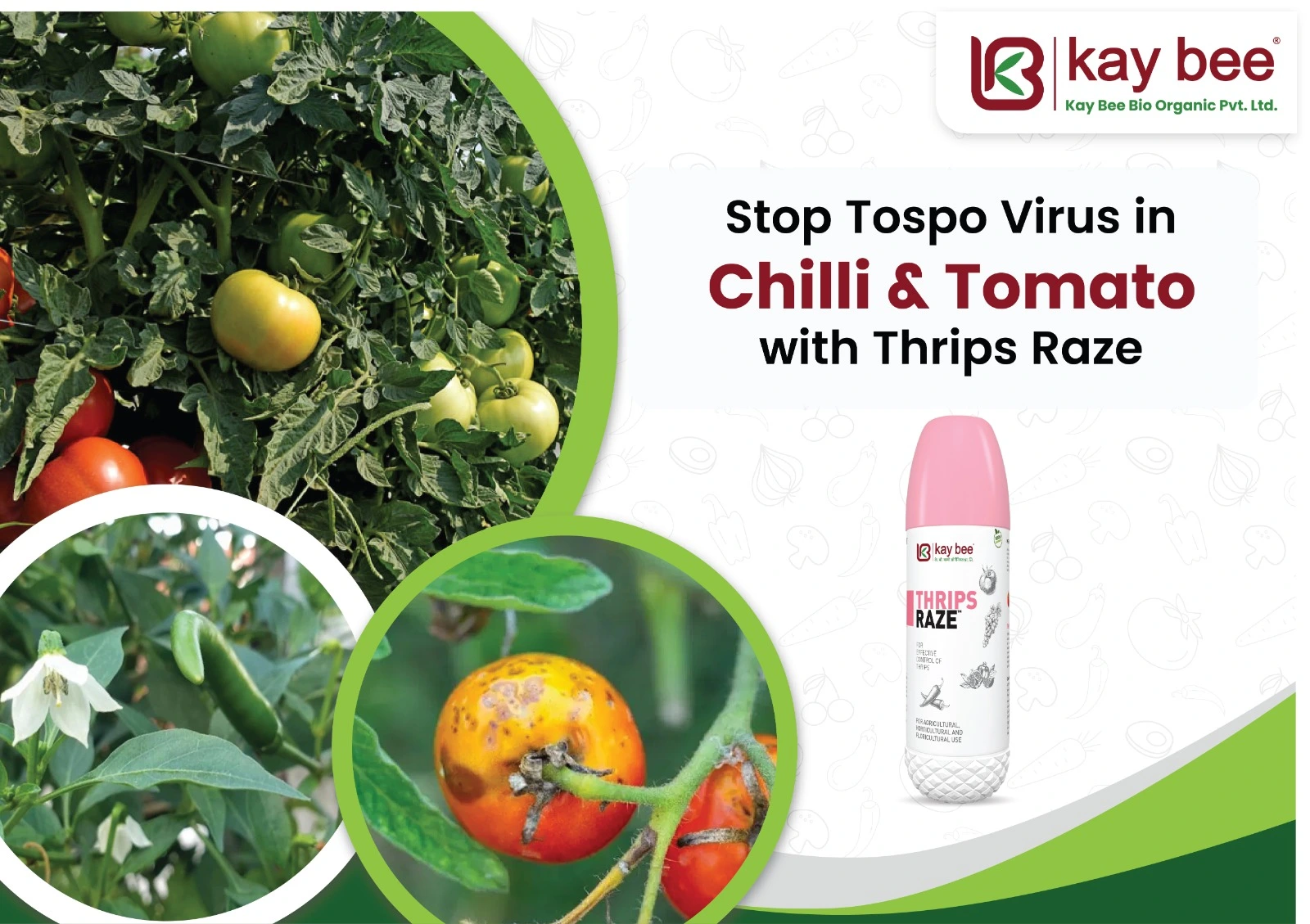
Thrips as Vectors of Tospo Virus in Chilli and Tomato: How Thrips Raze Breaks the Cycle
For farmers across India, the chili and tomato seasons represent a major portion of annual income. However, these crops are constantly under siege by invisible enemies. While many growers focus on external threats like fungal infections or erratic weather, the most devastating damage often comes from a tiny insect known as the thrips. These microscopic pests do more than just feed on your plants; they act as a gateway for viral diseases that can destroy a field in a matter of weeks.
If you are struggling to manage these persistent pests and the viral diseases that follow, it is time to shift your perspective. Understanding the biology of the thrips and how to effectively break the cycle of infection is the only way to safeguard your yield and ensure profitability.
The Microscopic Engine of Destruction
Thrips are minute insects, often barely visible to the naked eye. They belong to the order Thysanoptera and are specialized feeders. They possess rasping and sucking mouthparts that they use to puncture plant cells, extracting the sap. While this causes physical damage to the leaves, such as silvering or curling, the true devastation begins when they carry the Tospo virus.
The relationship between thrips and the Tospo virus is a textbook example of biological efficiency. The virus requires an insect vector to move from an infected plant to a healthy one. Thrips larvae feed on infected plant tissue, ingest the virus, and then retain it as they develop into adults. Once an adult thrips is infected, it can transmit the virus to every healthy plant it visits for the rest of its life. Because these insects fly and are easily carried by the wind, the spread of the virus across a field happens with alarming speed.
Why Your Current Strategy Might Be Failing
Many farmers rely on traditional chemical approaches, applying a standard thrips insecticide every few days to keep the population down. While this might seem logical, it often fails to stop the spread of the virus.
First, there is the issue of resistance. Thrips reproduce extremely quickly, producing several generations in a single season. If you use the same class of chemical repeatedly, the surviving insects pass on their resistance to the next generation, rendering your spray for thrips ineffective within a few seasons.
Second, thrips are masters of evasion. They hide deep within terminal buds, flower clusters, and tightly curled leaves. If your insecticide for thrips does not have the necessary contact or systemic action to reach these protected areas, you are essentially missing the core of the infestation.
Third, there is the problem of timing. In the context of the Tospo virus, killing the thrips is only half the battle. If the virus has already been transmitted, the damage to the plant physiology is irreversible. Relying solely on chemical sprays often means you are playing a game of catch up, responding to an outbreak that has already occurred rather than preventing the disease from taking hold.
View Products: Thrips Raze
A Smarter Option: Integrated Pest Management
True insect control for plants requires a shift away from reactive spraying and toward a proactive, integrated management strategy. This involves understanding the ecology of your farm and using tools that disrupt the lifecycle of the pest.
The goal is to move toward using biological solutions, such as bio pesticides for thrips, which offer a more sustainable way to manage populations. These solutions often work by interfering with the insect nervous system or inhibiting their ability to feed, rather than just relying on standard chemical toxins.
The Role of Thrips Raze in Modern Agriculture
Thrips Raze, developed by Kay Bee Bio Organics, is designed to address the gaps left by conventional chemistry. When searching for the best insecticide for chilli thrips or the best insecticide for thrips on chilli, many farmers are finding that a multi pronged approach is essential.
Thrips Raze is formulated to target multiple life stages of the pest. By reducing the overall population density more effectively, it lowers the probability of the virus being transmitted from one plant to another. When you integrate a product like this into your routine, you are not just killing the adults you see; you are managing the entire population cycle. This is a critical distinction if you are trying to minimize the incidence of chilli diseases or control the tomato leaf curl virus in your plots.
Best Practices for Prevention and Control
The best insecticide for thrips in chilli is only as good as the environment in which it is used. To maximize the effectiveness of your pest control program, you must adopt a comprehensive set of cultural practices.
Regular Scouting and Monitoring
You cannot manage what you do not measure. Use yellow and blue sticky traps to monitor the presence of thrips in your field. These traps act as early warning systems. If you see a sudden increase in the number of thrips on your traps, you know it is time to act before the population explodes.
Field Hygiene and Sanitation
Weeds are often the primary reservoir for both thrips and the viruses they carry. Before you even plant your crop, ensure the surrounding area is free of weeds. Many weeds act as asymptomatic hosts, meaning they carry the virus without showing signs of damage. If your field is surrounded by these host plants, your crop will be infected even if you follow a perfect spray schedule.
Balanced Nutrient Management
Farmers often make the mistake of over applying nitrogen to encourage fast growth. While this makes the plant look greener in the short term, it creates soft, succulent tissue that is highly attractive to thrips. This type of growth is essentially a magnet for the pests. Keep your nutrient management balanced, focusing on overall plant health rather than just forced vegetative growth.
Targeted Application
When applying any product, whether it is a bio pesticide for thrips or a standard spray, coverage is everything. As mentioned earlier, thrips hide in the most difficult to reach places. Ensure that your spray equipment is calibrated properly and that you are achieving thorough coverage of the undersides of leaves and the terminal growing points. Using a surfactant can help the product stick to the leaf surface and penetrate into the tight buds where thrips congregate.
The Economic Reality for Indian Farmers
The economic impact of thrips and associated viral diseases cannot be overstated. In severe cases, yield losses can range from 30 to 70 percent. For a small or medium scale farmer, this is the difference between a profitable season and a catastrophic financial loss.
When you factor in the rising costs of chemical inputs and the declining efficacy of traditional sprays, the current path is unsustainable. Farmers who are finding success today are those who have stopped viewing the thrips solely as a pest to be killed and started viewing the entire viral cycle as a process to be broken.
By using products like Thrips Raze as part of a holistic insect control for plants program, you reduce your reliance on expensive and potentially harmful chemicals. This leads to better crop quality, higher market value, and a more sustainable farming operation for the future.
Conclusion
Managing thrips and the viruses they carry is one of the most challenging aspects of chilli and tomato cultivation. However, it is not an impossible task. By combining the right products with good field hygiene, regular monitoring, and a deeper understanding of pest biology, you can take back control of your farm.
The best insecticide for chilli thrips is the one that fits into a broader strategy of crop protection. It should be effective against the pest, safe for the environment, and focused on stopping the disease cycle before it starts. As you move forward, remember that the goal is not just to kill the insects, but to foster an environment where your crops can thrive without the constant pressure of viral infection.
If you are currently looking for the best insecticide for thrips in chilli, take the time to evaluate your full management plan. Look for solutions that prioritize long term prevention over short term fixes. By staying proactive and informed, you can ensure that your chilli and tomato crops reach their full potential, providing you with the harvest you deserve and the profitability your hard work earns. Your commitment to smarter, more sustainable practices is the key to securing the future of your farm.
Latest Blogs
 Mycorrhiza Technical Manufacturer in India | Kay Bee Bio-Organics Pvt. Ltd.
 Cotton Whitefly Management During Square Formation Stage: Effective Control with Pesto Raze & OrgaNeem
 Calcium for Cabbage Head Formation: How Calboost (Ca-11%) Ensures Tight & Crack-Free Heads
 Citrus Canker Organic Control: A Complete Farmer’s Guide
 Orthosilicic Acid (OSA) for Monsoon Stress: Building Crop Strength & Resilience
COPYRIGHT © 2026 - ALL RIGHTS RESERVED. MADE BY WebAppGigs