
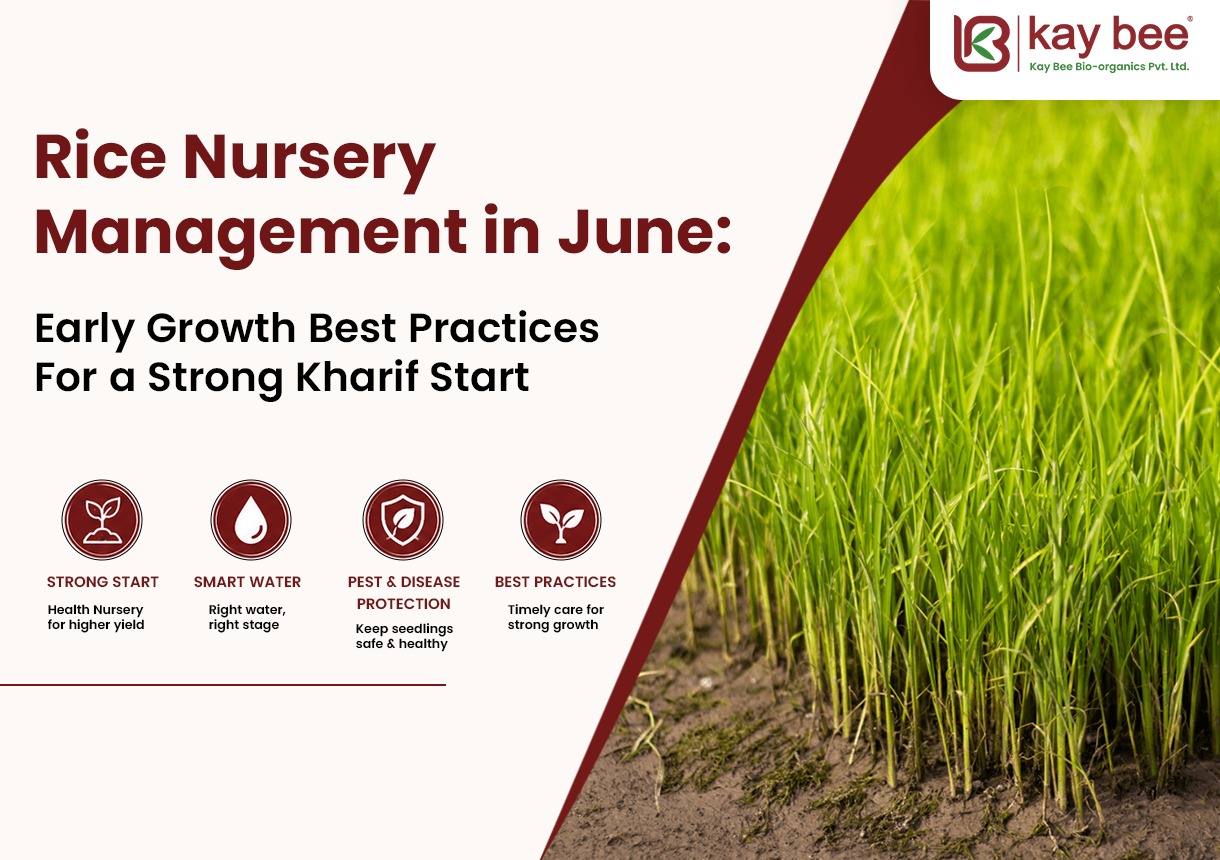
Rice Nursery Management in June: Early Growth Best Practices for a Strong Kharif Start
A good rice crop starts in the nursery. How you prepare and care for it in June decides how productive your crop will be at harvest, which is why rice nursery management in June is so important during the Kharif season. June brings the monsoon and the perfect window for paddy nursery in June, but it also brings risks of waterlogging, fungal disease, and pests if preparation is poor.
Why June is the Right Time for Paddy Nursery
June sits in the middle of India’s Kharif sowing Calendar (mid-May to early July), making it ideal for paddy nursery in June. Soil temperature reaches 25–35°C, the ideal germination range; monsoon rains reduce irrigation needs; and seedlings sown now are ready for transplanting in 25–30 days, matching the July transplanting window.
However, heavy rains can waterlog beds, humidity invites fungal disease, and pests are more active, which is why nursery management in Kharif needs careful attention from day one.
Choosing the Right Nursery Site
Good site selection is essential for successful rice nursery management in June. The land should get 6–8 hours of sunlight, have loamy or clay-loam soil, and be close to clean water and the main field. 1 acre of main field needs about 80–100 square meters of nursery area, with a small buffer for losses.
Nursery Bed Preparation — The Foundation of Good Seedlings
Bed quality directly affects rice seedling care outcomes. Plough 2–3 times for a fine tilth, level completely, and make beds 1–1.5 metres wide with 30 cm drainage channels. Mix in well-rotted FYM @ 2–3 kg/sq m and Trichoderma viride @ 5 gm/sq m to improve soil health and prevent damping off, then flood, soak for a day, and drain to kill weed seeds. During heavy monsoon, raised beds (10–15 cm high) prevent waterlogging; flat beds suit areas with good drainage control. Bed preparation is a critical component of rice nursery management in June.
Seed Selection and Seed Treatment
Seed selection and treatment are the most cost-effective steps in rice nursery management in June. Seed selection is a priority task in nursery management, Kharif. Use certified seeds (avoid stock older than 2 years) and run the Salt Water Test (2 tbsp salt per litre) to discard floating seeds, then wash the sinkers.Seed rate: 40–50 kg per acre of main field.
Sowing Seeds in the Nursery Bed
This is the heart of the paddy nursery in June. Broadcast pre-germinated seeds uniformly, press gently into the moist bed, and cover with under 1 cm of dry soil or sand. Sow at 50–60 gm of seed per square meter—overcrowding produces weak, spindly seedlings. Uniform sowing is central to rice nursery management in June.
Water Management in the Nursery
Water management is fundamental to rice seedling care. Water is the most mismanaged input in nursery management kharif. On days 1–5, keep beds moist but not flooded. On days 6–15, maintain a thin 1–2 cm film and never let the bed dry out. On days 16–25, maintain 2–3 cm standing water to suppress weeds and aid leaf growth, draining excess promptly after heavy rain. Never let water stagnate beyond 24 hours, irrigate dry spells only morning or evening, and keep channels clear.
Fertilizer and Nutrition in the Nursery
Good rice seedling care needs proper nutrition. Adequate fertilization of your paddy nursery in June ensures strong growth. At bed prep, mix in DAP @ 100 gm/sq m for root development. About 10–12 days after germination, top-dress with Urea @ 5–8 gm/sq m (avoid wet leaves). Treat zinc deficiency (pale leaves, brownish streaks) with Zilite @ 39.5% (0.5 ml/litre) spray, and apply Gypsum @ 100 gm/sq m for sulphur-deficient soils. also take one growth booster spray Nova Zyme 1 ml and Nutrix 0.5 ml per lt.
Weed Management in the Nursery
Warm, moist June conditions make weeds grow fast, a key concern in nursery management Kharif. Hand-pull weeds on days 8–12 (repeat around Day 18–20 if needed). A thin standing water layer (2–3 cm) from Day 10 onward is the most effective, zero-cost weed control method in your paddy nursery in June.
Pest Management in the Rice Nursery
Young seedlings have little tolerance for stress, so pests can wipe out large portions of your paddy nursery in June. Key pests:
Leaf folder and Stem Borer: Leaf folder rolls leaves into tubes and Stem borer causes Dead heart symptoms, spray Larvo Raze @ 1-1.5 ml/litre after draining nursery water.
Gall midge: causes a hollow ‘silver shoot’, a serious nursery management Kharif concern; apply Larvo Raze @ 1-1.5 ml/litre or use resistant varieties.
Birds and rodents: Protecting seedlings from birds and rodents is part of proper rice seedling care; use shiny strips or scarecrows for birds and zinc phosphide bait blocks for rats.
Scout daily, spray only when needed, and maintain your paddy nursery in June vigilantly. Prefer Larvo Raze @ 1-1.5 ml/litre + Orga Neem (3000 PPM) @ 0.5 ml/litre for mild infestations.
Disease Management in the Rice Nursery
Disease prevention is a key responsibility in Kharif nursery management. June’s warm, humid weather breeds disease; catching it early is critical for rice seedling care:
Damping off: The most common nursery disease, worsened by overwatering. Use Root Fit at 250 ml/acre of the nursery; just mix with sand and broadcast.
Rice blast: Grey/brown spindle spots spreading in cool, humid weather. Spray Fungo Raze @ 1-1.5 ml/litre. Avoid excess nitrogen and use resistant varieties where common.
Brown leaf spot: Brown spots with yellow halos from potassium/silicon deficiency. Spray Fungo Raze @ 1-1.5 ml/litre and correct soil nutrition.
Knowing When Seedlings Are Ready for Transplanting
All the effort in rice nursery management in June comes down to this moment. Seedlings are ready at 25–30 days, 20–25 cm tall with 3–4 healthy leaves, a thick dark-green stem base, and well-developed white roots.
Quick Reference: Nursery Management Activity Calendar
Days 1–6: Prepare beds with FYM and Trichoderma; select, treat, and sow seeds at 50–60 gm/sq m
Days 7–12: Keep beds moist, scare birds, first weed check, Urea top dressing, watch for damping off
Days 12–20: Maintain 2 cm standing water, hand weed, monitor for leaf folder, blast, and gall midge
Days 20–30: Spray Zinc if needed, continue water management, assess readiness, reduce water before uprooting
Conclusion: A Strong Nursery Builds a Strong Harvest
As the old farmer’s saying goes, take care of the nursery and it will take care of your harvest. Choosing the right site, preparing beds properly, treating seeds, managing water carefully, feeding moderately, and protecting seedlings from pests and disease together build the foundation of a successful Kharif season—every effort in your paddy nursery in June pays back many times over at harvest.
Remember the essentials of rice seedling care: never skip seed treatment, maintain proper water levels at each stage, scout daily, feed moderately, and transplant at the right age. Follow these and you’ll have strong, healthy seedlings—the real foundation of good nursery management in Kharif and a great rice harvest ahead.
Latest Blogs
 Brown Plant Hopper Paddy Organic Control with Pesto Raze & Mealy Raze
 Mycorrhiza Technical Manufacturer in India | Kay Bee Bio-Organics Pvt. Ltd.
 Cotton Whitefly Management During Square Formation Stage: Effective Control with Pesto Raze & OrgaNeem
 Calcium for Cabbage Head Formation: How Calboost (Ca-11%) Ensures Tight & Crack-Free Heads
 Citrus Canker Organic Control: A Complete Farmer’s Guide
COPYRIGHT © 2026 - ALL RIGHTS RESERVED. MADE BY WebAppGigs