
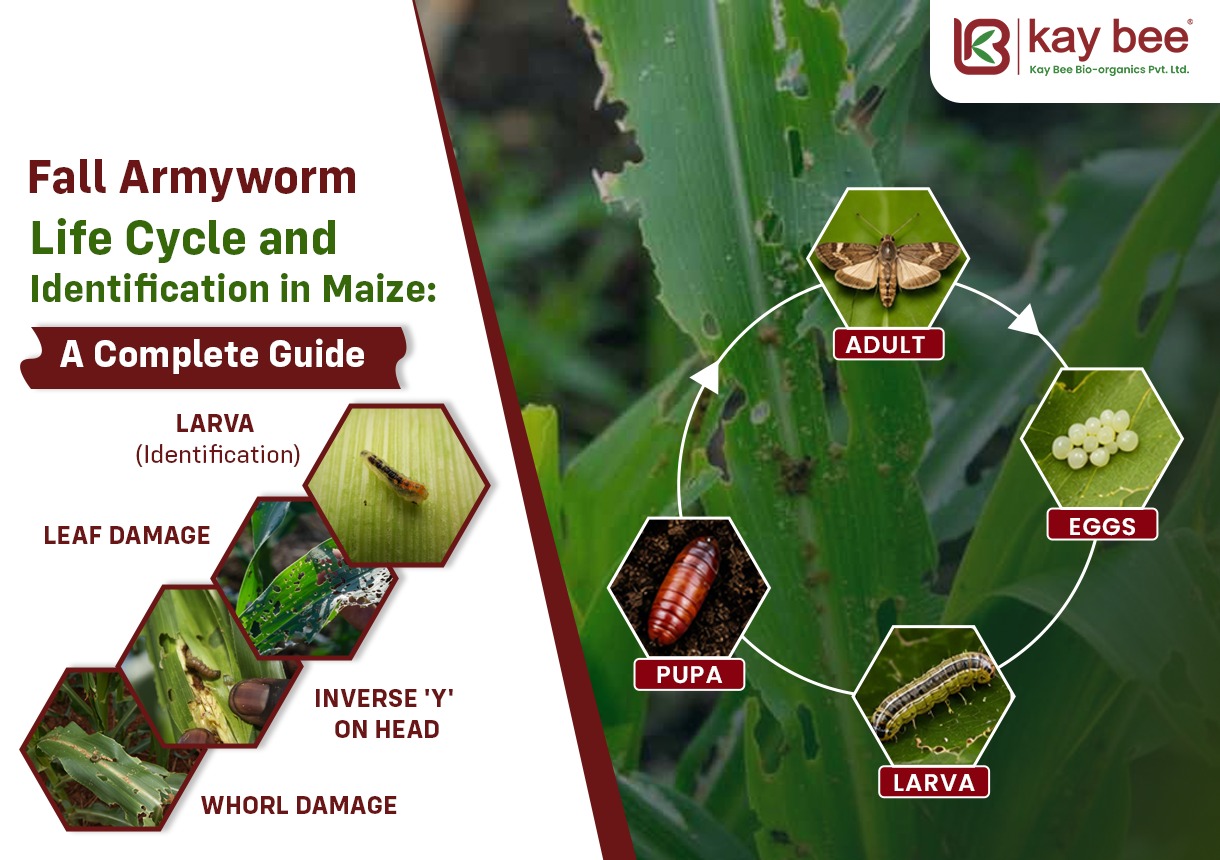
Fall Armyworm Life Cycle and Identification in Maize: A Complete Guide
In May 2018, a single moth landed in a maize field in Karnataka. Farmers did not notice. Nobody raised an alarm. Within twelve months, what arrived quietly had spread to more than ten Indian states damaging standing crops in Mizoram, Nagaland, Meghalaya, Manipur, Sikkim, and Arunachal Pradesh.
This was Spodoptera frugiperda the Fall Armyworm (FAW). It did not originate in India. It came from tropical and subtropical America, swept through sub-Saharan Africa in 2016, reached South Asia by 2018, and now threatens maize farms in over 50 countries. Genetic analysis of the Indian strain shows it is closely related to populations from Florida, Ghana, Nigeria, and Uganda.
For a country where maize is a staple cereal and a livelihood crop for millions of smallholder farmers, understanding this pest is no longer optional. This guide covers the complete fall armyworm life cycle, how to identify the pest and its damage accurately, and what this means for field management. For organic control strategies, read our guide on how to stop FAW before it destroys your maize farms.
Understanding the Fall Armyworm Life Cycle
Fall Armyworm is a holometabolous insect it goes through four completely distinct stages. Each stage has different behaviour, location, and vulnerability. Knowing which stage you are dealing with changes what action you can take.
Here is the complete fall armyworm life cycle:
| Stage | Duration | Location | What Is Happening |
| Egg | 4–6 days | Leaf underside /
inside whorl |
Female lays 1,000+ eggs in clusters covered with fine hair. Larvae develop silently inside the egg. Lab studies show Larvo Raze can prevent hatching entirely at this stage. |
| Larva (Caterpillar) | 14–17 days | Leaves → whorl → ear | The primary damage stage. Early instars feed together on leaf surfaces; later instars move alone deep into the whorl. This is the window for effective spray intervention. |
| Pupa | 7–8 days | 2–8 cm deep in soil | Reddish-brown pupa rests underground. Sprays cannot reach it here. Crop rotation and deep tillage disrupt this stage. |
| Adult Moth | 7–9 days | Can fly 100 km/night | Mates and restarts the cycle. One adult can produce an entirely new generation within days. Evening sprays with fumigant-action products help deter egg-laying. |
Why the Life Cycle Makes FAW Dangerous
The entire egg-to-adult cycle can be completed in 30–40 days under warm Kharif conditions (25–30°C). This means FAW can produce multiple generations in a single cropping season, with each generation potentially larger than the last if not checked. Add to this the adult moth’s ability to fly up to 100 km in a single night, and it becomes clear why FAW infestations can spread from one village to the entire district within weeks.
There is also a behaviour that sets FAW apart from other caterpillars: cannibalism. Older, larger larvae actively consume smaller ones. This is not a weakness it is a survival mechanism that ensures fewer but stronger larvae survive to do more damage. In the field, this means you rarely find many larvae together in the same whorl; a single large larva is often responsible for the damage you see.
For broader context on how Kharif pest pressure builds across crops, read our guide on role of micronutrients in kharif crops and our overview of top 10 kharif crops in India sowing calendar.
Also Read: Understand the Fall Armyworm Life Cycle
How to Identify Fall Armyworm in Your Maize Field
Step 1: Check the Eggs First
If you scout frequently, you may catch the infestation before larvae emerge. FAW egg clusters are creamy yellow to pale grey, oval-shaped, and typically laid on the underside of leaves or inside the whorl. A key identifier: the clusters are covered with fine hair or scale-like material from the female moth’s body they look faintly fuzzy. Each cluster can contain 100–200 eggs, and a single female lays over 1,000 eggs in her lifetime.
Early detection at the egg stage is high value it is the easiest moment to disrupt the cycle before any feeding damage occurs.
Step 2: Identify the Larva (The Key Step)
The larva stage is when damage occurs, and it is also the stage most commonly confused with other caterpillars. Accurate identification is critical because the wrong pest means the wrong solution.
Look for these diagnostic features on the larva body:
- Inverted Y-mark on the head: A clear white marking in the shape of an upside-down Y on the dark head capsule. This is the single most reliable field identifier for FAW.
- Four spots in a square (2nd-last segment): On the segment just before the tail, look for four large dark spots arranged in a square pattern two on top, two below.
- Trapeze spots on other segments: Smaller dark spots in a trapezoid arrangement run along the rest of the body.
- Pale dorsal stripe: A light-coloured line runs down the centre of the back from head to tail.
- Sawdust-like frass near the whorl: Even when larvae are hidden deep inside, their droppings coarse, granular, sawdust-like collect visibly at the whorl opening.
FAW vs Look-Alike Pests: A Quick Comparison
| Feature | Fall Armyworm | Common Armyworm /
Other Caterpillars |
| Head marking | Inverted white Y-mark clearly visible | No Y mark; plain or faint patterns |
| Body spots (2nd-last segment) | 4 large spots in a square | Absent or scattered |
| Dorsal stripe | Pale line running down centre of back | Varies; often absent |
| Behaviour | Cannibalistic older larvae eat younger ones | No cannibalism observed |
| Egg cluster | Covered in fine hair/scales | Bare or lightly covered |
The cannibalism behaviour in particular is a reliable field indicator if you open the whorl and find only one large larva where you expected many, that is a strong sign of FAW rather than a different species.
Fall Armyworm Symptoms in Maize: What to Look for by Crop Stage
Seedling Stage (V1–V3)
- Leaves show papery, transparent patches (called “windowpaning”) where young larvae have scraped the surface without breaking through.
- Tiny pinholes in unfolded leaves are an early sign.
- Severe attack can kill seedlings outright this appears as dead heart but at a very early stage.
Whorl Stage (V4–V8) Highest Risk Window
- Ragged, irregular holes in leaves as larger larvae chew through.
- Coarse frass (sawdust-like droppings) visible at the centre of the whorl this is the most reliable field symptom.
- The larva itself is hidden deep inside; pulling apart the whorl may reveal it.
- Leaves, when they unfurl, show a characteristic “shothole” pattern of ragged holes in a line.
Tasselling and Ear Stage (V12+)
- Damage shifts to the developing ear larvae bore into the cob and feed on grain.
- Entry holes at the base of the husk, with frass visible around them.
- Cob damage at this stage is irreversible yield loss cannot be recovered. This is why early-stage identification matters.
When Is the Right Time to Intervene?
Understanding the life cycle tells you the most important practical answer: spray at the larval stage, before the 3rd instar. Once larvae reach the 4th instar and move deep into the whorl or ear, they become harder to reach with any spray. The action thresholds recommended for Indian conditions are:
- Seedling to early whorl: Act when 20% of plants show fresh damage with live larvae present.
- Whorl stage: Act when 10% of plants have larvae in the whorl, or when you find 2–3 larvae per plant.
- Reproductive stage: Act immediately at 10% plant damage cob damage is not reversible.
Scout your field every 3 days during the early vegetative stage. FAW can go from low levels to heavy infestation in less than a week under warm, humid conditions.
A Note on Management
A detailed guide to FAW control options including timing, spray technique, and product combinations is covered in our post: Stop Fall Armyworm Before It Destroys Your Maize Farms.
What is worth noting here, in the context of the life cycle, is that interventions targeting both the egg and larval stage simultaneously give the best results. Products with ovicidal activity (which disrupt egg hatching) combined with larvicidal action can interrupt the cycle at two points rather than one. In internal lab trials, Kay Bee Bio-Organics’ Larvo Raze demonstrated that Spodoptera eggs treated with the formulation showed no hatching, while untreated control eggs hatched normally within 4 days showing the potential value of early-stage intervention. For neem-based complementary options, also explore ORGANEEM 3000 ppm for fumigant-action adult moth deterrence.
Conclusion
Fall Armyworm is not a pest that can be managed by guesswork. Its rapid life cycle, hidden larval behaviour, and ability to spread across large areas in days demand that farmers understand what they are dealing with before acting.
The three habits that consistently protect maize yields are simple: scout early and often, identify correctly before spending on inputs, and intervene at the larval stage before the 3rd instar. Everything else product choice, spray technique, field coordination becomes more effective when these foundations are in place.
For complete maize crop protection this Kharif season, combine FAW scouting with our guide on maize agronomy in June for uniform germination and growth and explore best organic farming products in India for a full-season crop health plan.
Latest Blogs
 Tomato Nematode Damage: Underground Signs, Crop Loss and Organic Control with Root Fit
 Sugarcane Growth Stages: Root, Tiller & Vegetative Schedule
 Guava Flowering & Fruit Development: Calbolite Powder for Calcium Nutrition
 Management of Cabbage Diamondback Moth with Larvo Raze + OrgaNeem Organic Products
 Papaya Fruit Rot & Powdery Mildew in Monsoon: Identification and Organic Management
COPYRIGHT © 2026 - ALL RIGHTS RESERVED. MADE BY WebAppGigs