
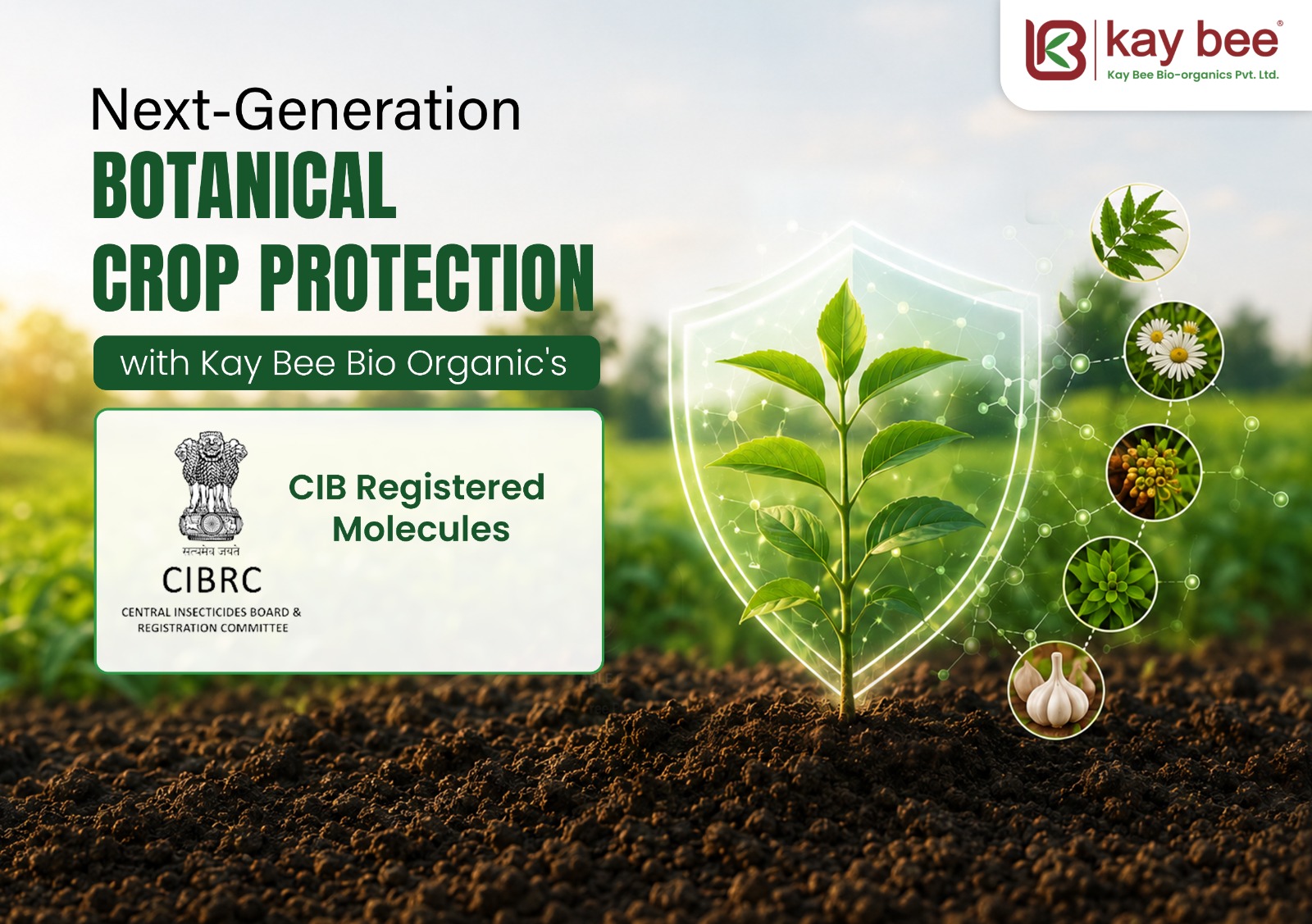
Next-Generation Botanical Crop Protection with Kay Bee Bio Organic’s CIB Registered Molecules
Introduction
Modern agriculture is evolving rapidly as farmers strive to produce higher yields while meeting the growing demand for safe, residue-free, export-quality produce and MRL Compliant Farming. Concerns over pesticide residues, pest resistance, environmental pollution, and consumer health have accelerated the shift toward sustainable crop protection. Botanical crop protection products, derived from natural plant sources, have emerged as an effective and environmentally responsible alternative that helps protect crops while supporting long-term agricultural sustainability. To understand why this shift is happening in India, read our guide on why India needs biopesticides in agriculture.
Recognizing this need, Kay Bee Bio Organic has developed advanced botanical crop protection solutions using its proprietary Marker Compound Technology. This innovative technology standardizes the key bioactive marker compounds responsible for crop protection, ensuring consistent quality, reliable field performance, and uniform efficacy in every batch.
Designed for high-value crops such as Grapes, Banana, Mango, Pomegranate, Rice, Cotton, Soybean and Vegetables, Kay Bee Bio Organic’s CIB Registered botanical products combine scientific innovation with the power of nature. With advantages including Zero Pre-Harvest Interval (PHI), residue-free crop protection, ECOCERT certification, reduced risk of resistance development, and phyto-tonic effects, these solutions are becoming the preferred choice for progressive farmers.
What is a Marker Compound?
A marker compound is a specific bioactive secondary metabolite naturally present in a plant that is identified and quantified to standardize botanical formulations, ensuring consistent quality, potency, and efficacy.
Why Marker Compound Technology Makes the Difference
Kay Bee Bio Organic’s proprietary Marker Compound Technology identifies and standardizes the specific bioactive marker compounds responsible for crop protection. As a result, every formulation delivers consistent quality, reliable performance, and predictable efficacy under diverse field conditions. For more on how Kay Bee Bio Organic extracts and standardizes its neem-based molecules, read our guide on the neem miracle — how we extract azadirachtin from neem.
Scientifically Validated by Leading Agricultural Universities
Kay Bee Bio Organic Pvt. Ltd.’s CIB-registered botanical crop protection molecules have been evaluated at UAS Dharwad (Karnataka), MPKV Rahuri (Maharashtra), Visva-Bharati (West Bengal), and RVSKVV Indore (Madhya Pradesh). The university trials demonstrated that the marker compound-based botanical formulations delivered bio-efficacy equivalent to conventional chemical molecules against target pests, validating their effectiveness as a sustainable and residue-free crop protection solution.
A Landmark in Botanical Crop Protection
Since the registration of Azadirachtin from neem marked the beginning of CIB-approved botanical biopesticides in India, Kay Bee Bio Organic Pvt. Ltd. has ushered in the next chapter by becoming the first botanical-based company to secure CIB registration for two novel botanical molecules under Section 9(3) of the Insecticides Act, 1968, advancing the future of scientifically validated botanical crop protection. For a detailed look at how the CIB registration process works for botanical molecules, read our guide on CIB registration for azadirachtin technical.
Next-Generation CIB Registered Botanical Molecules
As agriculture moves towards safer, sustainable, and residue-free production, the demand for scientifically validated crop protection solutions continues to grow. Kay Bee Bio Organic is leading this transformation with its CIB Registered botanical molecules, developed using Marker Compound Technology.
These advanced formulations help protect crops throughout their growth cycle, improve plant health, reduce dependence on repeated chemical pesticide applications, and support environmentally responsible farming practices.
Botanical Fungicide
A CIB Registered botanical fungicide based on Thymus vulgaris extract concentrate containing Thymol as the active botanical molecule.
| Composition: Thymol 15% WP |
| Registration: Section 9(3b) of the Insecticides Act, 1968 |
| Recommended for control of Powdery mildew Sphaerotheca fuliginea (Podosphaera Fuliginea) in cucumber |
It provides an effective, sustainable, and Zero PHI Pesticide solution for fungal disease management, enabling safe and timely harvesting. For organic powdery mildew control approaches across crops, also read our guide on powdery mildew control with bio-fungicide.
Botanical Insecticide
A CIB Registered botanical insecticide based on Piper longum extract concentrate containing the botanical active molecules Piperine and Thymol.
| Composition: Piperine 0.30% + Thymol 4.50% EW |
| Registration: Section 9(3b) of the Insecticides Act, 1968 |
| Recommended for control of thrips (Scirtothrips dorsalis) on chilli crop |
It delivers effective insect management while supporting residue-free farming and sustainable agriculture. For an in-depth look at how thrips are managed in chilli organically, read our guide on how to control black thrips in chilli.
Why Farmers Prefer Kay Bee Bio Organic Botanical Products
Farmers are increasingly adopting botanical crop protection because it combines effective crop protection with environmental sustainability and market acceptance. For more on what makes organic farming products trusted in India, read our guide on best organic farming products in India.
Key Advantages
- Marker Compound Technology for standardized botanical extracts and consistent performance.
- CIB Registered Bio Pesticide ensuring regulatory compliance, product quality, and farmer confidence.
- Zero PHI Pesticide technology allows harvest without extended waiting periods while supporting residue-free crop production.
- Residue-Free Crop Protection suitable for domestic consumption and export markets.
- ECOCERT Certified formulations supporting sustainable agricultural practices.
- Reduced Risk of Resistance Development through the multi-target action of botanical compounds.
- Phytotonic Effect that promotes healthier plant growth, stronger crop vigour, and improved stress tolerance.
- Compatible with Integrated Pest Management (IPM)
- Visible Results Within 48 Hours
Why Shift from Chemical to Botanical Crop Protection?
In crops such as rice, pomegranate, grapes, and chilli, repeated use of chemical insecticides has led to concerns including pesticide residues, pest resistance, residue-related export rejections, environmental contamination, and risks to beneficial insects. To understand the broader risks of chemical pesticide use, read our guides on harmful effects of chemical pesticides on humans and why export farmers choose neem insecticides.
Residue-free botanical pesticides provide a sustainable alternative by offering effective pest management while helping reduce chemical residues, supporting beneficial organisms, and strengthening Integrated Pest Management (IPM) strategies to meet the increasing demand for safer, high-quality agricultural produce.
The future of agriculture lies in solutions that deliver productivity without compromising food safety or environmental health. Farmers increasingly require crop protection products that are scientifically validated, effective, and environmentally responsible.
With Marker Compound Technology, CIB Registered botanical molecules, Zero PHI crop protection, Residue-Free Crop Protection, ECOCERT Certification, and Phytotonic Benefits, Kay Bee Bio Organic is helping farmers embrace the next generation of sustainable agriculture.
Its innovative botanical solutions support healthier crops, improved productivity, export-quality produce, and long-term environmental sustainability across crops including Rice, Grapes, Pomegranate, Chilli, and many others.
Conclusion
Sustainable agriculture requires crop protection solutions that balance productivity, food safety, and environmental responsibility. Kay Bee Bio Organic’s CIB Registered botanical crop protection products, powered by Marker Compound Technology, offer a science-backed approach to modern farming. With consistent performance, Zero PHI, residue-free protection, ECOCERT certification, phytotonic benefits, and proven quality, these botanical pesticide formulations help farmers produce healthier crops while improving profitability and supporting sustainable agriculture.
Choose Kay Bee Bio Organic’s next-generation botanical crop protection solutions to grow healthier crops, meet global quality standards, support MRL Compliant Farming, and build a more sustainable future for agriculture. Explore our full range of best neem-based pesticides for agricultural crops and learn about the global demand for certified azadirachtin-based products to see how Kay Bee Bio Organic is shaping the future of botanical crop protection in India and beyond.
Frequently Asked Questions (FAQs)
1. What is Zero PHI?
Zero PHI (Pre-Harvest Interval) means a crop can be harvested immediately after pesticide application without waiting, helping produce residue-free food.
2. What does PHI mean in agriculture?
PHI (Pre-Harvest Interval) is the required waiting period between the last pesticide spray and crop harvest to ensure pesticide residues remain within safe limits.
3. Why is Zero PHI important?
Zero PHI helps farmers harvest crops on time, minimizes residue concerns, supports food safety, and is ideal for Export Quality Farming where strict residue standards are required.
4. What is the difference between PHI and Zero PHI?
Traditional PHI requires farmers to wait for a specified period before harvesting, while Zero PHI allows harvesting immediately after application without an extended waiting period.
5. Can Zero PHI pesticides be sprayed before harvest?
Yes. Zero PHI pesticides are designed to be applied close to harvest, helping protect crops while supporting residue-free production.
6. Are botanical pesticides safe?
Botanical pesticides are plant-derived crop protection products that are generally considered safer for the environment, beneficial organisms, and residue management when used according to label recommendations.
7. What are CIB registered botanical products?
CIB registered botanical products are crop protection formulations approved by the Central Insecticides Board after evaluation for their safety, quality, and efficacy.
8. Why should farmers choose CIB registered products?
CIB registered products provide regulatory assurance, consistent quality, proven field performance, and greater confidence for growers.
9. How do CIB registered pesticides improve crop safety?
They help provide effective pest and disease control while supporting residue-free production and compliance with recommended agricultural practices.
10. Which crops benefit most from Zero PHI pesticides?
High-value crops such as grapes, pomegranate, chilli, rice, vegetables, fruits, and other export-oriented crops benefit the most from Zero PHI crop protection.
11. How do Zero PHI products help export-quality farming?
Zero PHI products help farmers meet international Maximum Residue Limit (MRL) requirements, making Botanical Pesticides India an important solution for producing safe, residue-free crops for domestic and export markets.
Citations
Directorate of Plant Protection, Quarantine & Storage (DPPQS), Government of India, 2026. Minutes of the 472nd Registration Committee Meeting. Ministry of Agriculture & Farmers Welfare, Government of India. Available at: https://ppqs.gov.in/sites/default/files/472%20RC%20MOM%20Final.pdf (Published Date: 15/06/2026). https://ppqs.gov.in/divisions/cib-rc/news-update
Directorate of Plant Protection, Quarantine & Storage (DPPQS), Government of India, 2026. Minutes of the 473rd Registration Committee Meeting. Ministry of Agriculture & Farmers Welfare, Government of India. Available at: https://ppqs.gov.in/sites/default/files/473%20RC%20MOM.pdf (Published Date: 03/07/2026). https://ppqs.gov.in/divisions/cib-rc/news-update
Latest Blogs
 Why Bio Pesticides Are the Best Step Forward in Sustainable Agriculture
 The Hidden Impact of Chemical Pesticides on Human Health (And What We Can Do About It)
 Brown Plant Hopper Paddy Organic Control with Pesto Raze & Mealy Raze
 Mycorrhiza Technical Manufacturer in India | Kay Bee Bio-Organics Pvt. Ltd.
 Cotton Whitefly Management During Square Formation Stage: Effective Control with Pesto Raze & OrgaNeem
COPYRIGHT © 2026 - ALL RIGHTS RESERVED. MADE BY WebAppGigs