
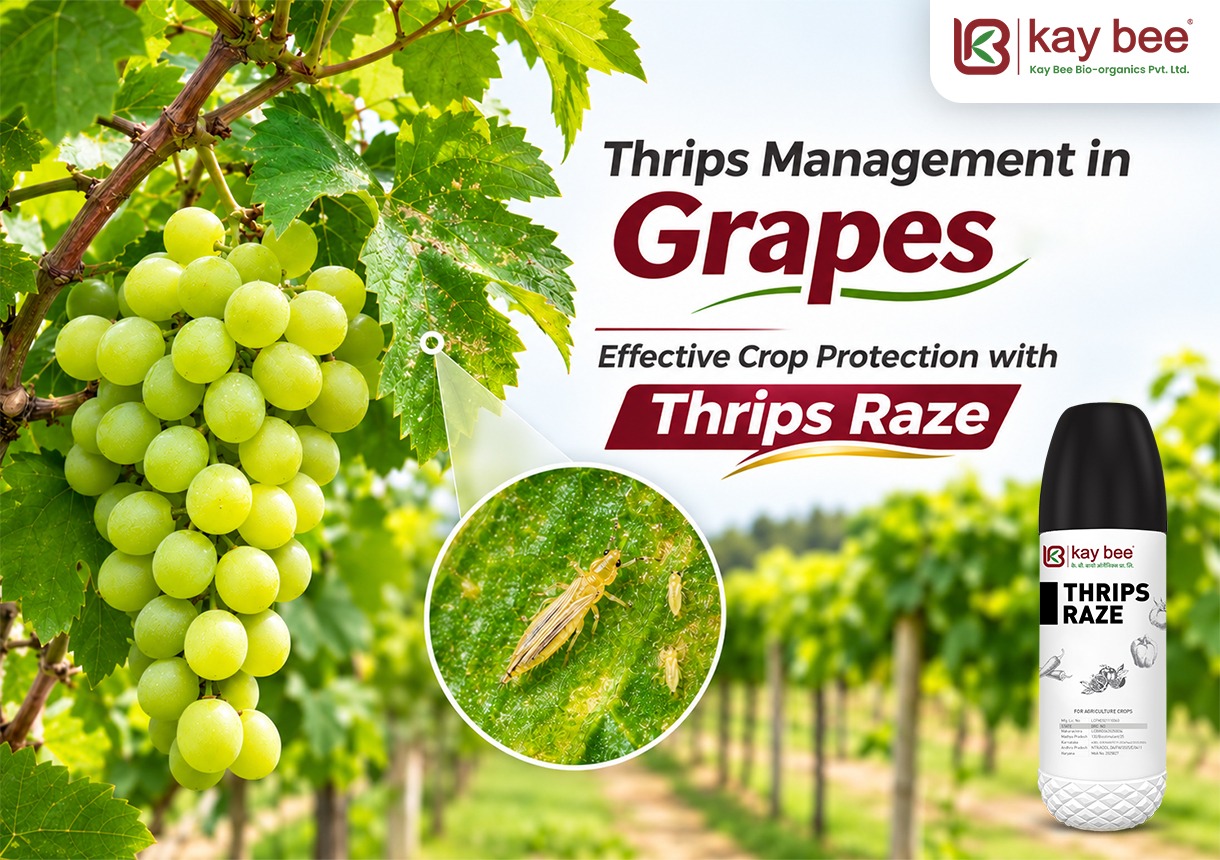
Thrips Management in Grapes: Effective Crop Protection with Thrips Raze
Introduction: Thrips Management in Grapes
Grape cultivation is an important source of income for farmers in Maharashtra, particularly in major grape-growing regions where fruit quality and appearance play a significant role in market acceptance and export opportunities. However, maintaining healthy grapevines throughout the growing season is not always easy. Several insect pests attack the crop, and thrips are among the pests that require careful attention.
Thrips are very small, slender insects that damage plants by scraping the surface tissues and feeding on the contents of damaged cells. They are commonly found on newly emerging leaves, tender shoots, flowers and young grape berries. Even a relatively small population can cause noticeable injury, especially when the crop is at a sensitive growth stage. If the infestation is not identified in time, feeding damage may affect leaf development, flower health and the appearance of developing berries.
Regular vineyard inspection and timely pest management are therefore important for maintaining vine health and producing good-quality grapes. This guide to thrips management in grapes explains how to identify thrips damage in grapes and how to protect your vines with Thrips Raze.
Thrips management in grapes starts with regular inspection at new flush, flowering and early berry development. Look for silvery leaf marks, curled shoots and berry scarring, keep the vineyard clean, protect beneficial insects, and spray a botanical insecticide such as Thrips Raze as per label.
ICAR-NRC Grapes notes that thrips cause scab formation on berries and heavy losses in vineyards, and that three species, Scirtothrips dorsalis, Thrips hawaiiensis and Rhipiphorothrips cruentatus, damage grapevines. Thrips peak at flowering, and the highest populations of 8–10 thrips per shoot were recorded in November and December.
How to Identify Thrips Damage in Grapes
Thrips infestation can be recognized through several visible changes in different parts of the grapevine. Spotting thrips damage in grapes early is the first step of grape thrips control.
-
Silvery marks on leaves
One of the common signs of thrips feeding is the appearance of silvery or pale patches on the leaf surface. These marks develop due to damage to the outer plant tissues. With continued injury, affected areas may turn brown and dry.
-
Curling and deformation of young leaves
Tender leaves are particularly vulnerable to thrips attack. Feeding damage may cause young leaves to curl, wrinkle or develop an irregular shape. Severe injury can interfere with normal shoot growth.
-
Scarring on developing berries
Thrips feeding on young berries can leave visible scars, rough patches or brownish marks on the fruit surface. Such damage can reduce the attractive appearance of grape bunches and affect their market acceptance.
-
Injury during flowering
Flowers and newly formed berries have delicate tissues that can be damaged by thrips. Infestation during flowering and early berry development may affect fruit development and bunch quality. A survey found that thrips numbers were highest on the inflorescence and declined as the berries matured, and were lowest on berries larger than pea size.
-
Weakening of tender growth
Continuous feeding on young plant tissues can affect healthy shoot and canopy development. When infestation becomes severe, the overall vigour of the vine may decline.
Farmers should pay particular attention to tender shoots, the underside of leaves, flower clusters and young bunches while inspecting their vineyards.
Why Is Thrips Management in Grapes Challenging?
Managing thrips in grape vineyards can be difficult because of their small size and hiding behaviour. They often remain inside flowers, curled leaves and compact bunches, where they may escape direct spray contact.
Another challenge is their ability to multiply quickly under favorable conditions. Different developmental stages may occupy different parts of the plant, making adequate spray coverage important.
Repeated application of insecticides belonging to the same mode-of-action group can also increase the risk of resistance development. Therefore, successful management requires regular monitoring, appropriate product selection and resistance-management practices rather than depending on repeated spraying alone. Good thrips insect control means rotating products and protecting predatory mites and other natural enemies of thrips and mites.
Integrated Management of Thrips in Grapes
A combination of preventive practices and timely pest management helps reduce thrips pressure in vineyards.
-
Regular Vineyard Inspection
Inspect grapevines frequently, particularly during new shoot development, flowering and early berry formation. Examine tender leaves, flower clusters and developing bunches for the presence of thrips and their feeding symptoms.
Early identification helps farmers take appropriate action before the infestation becomes severe. ICAR-NRC Grapes suggests installing 4–5 blue or yellow sticky traps per acre to help monitor thrips, and applying treatments at new flush, flowering and berry development. In an ICAR-NRC Grapes study, yellow sticky traps placed above the canopy were the most effective for catching grapevine thrips. Scirtothrips dorsalis in grapes is the main species found on new flushes, flowers and berries in surveys.
-
Vineyard Sanitation
Unwanted weeds growing within and around vineyards can provide shelter and alternative hosts for thrips. Maintaining field cleanliness and managing weeds regularly can help reduce suitable pest-harbouring areas.
Proper canopy management also improves air movement and allows better spray penetration into different parts of the vine.
-
Protect Beneficial Organisms
Predatory mites, minute pirate bugs and other beneficial organisms help regulate thrips populations naturally. Unnecessary use of broad-spectrum insecticides may affect these natural enemies. Conserving beneficial organisms is an important part of maintaining a balanced vineyard ecosystem. A botanical plant pest control product fits well into this approach.
-
Timely Management with Thrips Raze
Thrips Raze from Kay Bee Bio-Organics can be included in an appropriate grape thrips management programme. Timely application is important, particularly when thrips are actively feeding on tender plant parts. Proper spray coverage should be ensured on affected areas, including young shoots, leaf undersides, flowers and developing bunches, wherever permitted by the crop-specific product label.
Thrips Raze is a botanical bio-pesticide made with marker compounds from botanical extracts. As a bio pesticide for thrips, it is used as a spray for thrips in grapes, and its product page lists grape at 1.5–2.5 ml per litre of water, depending on crop stage and thrips population. It is described as residue-free and suitable for organic farming and export production, so check the requirements of your buyer or importing country.
Recommended dosage: 2 ml per litre of water
Spray in the cool morning or evening hours and avoid noon. Repeat at an interval of 7–8 days, or as needed based on the thrips population. Thrips Raze is not compatible with sulphur, copper-based fungicides or Bordeaux mixture, which are common in vineyard programmes, so plan your sprays in advance and do a jar test before mixing. See common fertiliser and pesticide application mistakes. For better spread on leaf undersides and flowers, Balanstick (0.4 ml/L) can be added to the mix.
Frequently Asked Questions (FAQs)
Q1. How can I identify thrips damage in grapes?
Look for silvery or pale patches on leaves, curled and wrinkled young leaves, scars or rough brownish marks on berries, and injury to flowers and tender shoots.
Q2. When should thrips be managed in grapes?
At new shoot development, flowering and early berry formation, when thrips feed on tender parts. ICAR-NRC Grapes notes that thrips peak at flowering.
Q3. Why is thrips management in grapes difficult?
Thrips are tiny and hide inside flowers, curled leaves and compact bunches, multiply quickly, and can develop resistance if the same mode of action is used repeatedly.
Q4. What is the dose of Thrips Raze for grapes?
The suggested dose is 2 ml per litre of water. The product page range is 1.5–2.5 ml per litre, depending on crop stage and thrips population.
Q5. Can Thrips Raze be mixed with sulphur or copper fungicides?
No. It is not compatible with sulphur, copper-based fungicides or Bordeaux mixture. Plan sprays accordingly and do a jar test.
Q6. How can farmers protect natural enemies of thrips?
Avoid unnecessary broad-spectrum insecticides, which can harm predatory mites and minute pirate bugs, and use botanical products as part of an integrated programme.
Conclusion
Thrips may be difficult to notice during the early stages of infestation, but their feeding can leave visible marks on grape leaves, flowers and developing berries. These injuries can affect fruit appearance and market quality, making timely management an important part of vineyard care. Frequent crop inspection, proper vineyard sanitation and conservation of beneficial organisms should form the foundation of thrips management. Combining these practices with suitable botanical-based solutions such as Thrips Raze can help grape growers follow a more integrated approach to crop protection. For growers looking for thrips control pesticides in India, a botanical option like Thrips Raze, used as per label, is worth including in the programme.
Seeing silvery marks or scarring in your vineyard? Talk to the Kay Bee Bio Organics team for free crop advice. Call 1800 532 2612 or visit kaybeebio.com.
Latest Blogs
 Low Temperature Stress in Crops: Physiological Changes and Management Strategies
 Wheat Aphid Management: Effective and Sustainable Control with Pesto Raze
 Onion Twister Disease Prevention and Integrated Disease Management Strategies
 Sesame Phyllody Disease: Symptoms, Disease Cycle and Organic Management Strategies
 Nutrient Management for Mustard and Gram Crops: Best Micronutrient Practices
COPYRIGHT © 2026 - ALL RIGHTS RESERVED. MADE BY WebAppGigs