
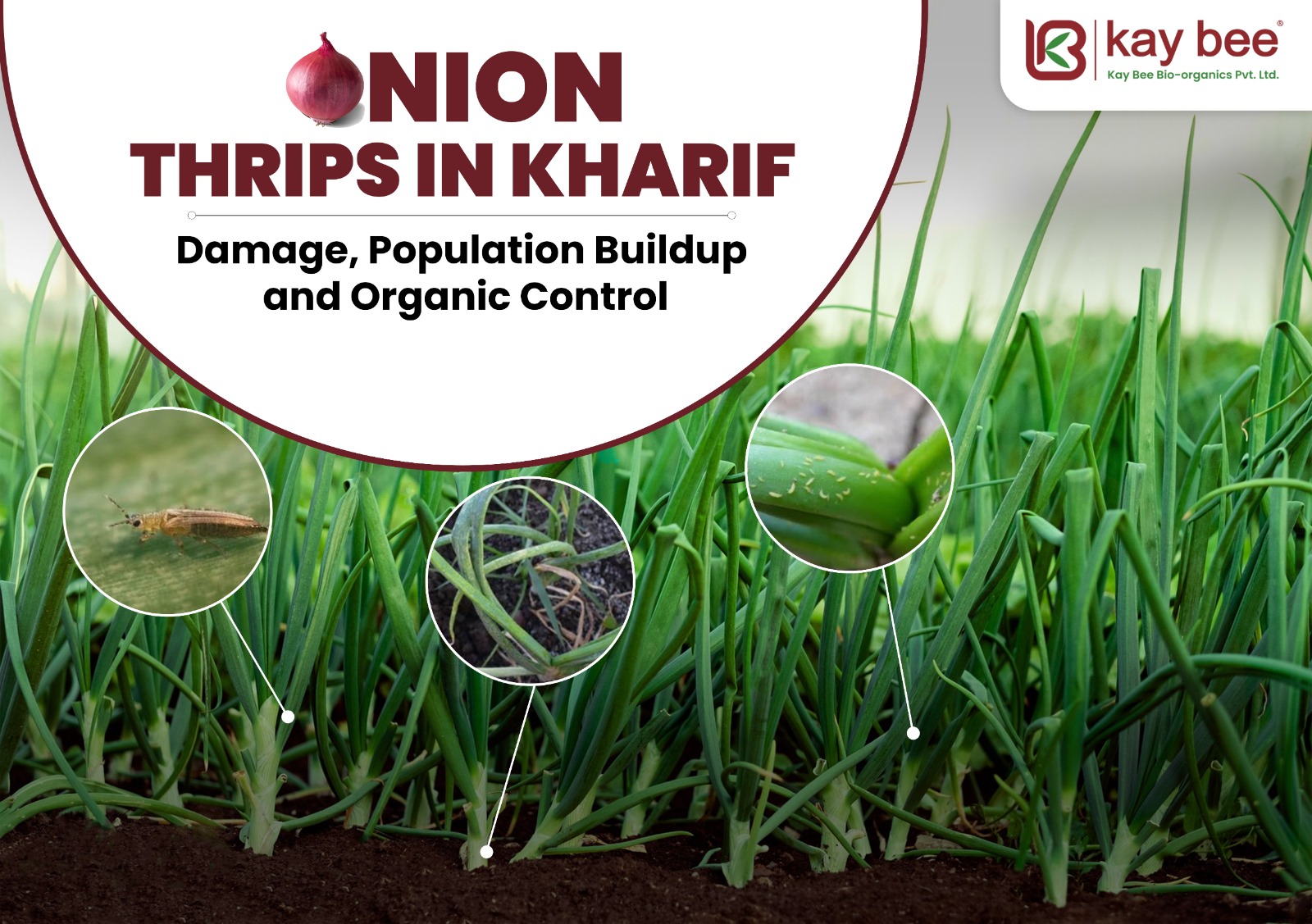
Onion Thrips in Kharif: Damage, Population Buildup and Organic Control
Onion (Allium cepa L.) is one of the most important commercial vegetable crops cultivated during the kharif, rabi, and summer seasons. However, among the various insect pests affecting onion, onion thrips (Thrips tabaci) are considered one of the most destructive. Therefore, onion thrips control is a major concern for growers, particularly during the kharif season, when warm and humid conditions favour rapid pest multiplication. Severe infestations reduce bulb size, decrease marketable yield, and significantly affect bulb quality.
The onion thrips, Thrips tabaci Lindeman (Thysanoptera: Thripidae), is a tiny sap-sucking insect that feeds by rasping the leaf surface and sucking out the cell contents. Continuous feeding destroys chlorophyll-bearing tissues, resulting in silvery streaks, leaf curling, reduced photosynthesis, and premature drying of leaves. These onion thrips damage symptoms directly reduce plant vigour and bulb development. In addition to feeding damage, onion thrips can also transmit Iris Yellow Spot Virus (IYSV) in certain onion-growing regions, further increasing crop losses. For a broader look at how thrips are managed across other crops, read our guide on thrips and mite management in capsicum and chilli.
Since thrips reproduce rapidly and complete several generations within a single crop season, early monitoring and effective onion thrips management are essential. Botanical insecticides such as Thrips Raze provide an environmentally responsible solution for onion thrips organic control, helping growers suppress pest populations while preserving beneficial insects.
Identification of Onion Thrips
Correct identification is the first step toward successful onion thrips control. Early detection enables timely intervention before severe crop damage occurs.
Adult Thrips
- Slender and elongated insects
- 1–1.5 mm long
- Pale yellow to light brown
- Narrow fringed wings
- Highly active and usually hide inside leaf folds
Nymphs
- Wingless
- Creamy yellow in colour
- Smaller than adults
- Feed continuously on tender leaves
Because of their tiny size and concealed feeding habit, thrips often remain unnoticed until onion thrips damage symptoms become clearly visible.
Onion Thrips Lifecycle
Understanding the onion thrips lifecycle is an important part of effective onion thrips management, as it helps farmers target the pest during its most vulnerable stages.
Egg Stage (4–7 Days)
Female thrips insert eggs individually inside leaf tissues.
Nymph Stage (6–10 Days)
Nymphs actively feed on leaf sap and are responsible for most of the crop damage.
Prepupal and Pupal Stage (2–5 Days)
These non-feeding stages generally occur in the soil or around the base of onion plants.
Adult Stage (15–30 Days)
Adults emerge and begin feeding and reproduction shortly after emergence.
Population Build-up during Kharif
The population of onion thrips increases rapidly during the kharif season due to:
- Warm temperatures (25–32°C)
- High relative humidity
- Dry periods between rainfall events
- Dense crop canopy
- Excess nitrogen fertilization
- Continuous onion cultivation
- Presence of alternate host weeds
Adult thrips are easily dispersed by wind, enabling rapid spread from one field to another. These conditions make timely onion thrips control essential for minimizing economic losses. For more on how disease and pest pressure builds in kharif vegetables, read our guide on disease-free onion seedlings in June.
Onion Thrips Damage Symptoms
The most common onion thrips damage symptoms result from continuous rasping and sap feeding by both adults and nymphs.
Early Symptoms
- Silvery white streaks on leaves
- Tiny whitish feeding scars
- Loss of natural leaf shine
- Small yellow patches
Moderate Damage
- Leaf curling
- Yellowing of foliage
- Reduced chlorophyll content
- Slower plant growth
Severe Damage
- Drying of leaf tips
- Twisted leaves
- Premature leaf senescence
- Reduced bulb enlargement
- Smaller bulb size
- Lower bulb weight
- Poor storage quality
- Increased susceptibility to diseases
If left unmanaged, these onion thrips damage symptoms can reduce yields by 30–60%, depending on crop stage and environmental conditions.
Economic Importance
Among the major onion pests, onion thrips cause significant economic losses due to:
- Reduced photosynthesis
- Lower bulb weight
- Poor bulb size
- Reduced market quality
- Increased storage losses
- Transmission of Iris Yellow Spot Virus (IYSV) in susceptible regions
Regular monitoring and timely onion thrips control are therefore essential for profitable onion cultivation. For a complete picture of onion crop management, also read our guides on onion leaf blight control and damping off in onion crop.
Monitoring and Surveillance
Regular field scouting forms the foundation of successful onion thrips management. Monitoring should begin 15–20 days after transplanting.
Inspect:
- Young central leaves
- Leaf folds
- Silvery streaks
- Curling symptoms
- Presence of adults and nymphs
Monitor at least 20–25 plants from different areas of the field every week. Early detection allows farmers to initiate onion thrips control before the pest reaches damaging levels.
Integrated Onion Thrips Management
Successful onion thrips management combines cultural, biological, and botanical methods to reduce pest populations while conserving beneficial insects.
1. Field Sanitation
Remove crop residues after harvest to reduce carry-over populations.
2. Weed Management
Control alternate host weeds around the crop to eliminate breeding sites.
3. Balanced Fertilization
Avoid excessive nitrogen application, as lush growth favours thrips multiplication. Balanced nutrition improves plant tolerance against sucking pests.
4. Adequate Irrigation
Maintain optimum soil moisture to reduce crop stress and discourage rapid pest multiplication during dry periods.
5. Conservation of Beneficial Insects
Protect natural enemies such as:
- Minute pirate bugs (Orius)
- Green lacewings
- Ladybird beetles
- Predatory mites
Avoid indiscriminate insecticide applications that may harm these beneficial organisms.
Onion Thrips Organic Control
With increasing consumer demand for residue-free vegetables, onion thrips organic control has become an important component of sustainable onion production. To understand why biopesticides are the right choice for vegetable crops, read our guide on why India needs biopesticides in agriculture.
Botanical insecticides offer several advantages:
- Plant-derived active compounds
- Multiple modes of action
- Reduced pesticide residues
- Lower risk of resistance development
- Compatible with Integrated Pest Management (IPM)
- Safer for beneficial insects when used according to label recommendations
Applications targeting early nymphal stages provide the highest level of control and improve the effectiveness of onion thrips control.
Thrips Raze — Botanical Protection against Onion Thrips
Thrips Raze is a scientifically formulated botanical insecticide developed for effective onion thrips control and sustainable onion thrips management. Its plant-derived bioactive ingredients suppress feeding activity, reduce pest multiplication, and protect onion foliage from extensive damage. Early application minimizes onion thrips damage symptoms, supports healthy leaf growth, and contributes to improved bulb development.
Mode of Action
Thrips Raze acts through contact, systemic and fumigant action. It exhibits antifeedant, desiccation, and cytolytic effects, causing rapid knockdown of neonates and early instars. It also acts as a stomach poison, disrupts molting through Insect Growth Regulator (IGR) activity, and affects the insect nervous system. Its multi-target mode of action reduces the likelihood of resistance development while providing effective and long-lasting pest control.
Recommended Dose
Thrips Raze @ 2–2.5 ml per litre of water
Apply as a thorough foliar spray, ensuring complete coverage of:
- Young central leaves
- Leaf folds
- Inner leaf surfaces
- Areas where thrips hide and feed
Repeat the spray after 7–10 days if thrips populations persist or according to field scouting observations. For better spray adhesion and leaf coverage, add Balanstick (0.4 ml/l) to your spray mix.
Benefits of Thrips Raze
- Botanical formulation suitable for sustainable onion cultivation
- Effective against onion thrips and other sucking pests
- Supports efficient onion thrips control
- Reduces feeding injury and pest multiplication
- Helps minimize onion thrips damage symptoms
- Promotes healthy bulb development
- Suitable for onion thrips organic control
- Compatible with Integrated Pest Management (IPM)
- Lower pesticide residue concerns
- Safer for beneficial insects when used according to label recommendations
- Easy foliar application at 2 ml/L of water
Recommended Spray Schedule
| Crop Stage | Recommendation |
| 15–20 DAT | Begin weekly scouting for thrips |
| Initial thrips appearance | Thrips Raze @ 2–2.5 ml/L of water |
| 7–10 days later | Re-monitor and repeat spray if required |
| Throughout crop growth | Continue field monitoring, weed management, balanced fertilization, and irrigation |
Conclusion
Onion thrips control is essential for protecting onion crops from severe yield and quality losses during the kharif season. Early identification of onion thrips damage symptoms, combined with timely onion thrips management, helps prevent rapid pest multiplication and protects bulb development. An integrated strategy that includes regular scouting, field sanitation, balanced fertilization, weed management, conservation of natural enemies, and onion thrips organic control provides sustainable and long-term protection.
The timely application of Thrips Raze @ 2–2.5 ml/L of water, a botanical insecticide for onion, effectively suppresses thrips populations, protects foliage, and supports healthier, high-quality onion production while promoting environmentally responsible farming. For a complete onion crop protection programme, also read our guide on onion cultivation from seed to harvest.
Latest Blogs
 Advancing Agronomic Resilience: A Scientific Analysis of Crop Rotation and Bio-Input Synergies in Indian Agriculture
 Biopesticides in India: Why Indian Agriculture Urgently Needs Sustainable Solutions
 Intercropping in Indian Farming: Benefits, High-Yield Examples, and Bio-Input Strategies
 Safeguarding Grapevines Through Bio-Organic Mealybug Treatment, Control And Best Insecticides
 Why Bio Pesticides Are the Best Step Forward in Sustainable Agriculture
COPYRIGHT © 2026 - ALL RIGHTS RESERVED. MADE BY WebAppGigs