Pomegranate cultivation is a profitable farming business, but one pest can destroy months of hard work — the pomegranate fruit borer. Many farmers experience heavy fruit damage, premature fruit drop, and rejection at the market due to this single pest. Repeated use of chemical pesticides often leads to residue problems, resistance, and higher costs.
The good news is that fruit borer can be effectively controlled through organic pest management. With the right products, correct dosage, and proper timing, farmers can protect their pomegranate crop safely and sustainably.
In this blog, we explain:
- How fruit borer damages pomegranate
- Why organic control is the best option
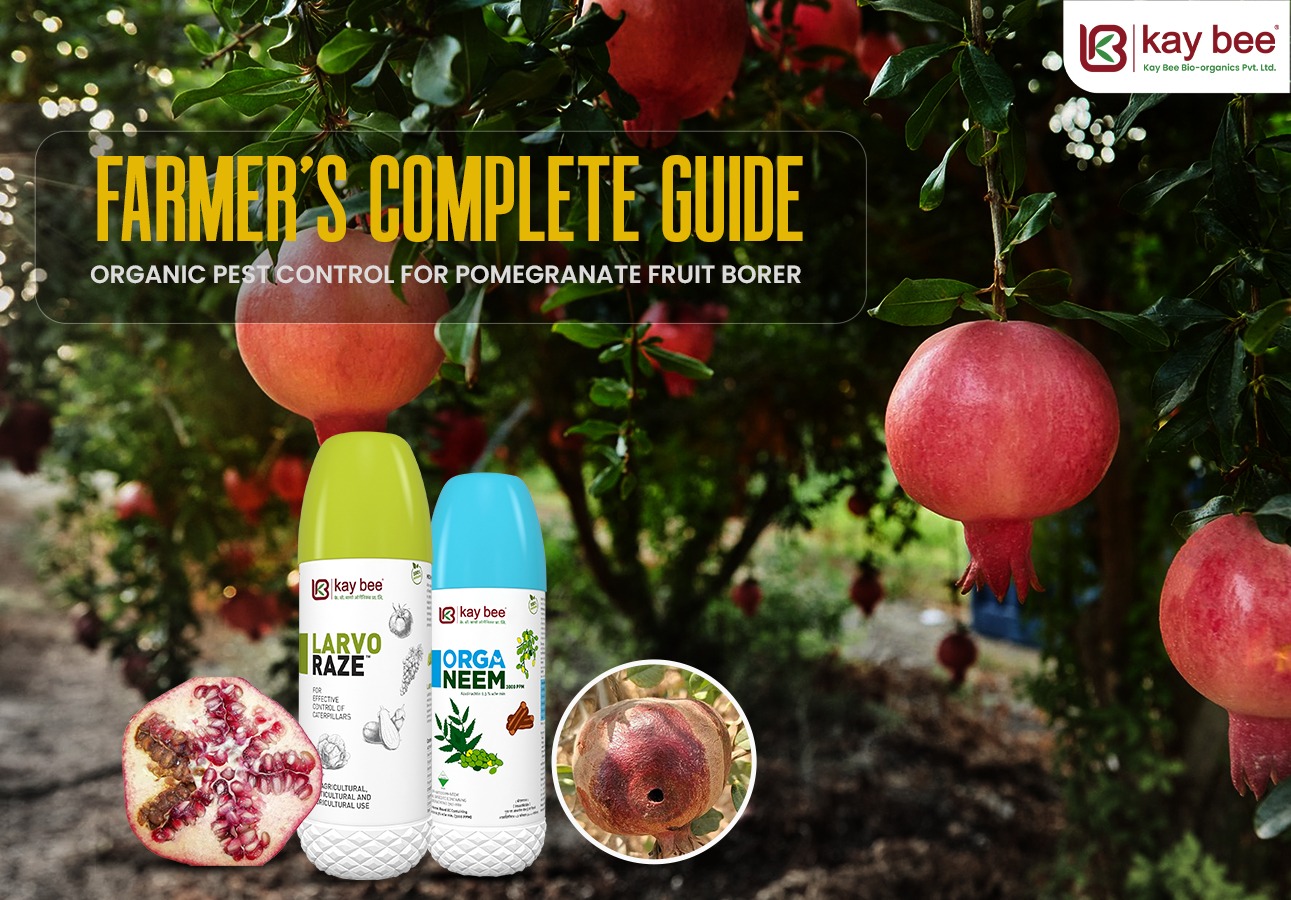
- A proven organic solution using Larvo Raze + Organeem 3000 PPM
- Step-by-step spray method for best results
Understanding the Pomegranate Fruit Borer
The pomegranate fruit borer is one of the most destructive pests affecting pomegranate orchards across India.
How Fruit Borer Damages the Crop
- Adult moth lays eggs on flowers or young fruits
- After hatching, larvae enter the fruit
- Larvae feed inside the fruit, making control difficult
- Infested fruits rot from inside and drop early
Common Symptoms Farmers Can Easily Identify
- Small holes near fruit crown
- Black powder-like material (frass) outside the fruit
- Premature fruit drop
- Rotten or hollow fruits at harvest
Once the larva enters the fruit, surface sprays alone are not enough. That is why early-stage and larval control is critical.
Why Chemical Control Is No Longer the Best Option
Many farmers rely heavily on chemical insecticides, but this approach is becoming risky and less effective.
Problems with Chemical Pesticides
- Chemical residues reduce export quality
- Market rejection due to residue limits
- Pest resistance after repeated use
- Harm to beneficial insects and soil health
- Higher cost with lower long-term results
Because of these issues, farmers are now shifting toward organic and residue-free pest control methods.
Why Organic Pest Control Is the Right Choice for Farmers
Organic pest control focuses on preventing pest multiplication, targeting larvae, and boosting plant resistance.
Key Benefits of Organic Control
- Safe for fruits, farmers, and consumers
- No harmful chemical residue
- Suitable for organic and export farming
- Works well in Integrated Pest Management (IPM)
- Long-term pest suppression
One of the most effective organic combinations for fruit borer control is Larvo Raze + Organeem 3000 PPM.
Best Organic Solution for Pomegranate Fruit Borer
1. Larvo Raze – Powerful Control on Fruit Borer Larvae
Larvo Raze is an organic biological solution specially designed to control larval stages of insect pests, including fruit borer.
Why Farmers Should Use Larvo Raze
- Targets larvae before severe fruit damage
- Reduces internal feeding of fruit borer
- Safe for beneficial insects
- Suitable for IPM and organic farming
👉 Recommended Dose:
Larvo Raze – 2.5 ml per liter of water
🔗 Product details:
https://kaybeebio.com/product/larvo-raze/
Larvo Raze works best when applied at the right time and in combination with neem-based protection.
2. Organeem 3000 PPM – Strong Neem-Based Protection
Organeem 3000 PPM is a high-quality neem formulation with strong insect-repellent and growth-regulating properties.
Benefits of Organeem 3000 PPM
- High neem concentration (3000 PPM)
- Repels adult insects and disrupts egg laying
- Controls early pest stages
- Improves plant resistance naturally
👉 Recommended Dose:
Organeem 3000 PPM – 1 ml per liter of water
🔗 Product details:
https://kaybeebio.com/product/organeem-3000-ppm/
Neem plays a critical role in preventing reinfestation and supporting long-term pest control.
How Larvo Raze and Organeem 3000 PPM Work (Mode of Action)
To win against pomegranate fruit borer, it’s not just what you spray — it’s how it works. Both Larvo Raze and Organeem 3000 PPM use natural, multi-level action to control pests safely and effectively. This is especially important for farmers aiming for organic or residue-free fruit.
Larvo Raze – Multi-Action Larval Control
Larvo Raze is a botanical bio-larvicide designed specifically to stop fruit borer larvae before they can damage the fruit.
Here’s how it works:
- Contact Action
- When spray droplets touch larvae on fruit or leaves, it quickly affects their feeding and survival.
- Systemic Action
- The formulation moves inside plant tissues so larvae also take it in while feeding inside the fruit.
- Fumigant Action
- Volatile botanical compounds help reach hidden larvae deep inside fruit or plant parts.
- Interrupts Larval Biology
- It disrupts larval growth, metabolism, and development — causing mortality and slowing pest progression.
Result: Larvo Raze stops larval feeding and growth early, breaking the fruit borer’s lifecycle safely and organically.
Organeem 3000 PPM – Neem-Based Multi-Target Protection
Organeem 3000 PPM is a neem oil biopesticide with a high concentration (3000 PPM) of azadirachtin and other neem compounds. It protects your crop in more than one way:
- Contact Repellent & Feeding Deterrent
- When fruit borer adults touch or attempt to feed, neem compounds repel them — reducing egg laying.
- Insect Growth Regulator (IGR)
- Affects hormones in larvae and adults, slowing down growth and preventing normal development.
- Stomach Poisoning & Developmental Disruption
- Larvae that feed on treated tissue ingest neem compounds — interfering with digestion and moulting.
- Multiple Active Compounds
- Includes azadirachtin and other bioactives that work together to confuse and suppress pest biology.
Result: Organeem not only repels pests but also limits reproduction and growth — which reduces pest pressure over time.
Why This Matters for Farmers
- These products don’t rely on one single chemical hit — they target pests at different stages.
- Multi-action results in lower resistance development in pests.
- Both are safe for beneficial insects, soil health, and export markets.
When used together (Larvo Raze + Organeem 3000 PPM at recommended doses), you get:
✔ Early larval control
✔ Reduced pest feeding and fruit damage
✔ Natural repellency and hormonal disruption
✔ Better orchard health & residue-free fruit
How to Use Larvo Raze + Organeem 3000 PPM (Step-by-Step Guide)
Spray Dosage (Very Important)
For 1 liter of water, mix:
- Larvo Raze – 2.5 ml
- Organeem 3000 PPM – 1 ml
Mix thoroughly and use the solution immediately.
Best Time for Spraying
- Early morning or late evening
- Avoid spraying during hot afternoon
- Do not spray before rain
Spray Schedule for Best Results
- First spray: At flowering stage
- Second spray: During early fruit development
- Repeat spray: Every 7–10 days depending on pest pressure
Regular monitoring of the orchard is essential.
Additional Organic Practices to Improve Results
Using organic products gives the best results when combined with good farming practices.
1. Orchard Sanitation
- Collect and destroy infested fruits
- Do not leave damaged fruits on the ground
2. Pheromone Traps
- Helps monitor fruit borer population
- Reduces adult moth numbers
3. Proper Pruning
- Improves air circulation
- Allows better spray coverage
These practices reduce pest pressure and increase spray effectiveness.
Benefits of Using Larvo Raze + Organeem Together
Using both products together gives complete organic protection.
| Benefit | Result |
| Larval control | Reduced internal fruit damage |
| Neem protection | Less egg laying and reinfestation |
| Fruit quality | Better size, color, and shelf life |
| Yield | Higher marketable produce |
| Safety | No residue, eco-friendly |
Farmers who follow this program report visible reduction in fruit borer damage within 10–14 days.
Common Mistakes Farmers Should Avoid
- Skipping early sprays
- Using higher dose than recommended
- Spraying during strong sunlight
- Ignoring sanitation practices
Correct timing and regular application are more important than heavy spraying.
Expected Field Results
With proper application of Larvo Raze (2.5 ml/L) + Organeem 3000 PPM (1 ml/L), farmers can expect:
- Reduced fruit borer infestation
- Healthier fruits with less rejection
- Improved yield and profitability
- Better acceptance in domestic and export markets
Conclusion: Safe and Effective Organic Fruit Borer Control
Fruit borer is a serious threat to pomegranate farming, but chemical pesticides are no longer the only solution. By adopting organic pest control methods, farmers can protect their crops safely and sustainably.
The combination of Larvo Raze + Organeem 3000 PPM offers:
- Strong larval control
- Natural neem-based protection
- Residue-free farming
- Better long-term results
👉 Recommended Spray:
Larvo Raze – 2.5 ml + Organeem 3000 PPM – 1 ml per liter of water
Start early, spray regularly, and keep your orchard clean for maximum benefit.
Frequently Asked Questions (FAQs)
Q1. Is this spray safe during fruiting stage?
Yes, both products are safe when used at recommended dosage.
Q2. Can this be used for organic farming?
Yes, it is suitable for organic and residue-free cultivation.
Q3. How many sprays are required?
2–4 sprays depending on pest pressure and orchard conditions.
Q4. Can Larvo Raze and Organeem 3000 PPM be mixed with other fertilizers or micronutrients?
It is best to spray Larvo Raze + Organeem 3000 PPM separately for maximum effectiveness. If mixing is required, always do a small jar test before spraying on the entire orchard.
Q5. How soon will I see results after spraying?
Farmers usually observe a reduction in fresh fruit borer damage within 7–14 days after spraying, depending on infestation level and spray coverage.
Q6. Are these products safe for bees and beneficial insects?
Yes. When used at recommended doses, Larvo Raze and Organeem 3000 PPM are safe for beneficial insects, making them ideal for integrated pest management (IPM).
Q7. Can this spray be used in all pomegranate varieties?
Yes. This organic spray combination is safe and effective for all pomegranate varieties, including Bhagwa and other commercial cultivars.
Q8. What precautions should farmers take while spraying?
- Wear basic protective clothing
- Ensure uniform spray coverage
- Avoid spraying during strong wind or hot sunlight
Clean spray equipment after use

 Downy Mildew in Cucumber: Disease Cycle, Economic Impact & Effective Control
 Whitefly in Brinjal: Symptoms, Spread & Organic Management
 Thrips as Vectors of Tospo Virus in Chilli and Tomato: How Thrips Raze Breaks the Cycle
 Boost Your Cotton Yield: A Practical Guide to Soil Nutrient Mobilization
 The Neem Miracle: How We Extract Azadirachtin from Neem