
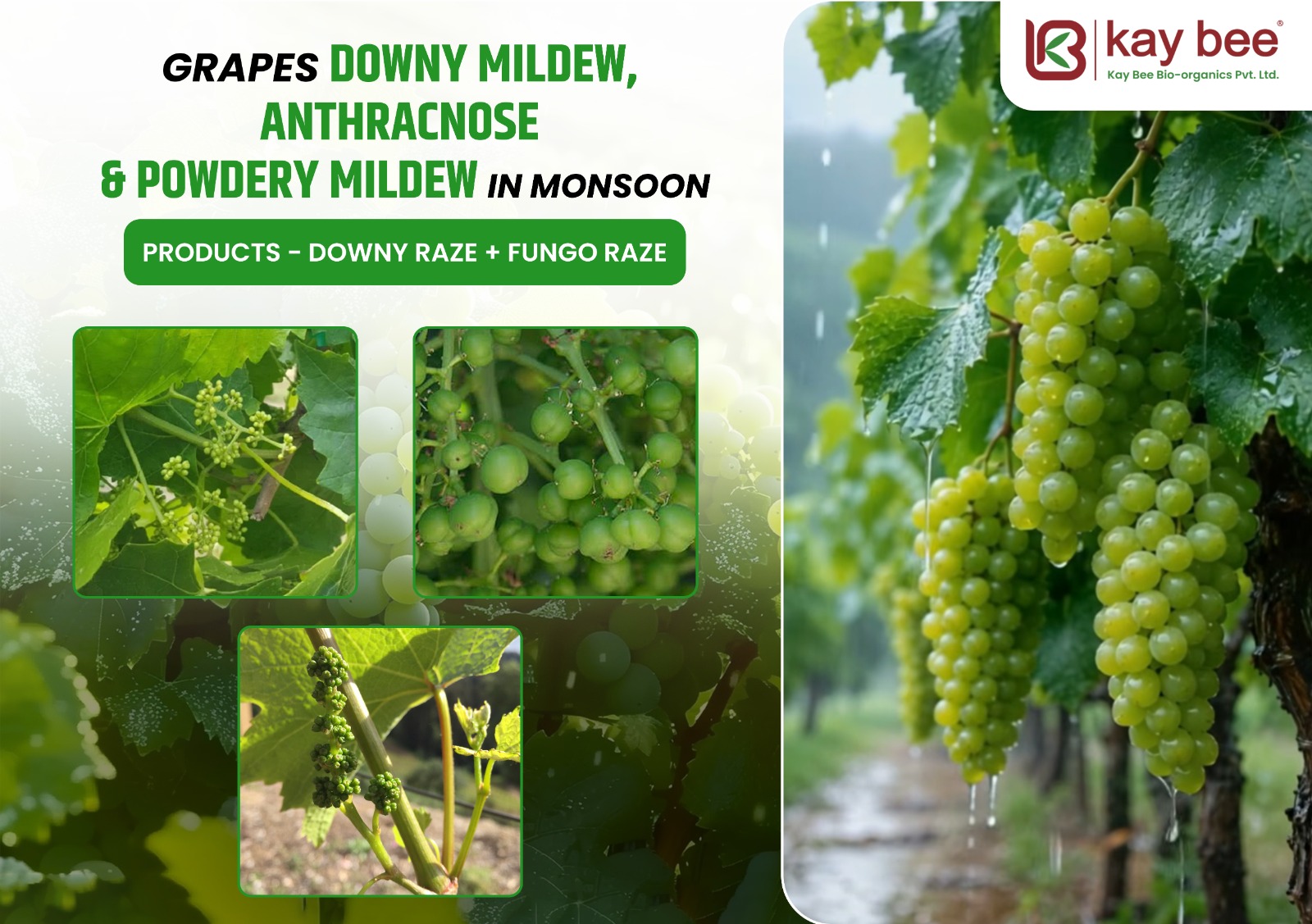
Grapes Downy Mildew, Anthracnose & Powdery Mildew in Monsoon: Downy Raze + Fungo Raze Guide
Three diseases. One practical protection guide.
The arrival of the monsoon is a welcome relief for grape growers. The vines become greener, new shoots emerge, and the vineyard looks full of life.
But along with the rain comes something growers don’t look forward to — fungal diseases.
Just a few days of continuous rainfall, cloudy skies, high humidity, and wet leaves are enough for diseases to spread rapidly across a vineyard.
One disease leaves yellow oily spots on the leaves. Another covers them with a white powdery layer. A third creates bird’s-eye spots on berries and young shoots.
These aren’t three stages of the same disease — they’re three different threats that every grape grower should recognize during the monsoon:
-
- Downy mildew in grapes
- Powdery mildew in grapes
- Anthracnose in grapes
Knowing the difference is the first step toward protecting your vineyard. For a broader look at fungal disease management in grapes, also read our guides on bunch rot of grapes — symptoms, causes and control and safeguarding grapevines from mealybug.
Disease 1: Downy Mildew — The Rain Lover
Unlike many fungal diseases, downy mildew in grapes thrives when leaves remain wet after rain.
The disease begins with pale yellow or oily spots on the upper surface of leaves. As humidity increases, a delicate white cotton-like growth develops on the underside. If ignored, the infection spreads to shoots, flower clusters, and even young berries.
Common symptoms include:
-
- Yellow or oily leaf spots
- White cottony growth beneath leaves
- Young shoot tip bending downward into a hook shape
- Drying of flower clusters
- Gray or brown infected berries
How It Spreads
The disease cycle of downy mildew of grapes starts when the fungus survives in infected plant debris or soil. Rain splashes and wind spread the spores onto healthy leaves. Under warm, humid conditions, new infections can develop within just a few days, allowing the disease to spread rapidly throughout the vineyard. For a deep dive into how downy mildew behaves across crops, read our guide on downy mildew in cucumber — disease cycle.
Disease 2: Powdery Mildew — The Silent White Coating
While downy mildew needs wet leaves, powdery mildew in grapes prefers warm, humid weather with cloudy conditions and poor air circulation.
One of the earliest signs is a white powdery coating on leaves. As the disease progresses, shoots and berries become infected. Older berries may crack, reducing both fruit quality and market value.
Look for these symptoms:
-
- White powder on leaves and shoots
- Leaf curling and discoloration
- Flower drop and poor fruit set
- Berry cracking at later stages
Whether growers call it grape mildew, grapevine powdery mildew, powdery mildew of grapevine, or powdery mildew on grapevines, the disease can spread quickly if left unmanaged. For organic management of powdery mildew across crops, also read our guide on powdery mildew control with bio-fungicide.
Disease 3: Anthracnose — The Bird’s-Eye Disease
Among the common fungal diseases during the rainy season, anthracnose in grapes is easy to recognize because of its distinctive lesions.
The disease first appears as small dark spots on berries and shoots. As they enlarge, the centre turns ash-grey while the border remains dark, giving the characteristic bird’s-eye appearance.
Other symptoms include:
-
- Sunken circular lesions on berries
- Bird’s-eye spots
- Dark cankers on shoots
- Curled and distorted leaves
- Drying of young shoot tips
Warm, wet weather and poorly drained vineyards favour disease development.
Don’t Guess the Disease — Identify It First
Although all three diseases are common during the monsoon, each has unique symptoms. Correct identification helps growers choose the right management approach before the disease spreads across the vineyard.
| If you notice… | It is likely… |
|---|---|
| Yellow oily spots with white cottony growth underneath the leaves | Downy Mildew |
| White powdery coating on leaves, shoots, or berries | Powdery Mildew |
| Sunken bird’s-eye lesions on berries and shoots | Anthracnose |
Organic Protection for a Healthier Grape Farm
Managing fungal diseases during the monsoon requires both preventive and curative action. To understand why botanical fungicides protect soil health better than chemical options, read our guide on the impact of fungicides on plant roots and soil.
Downy Raze
For downy mildew grape vines, Downy Raze provides contact and systemic action, helping control the disease at different stages of its development.
It works by inhibiting the formation of sporangia and zoospores, restricting spore germination, preventing secondary infections, and suppressing fungal growth. Its preventive and curative action helps manage downy mildew in grapes, while its phytotonic effect supports healthier plant growth. For more on how Downy Raze has been used successfully, read our case study on downy mildew control with Downy Raze.
Fungo Raze
For powdery mildew in grapes and anthracnose in grapes, Fungo Raze offers a botanical broad-spectrum solution.
Its contact and systemic action restricts spore adhesion, inhibits mycelial growth, and prevents fungal establishment within plant tissues. Along with disease management, it supports better crop quality and is suitable for organic, residue-free, and export-oriented farming. For a proven field example, read our case study on a triumph over powdery mildew for a chilli yield.
Recommended Spray Dose
-
- Downy Raze: 2.5 ml per litre of water
- Fungo Raze: 2 ml per litre of water
For better spray adhesion and canopy coverage, add Balanstick (0.4 ml/l) to your spray mix.
Stay Ahead of Grape Farm Diseases
The monsoon doesn’t just bring rain — it also creates ideal conditions for fungal diseases.
Regular vineyard scouting, early identification of downy mildew in grapes, powdery mildew on grapevines, and anthracnose in grapes, combined with timely organic protection, can significantly reduce crop losses.
By choosing the right solution at the right time — Downy Raze for downy mildew and Fungo Raze for powdery mildew and anthracnose — growers can keep their vineyards healthy, protect fruit quality, and achieve a productive harvest throughout the season.
Latest Blogs
 Tomato Nematode Damage: Underground Signs, Crop Loss and Organic Control with Root Fit
 Turmeric Cultivation in India: Vegetative Stage Care with Nova Drip + MYCORIS
 Turmeric Shoot Borer: Lifecycle, Damage & Organic Control with Larvo Raze
 Okra Sucking Pests: Jassids, Aphids & Whitefly — Organic Control with Kay Bee’s Pesto Raze
 Onion Thrips in Kharif: Damage, Population Buildup and Organic Control
COPYRIGHT © 2026 - ALL RIGHTS RESERVED. MADE BY WebAppGigs