
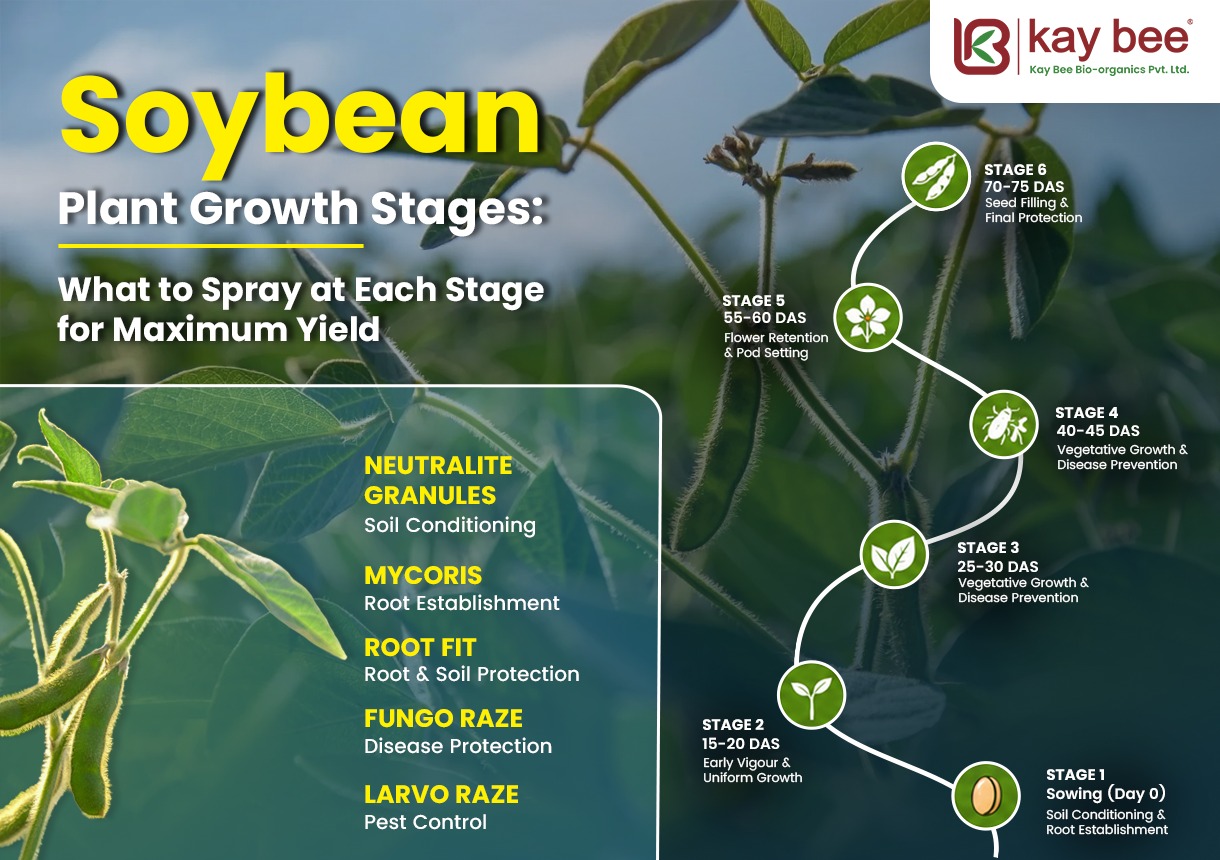
Soybean Plant Growth Stages: What to Spray at Each Stage for Maximum Yield
Soybean is one of the most rewarding crops an Indian farmer can grow. It carries 20–30% oil and 38–40% protein in one small seed, feeds livestock, feeds industry, and earns well in domestic and international markets. It is easy to store, needs less labour than most crops, and works beautifully as a rotation crop that rests the soil between seasons.
Yet, Indian farmers consistently achieve yields far below their crop’s true potential. Countries like Brazil and the United States often harvest significantly more from the same crop — and sometimes even from the same seed genetics. The difference isn’t just the variety or the soil. One of the biggest factors is timing: knowing exactly what the crop needs at each growth stage, and deciding what to spray — or what to skip — at the right moment. This guide is built around that principle.
Why Do Soybean Growth Stages Matter?
Before flowering, the soybean plant is building roots, leaves, and nitrogen-fixing nodules. After flowering, it switches entirely to pod setting and seed filling. Spraying the wrong product at the wrong stage wastes money and can actually hurt yield. Stage-wise management is the single most effective change any farmer can make without spending more, just spending smarter.
Understanding the key threats at each stage also helps — from sap-sucking pests to fungal diseases. For detailed guidance on individual threats, see our blogs on sap-sucking pests in soybean, fungal diseases in soybean, and soybean stem rot and Cercospora leaf spot.
Stage 1 — Setting the Foundation (Sowing, Day 0)
Use 16–17 kg seed per acre. One kg contains approximately 5,000–6,000 seeds. Maintain a spacing of 1 foot with 5 plants per foot, targeting a population of 1,00,000 to 1,10,000 plants per acre — the range needed to hit 20–22 quintals per acre.
At sowing, apply Neutralite Granules for soil conditioning, combined with MYCORIS mycorrhizal biofertilizer for superior root establishment from day one. MYCORIS significantly expands the root’s nutrient and water absorption zone — learn more about mycorrhiza biofertilizer benefits, application and dosage.
Stage 2 — Early Growth Boost (15–20 DAS)
The seedling is pushing its first true leaves. The focus here is uniform plant establishment. Uneven plant height at this stage means uneven canopy, poor light distribution, and uneven yield at harvest.
Spray Nova GA (gibberellic acid) at 2 ml/l combined with Zilite at 0.5 ml/l to drive early vigour and uniform vegetative growth.
Stage 3 — Building Vegetative Strength (25–30 DAS)
This is the most important of all soybean vegetative growth stages. The plant is building leaf area, root biomass, and the structure that will carry the final yield. A weak plant at 30 DAS cannot recover later, no matter what you spray.
Apply Nova Zyme + 19:19:19 + Nutrix for nutrition and growth, combined with Fungo Raze for early disease prevention against Anthracnose and Cercospora Leaf Spot. Always add Balanstick (0.4 ml/l) as a sticker-spreader for better canopy coverage.
For managing zinc deficiency that commonly appears at this vegetative stage, read our guide on zinc management in soybean.
Stage 4 — Pre-Flowering Pest Control (40–45 DAS)
This is the last confident pest management window before flowering begins. Once the plant enters its reproductive stage, pollinators are active and ill-timed sprays can disturb pod set. Control pests now and avoid emergency applications later.
Spray Larvo Raze (2.5 ml/l) + ORGANEEM 3000 ppm (1 ml/l) + Balanstick (0.4 ml/l) to control Spodoptera, Tobacco Caterpillar, Girdle Beetle, Whitefly and Thrips. For a detailed look at the Girdle Beetle threat in soybean, read our guide on soybean girdle beetle in kharif.
Stage 5 — Flowering and Pod Setting (55–60 DAS)
This is the most critical stage. Flowering, pod initiation, and early seed fill are all happening at once. What the plant receives now decides the number of pods per plant — the biggest driver of your final yield.
Apply Nova Zyme (2 ml/l) + 00:52:34 (3 g/l) + Calbolite (1 g/l) + Fungo Raze (2 ml/l) + ORGANEEM 3000 ppm (2 ml/l) to protect flower retention and pod setting. For more on managing the pod borer threat, see our guide on soybean pod borer infestation.
Stage 6 — Seed Filling and Final Protection (70–75 DAS)
The pods are set. The plant is filling each seed to maximum weight. Every product here has one goal: protect what the plant has built and push seed weight to its ceiling.
Apply 13:00:45 (4 g/l) + Larvo Raze (2.0 ml/l) + ORGANEEM 3000 ppm (1 ml/l) + Calboost (2 ml/l) + Balanstick (0.4 ml/l) for maximum seed quality and pod protection.
Complete Soybean Crop Calendar: Stage-Wise Bio-Organic Spray Schedule for Higher Yield
| Crop Stage (DAS) | Recommended Spray (Dose/l or Acre) | Key Benefit | Target Pest / Disease |
| Sowing (Day 0) | Neutralite Granules (4 kg/acre) MYCORIS (2 kg/acre) DAP (50 kg/acre) + SSP (50 kg/acre) + MOP (25 kg/acre) | Soil conditioning, root establishment & balanced nutrition | — |
| 15–20 DAS | Nova GA (2 ml/l) + Zilite (0.5 ml/l) | Early vigour & uniform vegetative growth | — |
| 25–30 DAS | Nova Zyme (1 ml/l) + 19:19:19 (2 g/l) + Nutrix (0.5 g/l) + Fungo Raze (1 ml/l) + Balanstick (0.4 ml/l) | Vigorous vegetative growth & disease prevention | Anthracnose, Cercospora Leaf Spot |
| 40–45 DAS | Larvo Raze (2.5 ml/l) + ORGANEEM 3000 ppm (1 ml/l) + Balanstick (0.4 ml/l) | Early insect control | Spodoptera, Tobacco Caterpillar, Girdle Beetle, Whitefly & Thrips |
| 55–60 DAS | Nova Zyme (2 ml/l) + 00:52:34 (3 g/l) + Calbolite (1 g/l) + Fungo Raze (2 ml/l) + ORGANEEM 3000 ppm (2 ml/l) | Flower retention, pod setting & disease protection | Anthracnose, Cercospora Leaf Spot, Pod Blight, Target Spot, Whitefly & Thrips |
| 70–75 DAS | 13:00:45 (4 g/l) + Larvo Raze (2.0 ml/l) + ORGANEEM 3000 ppm (1 ml/l) + Calboost (2 ml/l) + Balanstick (0.4 ml/l) | Seed filling, pod protection & improved seed quality | Pod Borer, Lima Bean Pod Borer & Sucking Pests |
| Recommended: Root Fit (500 ml/acre) mixed with granular fertilizer for controlling Collar Rot & Rhizoctonia Root Rot. | |||
NOTE: Walk the field before every spray. Apply only when crop stage and field conditions justify it.
After 80 DAS, stop all spraying. Let the crop mature naturally.
Weed and Water Management
The first 30 days are when weeds do the most damage to young seedlings. Timely weeding during this window is essential.
Irrigation: Whatever irrigation method you use — drip or drenching — consistency matters more than the system. Avoid moisture stress especially during flowering and seed filling. If drip irrigation is an option, it is worth adopting for steady root zone moisture and better pod filling.
For a broader understanding of kharif micronutrient needs in soybean and other crops, read our guide on role of micronutrients in kharif crops.
Conclusion
Understanding soybean plant growth stages isn’t about following more rules. It is about giving the plant what it needs, only when it needs it. The target of 20–22 quintals per acre is not a dream number. It is what happens when the right product reaches the plant at exactly the right time.
Explore and buy the products used in this schedule:
Neutralite Granules | MYCORIS | Nova GA | Zilite | Nova Zyme | Fungo Raze | Nutrix | Balanstick | Larvo Raze | ORGANEEM 3000 ppm | Calbolite | Calboost | Root Fit
Latest Blogs
 Brown Plant Hopper Paddy Organic Control with Pesto Raze & Mealy Raze
 Mycorrhiza Technical Manufacturer in India | Kay Bee Bio-Organics Pvt. Ltd.
 Cotton Whitefly Management During Square Formation Stage: Effective Control with Pesto Raze & OrgaNeem
 Calcium for Cabbage Head Formation: How Calboost (Ca-11%) Ensures Tight & Crack-Free Heads
 Citrus Canker Organic Control: A Complete Farmer’s Guide
COPYRIGHT © 2026 - ALL RIGHTS RESERVED. MADE BY WebAppGigs